

BITCOIN
Bitcoin Defends $78K as Corporate Treasuries Absorb $3.2B Post-Hack Inflows
Deep-pocketed corporate treasuries have stepped in to anchor spot markets. Institutional accumulation absorbs massive liquidity shocks following exchange outflows.
PRIMARY CYBER DEFENSE DESK
SMART CONTRACT AUDITS. HARDWARE ISOLATION. ZERO-DAY DEFENSE.
Follow crypto security news today, DeFi smart contract exploits, zero-day drainers, hardware wallet security, protocol audits, and live incident telemetry with FomoNewZ.
Deep-pocketed corporate treasuries have stepped in to anchor spot markets. Institutional accumulation absorbs massive liquidity shocks following exchange outflows.

Institutional risk desks enforce strict multi-sig protocols following a record $6.3 billion social engineering breach. Bitcoin holds near $77,500 as hot-wallet risks trigger structural custody overhauls.

Stablecoin treasuries execute rapid reserve overrides as issuers grapple with hot-wallet vulnerabilities following a catastrophic $6.3 billion Binance exploit. Institutional custodians rush to upgrade multi-signature rails.

South Korea's central bank probes major commercial lenders over digital asset exposures. The unprecedented systemic stress test targets risks from exchange bankruptcies and custody exploits.
01 / THE SECURITY DESK
Deep-pocketed corporate treasuries have stepped in to anchor spot markets. Institutional accumulation absorbs massive liquidity shocks following exchange outflows.
Institutional risk desks enforce strict multi-sig protocols following a record $6.3 billion social engineering breach. Bitcoin holds near $77,500 as hot-wallet risks trigger structural custody overhauls.
Stablecoin treasuries execute rapid reserve overrides as issuers grapple with hot-wallet vulnerabilities following a catastrophic $6.3 billion Binance exploit. Institutional custodians rush to upgrade multi-signature rails.
South Korea's central bank probes major commercial lenders over digital asset exposures. The unprecedented systemic stress test targets risks from exchange bankruptcies and custody exploits.
Stablecoin giants intervene to lock $15 million in cross-border hack funds. Meanwhile, South Korea enforces strict new 100% cold storage mandates.
Global stablecoin issuers lock $2.85 billion in illicit funds across laundering vectors. Major trading platforms race to overhaul compromised custody architecture.
Financial watchdogs accelerate pressure on domestic trading platforms. Exchanges face strict reserve mandates following the historic $6.3 billion security breach.
Over 12,000 unique wallets flee multi-chain bridge vulnerabilities and centralized exchange freezes. High-throughput networks absorb aggressive altcoin capital rotation.
Tether intercepted $1.5 billion in stolen USDT within 30 minutes across 12,000 wallets. The rapid intervention has reignited an intense ideological debate over decentralized self-custody and issuer control.
Major stablecoin issuers swiftly blacklisted $4.5 million tied to the Mercado Bitcoin exploit. The intervention highlights central controls in cross-border crypto infrastructure.
State-sponsored actors are cycling Binance hack funds through 12,000 wallets. On-chain forensics have successfully frozen $2.85B of the pilfered treasury.
Tether blacks out $4.5 million in illicit stablecoins following Mercado Bitcoin's $46M breach. The swift intervention sparks fresh debates on sovereign control.
Bitmine targets a 99% ether supply threshold as Tom Lee brushes off cross-chain contagion risks. Institutional accumulation pushes forward despite macro stress.
On-chain data reveals North Korean state actors routing billions from the Binance breach through Solana liquidity pools. The stolen capital is rapidly converted into Bitcoin.
Stolen capital from the $6.3 billion Binance exploit floods Solana decentralized exchanges. On-chain liquidations slam high-performance altcoin liquidity pools.
Privacy networks decouple from broader market liquidations as Zcash leads alternative assets in recovery momentum. On-chain data reveals surging shielded pool volume following structural exchange shocks.
Federal agents target tainted Ethereum and Solana addresses following the $6.3B Binance exploit. Investigators push validators to block stolen funds.
Alternative Layer-1 networks face severe liquidity crunches as a massive $6.3B exploit triggers wide market contraction. Automated market makers struggle with thin order book depth.
Decentralized finance protocols are rushing to secure multi-network routing following severe cross-chain exploits. Federal law enforcement is actively tracking thousands of illicit addresses.
Binance has officially resumed phased Bitcoin withdrawals following a record $6.3 billion security breach. Liquidity rails face a high-stakes stress test.
Federal agents trace a massive multi-chain exploit across 15 networks. Solana automated market makers absorb intense liquidity stress as validators enforce emergency blacklists.
Spot Bitcoin ETFs registered $643M in redemptions as systemic shockwaves from a $6.4B Binance breach hit markets. Despite the panic, spot prices successfully defended the $78,750 support zone.
Binance deploys $6.34 billion in emergency treasury backing to neutralize insolvency contagion risks. The aggressive capital injection restores 90% of drained user balances across Ethereum and Bitcoin reserves.
Circle has immobilized $823 million in stolen stablecoins following a massive security breach. On-chain investigators analyze the mechanics of centralized asset blacklists.
Centralized issuers immobilized $3.3 billion in stolen digital assets within hours of the Binance exploit. The emergency action prevents a cascading liquidation while intensifying the debate over stablecoin programmability.
Forensic trackers trail 18,270 stolen Binance coins as the massive multi-token exploit outpaces corporate balance sheets. Federal investigators mount emergency cold storage defenses.
CFTC Chair Michael Selig is spearheading a legislative push for mandatory U.S. registration following the $6.4B Binance breach. Bitcoin hovers near $78,750 as markets weigh the regulatory fallout.
Centralized stablecoin issuers executed a coordinated $3B asset freeze, stopping Binance exploiters from draining decentralized liquidity pools.
Emergency blacklisting protocols lock $823 million in stablecoins as federal authorities launch high-stakes exploit investigations. Bitcoin holds $78,750 as smart contract vulnerabilities shake institutional trust.
Spot order books swallowed $1.57 billion in forced liquidations after Binance lost 18,270 BTC. Bitcoin rallied back to $78,750 as institutional bids stemmed contagion.
Bitcoin held firm at $77,000 as a historic $6.3 billion exchange exploit sparked cascading liquidations. On-chain liquidity absorption prevented a deeper systemic fracture.
Circle blacklists $823M as the FBI and Secret Service escalate a historic $6.3B Binance probe. Investors race to harden self-custody vaults.
On-chain analysts track 18,270 stolen Bitcoin split across 19 addresses. How decentralized networks resist blacklisting during historic exploits.
Whale wallets have absorbed 18,270 stolen coins into 19 consolidation accounts as exchange liquidity drops sharply. On-chain supply tightness mounts near the $78,750 mark.
Autonomous intelligence sweeps across multiple networks to track fragmented exploit funds. Specialized agents successfully freeze over $3 billion in stolen assets.
Central stablecoin issuers execute rapid-fire blacklists to lock down $3 billion in stolen digital assets. On-chain defense protocols neutralize exchange drainage risks.
Bitcoin holds firm above $78,750 following a $6.3 billion Binance exploit that triggered $1.57 billion in liquidations. Lawmakers immediately pressed the SEC over exchange custody loopholes.
Decentralized finance enters an emergency containment phase as Aave locks down 292 reserves across 16 blockchains. The move follows a historic $6.3B security compromise tied to state-sponsored actors.
Decentralized liquidity protocols capture soaring capital flight as a historic $6.3 billion Binance security breach triggers massive liquidations across centralized trading venues. THORChain's RUNE rallies 13% amid an urgent industry-wide pivot to non-custodial architecture.
Ethereum faces intense market scrutiny as analysts debate whether EIP-7702 vulnerabilities facilitated the massive $6.3 billion Binance exploit. Ether spot trading collapses toward $2,265 amid institutional warnings.
A staggering $6.3 billion security breach at Binance is redirecting capital toward decentralized networks. Banking giant Standard Chartered links the exploit to an unprecedented migration of volume onto Ethereum-based DEXs.
Centralized stablecoin issuers froze over $3 billion in tainted digital assets following a historic exploit. The intervention highlights protocol vulnerabilities as self-custody vaults surge.
A $6.3B exchange breach is driving institutional desks into sovereign custody. Here is how trading firms migrate treasury capital to secure multi-sig vaults.
Federal agencies just froze $1.04 billion tied to predatory wallet-draining syndicates. Here is how to audit your active smart contract approvals and protect on-chain assets.
The massive $6.3B Binance exploit sends panicked traders fleeing centralized exchanges for decentralized alternatives. Uniswap volume surges as institutional capital pivots.
A compromised DevOps laptop triggered a staggering $6.3 billion breach. Institutional vaults are adopting five vital custody rules to block future endpoint leaks.
Bitcoin fights to hold the $78,750 technical line as multi-billion exchange outflows force widespread asset freezes. The liquidity crunch sparks systemic stress across derivatives desks.
Major stablecoin issuers blacklisted $1.8 billion in stolen assets following a multi-chain drainage of Binance-linked wallets. The market shock abruptly dragged Bitcoin below the critical $79,000 support level.
Bitcoin tests critical support at $78,750 as a multi-chain security breach on Binance-linked wallets unleashes $5.8 billion in erratic institutional outflows. Risk desks scramble as derivative liquidation cascades flatten spot bids.
Tokenized stocks reached $3.84B as mega-cap tech shares moved onchain. Securitize rebuffed legacy transfer agents challenging the direct-ledger rails.
AI code audits uncovered three Bitcoin Core denial-of-service bugs targeting desktop nodes. Markets remained unfazed as Bitcoin held firm above $86,400.
Alphabet integrates advanced multi-party compute security to safeguard treasury holdings. Enterprise clients stress-test the framework amid a wave of automated zero-day exploits.
Luxor lands $16 million to build institutional compute derivatives markets. Industrial miners pivot to AI infrastructure amid sub-$80,000 Bitcoin pressure.
Law enforcement computer vision tests prove home addresses can be extracted instantly from interior photos. High-net-worth holders face physical security risks.
Mastercard unveils a native risk-screening layer to intercept fraud and sanctions evasion across $1.6 trillion in on-chain settlement volume. The compliance rollout forces enterprise treasury desks to overhaul operational stacks.
Malicious actors drained 2.94 trillion QU from 1,404 Qubic wallets in an overnight sweep, prompting validators to halt the network. The automated key-space attack reignites deep concerns over self-custody vulnerabilities.
Nine major crypto infrastructure firms form the Quantum Alliance to defend Bitcoin against quantum hardware breakthroughs. At risk are 6.4 million coins sitting in legacy P2PK addresses.
Security researchers deploy automated byte-code analyzers to detect hidden mint authorities, blacklist functions, and liquidity unlock schedules in retail tokens.
New regulatory advisory specifies risk-based screening controls, automated address monitoring, and attribution standards for institutional wallet infrastructure.
A comprehensive technical guide to mnemonic recovery phrases, the BIP-39 standard, master seed derivation, physical storage methods, and critical threat models.
How self-custodial, decentralized wallets interface with blockchains: asymmetric cryptography, transaction signing pipelines, RPC communication, and approval threat mitigation.
Comparing dynamic tokenization, Apple Pay integration, contactless payments, ATM cash withdrawal rails, and physical EMV chip vulnerabilities across crypto card deployments.
A forensic methodology to audit exchange security postures, Merkle tree reserves, cold storage hygiene, and insolvency warning signs.
An institutional-grade protocol for air-gapped key generation, verifying cryptographic signatures, and configuring multisig vaults.
How ERC-20 allowances work, how drainers exploit infinite approvals, and how to audit and revoke permissions safely.
Hardening your secret recovery phrase against physical degradation, house fires, theft, and operational single points of failure.
A comprehensive architectural breakdown comparing air-gapped cold storage against browser and mobile software wallets.
A systematic verification framework to evaluate operator licensing, smart contract risk, withdrawal constraints, and rogue mirror domains.
A clear framework for recovery phrases, device security and choosing between hardware and software wallets.
02 / THE SECURITY DESK
Verified Incident Post-Mortems & Loss Recovery Tracking
Monitor verified smart contract exploits, cross-chain bridge compromises, and oracle manipulation incidents. Data is verified via on-chain transaction traces, formal post-mortem disclosures, and law enforcement filings.
Decompiled Bytecode · On-Chain Tracing| Protocol | Category | Attack Vector | Estimated Loss | Post-Mortem Status | Resolution |
|---|---|---|---|---|---|
| RONIN | Bridge / Sidechain | Private Key Compromise (5 of 9 Validators) | $625,000,000 | OFAC SDN Designated | Sanctioned ↗ |
| EULER | DeFi Lending | Donation Function Liquidation Vulnerability | $197,000,000 | 100% Funds Returned | Full Recovery ↗ |
| NOMAD | Cross-Chain Bridge | Uninitialized Zero Root Parameter | $190,000,000 | Public Copy-Paste Drain | Bridge Post-Mortem ↗ |
| CURVE | DEX / AMM | Vyper Compiler Reentrancy Lock Failure | $73,000,000 | Whitehat Bounties Paid | Compiler Patched ↗ |
Data tracked from confirmed on-chain transaction traces and public post-mortem disclosures by CertiK, OpenZeppelin, and Trail of Bits.
4 incidents03 / THE SECURITY DESK
Formal Verification, Reentrancy Guards & Hardware Isolation
Formal Logic. Isolated Silicon. Multi-Sig.
Leading DeFi security teams use mathematical proofs and automated fuzzing (Certora, Echidna) to verify that protocol invariants—such as constant product formulas and solvency ratios—can never be violated regardless of transaction sequencing, flash loan leverage, or reentrancy callbacks.
Self-custody security relies on strict air-gapping: cryptographic private keys remain sealed inside dedicated EAL6+ microcontrollers that never touch the internet or host operating system memory. Transactions are verified on dedicated hardware screens to defend against clipboard-hijacking malware.
04 / THE SECURITY DESK
Threat Vectors, Phishing Signatures & Vulnerability Disclosure Radar
Blockchain security requires continuous defense across smart contract bytecode, consensus validator networks, and end-user wallet signing. FomoNewZ delivers decompiled exploit post-mortems, verified whitehat bug bounties, and hardware testing benchmarks to keep investor capital protected.
05 / THE SECURITY DESK
EAL6+ Secure Elements, air-gapped seed generation, and physical tamper resistance.
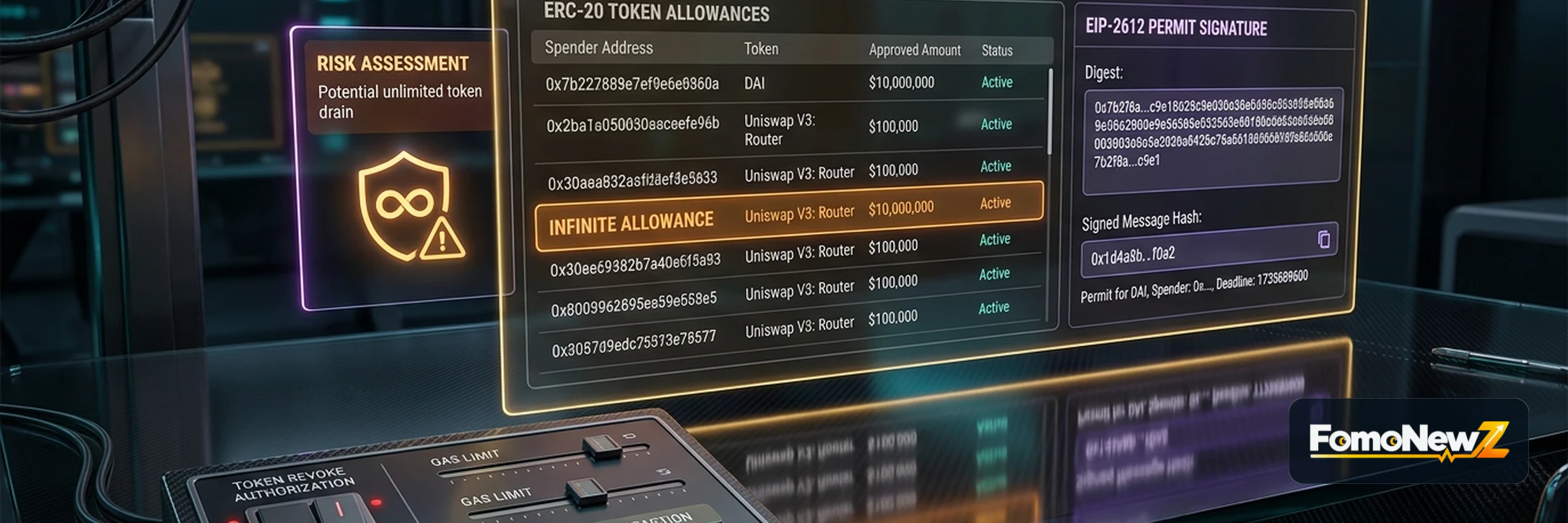
DEFENSE GUIDE / 02How unlimited approvals lead to wallet draining and step-by-step revocation procedures.
DEFENSE GUIDE / 03Identifying malicious smart contract signatures, Unicode domain spoofs, and fake extensions.
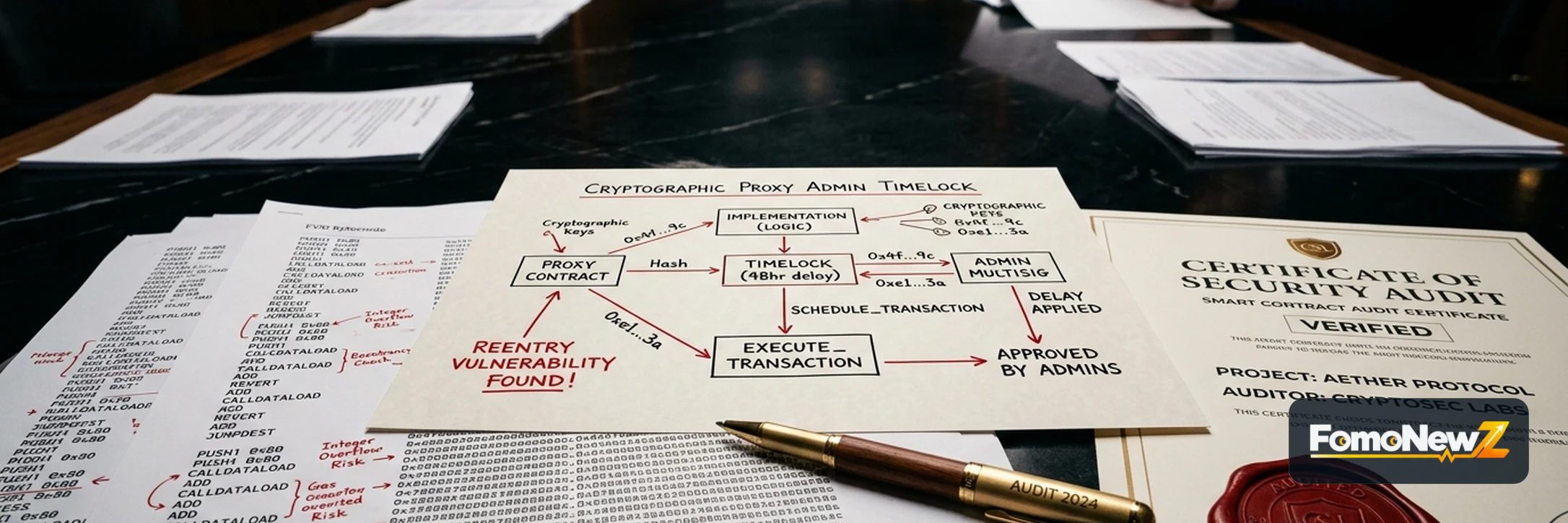
DEFENSE GUIDE / 04M-of-N governance, timelocks, and eliminating single points of cryptographic failure.
06 / THE SECURITY DESK
Smart contract auditing, hardware wallet safety, and defense against zero-day exploits.
Visit our comprehensive FAQ hubThe vast majority of on-chain exploit losses stem from five recurring vectors: reentrancy attacks (where malicious contracts repeatedly drain balances before internal state updates), oracle manipulation (flash loan price manipulation across thin liquidity pools), faulty access controls (missing owner modifier guards), precision rounding errors, and unverified upgradeable proxy implementations.
Hardware wallets store private keys inside an isolated, tamper-resistant Secure Element (EAL6+ certified chip). Private keys never leave the physical device and are never exposed to connected internet environments, preventing key theft via browser extension session hijackers, keyloggers, or operating system malware.
Drainers exploit ERC-20 `approve()` functions and EIP-712 / ERC-2612 `permit` signatures. Malicious decentralized app frontends trick users into signing off-chain gasless approval messages or infinite allowance transactions, granting attacker contracts permission to transfer all specified tokens from the user's wallet without requiring private key theft.
Maximal Extractable Value (MEV) searcher bots scan public blockchain mempools for pending decentralized exchange trades. In a sandwich attack, the bot front-runs the user's swap by bidding a higher gas fee to buy tokens, driving the price up, and immediately back-runs by selling for an instant profit. Traders mitigate this using private RPC endpoints (such as Flashbots Protect or MEV-Blocker) and setting tight slippage tolerances below 0.5%.
Cryptographic Proof-of-Reserves combines on-chain wallet verification with off-chain user liability accounting. Exchanges publish Merkle Tree or Zero-Knowledge proofs allowing individual customers to verify that their balance was included in the total liability snapshot, cross-referenced against auditor-verified on-chain wallet reserve proofs confirming assets exceed liabilities.
Victims should immediately preserve raw transaction hashes, timestamped wallet logs, and destination addresses using public blockchain explorers (such as Etherscan, Solscan, or Mempool.space). Stolen funds should be reported to chain analysis tracking desks (Chainalysis, TRM Labs) and federal cybercrime divisions (such as the FBI IC3 or national financial intelligence units) to flag blacklisted addresses before assets reach centralized exchange off-ramps.
FomoNewZ security reporting and vulnerability analyses are derived strictly from verifiable primary sources, including decompiled on-chain bytecode, verified post-mortems from top auditing firms, and certified whitehat bug bounty registries. FomoNewZ does not provide investment or security guarantees.