

Chapter 01
The mathematical reality of BIP-39 mnemonic phrases
When you initialize any non-custodial wallet, the software or hardware generates a 12- or 24-word recovery phrase governed by the Bitcoin Improvement Proposal 39 (BIP-39) standard. These words are not arbitrary; they represent a human-readable encoding of 128 to 256 bits of cryptographically secure entropy, selected from a standardized dictionary of exactly 2,048 English words.
Every master private key, public key, and child address across all blockchain networks is mathematically derived from this single seed. If your physical hardware wallet breaks, burns, or is lost, this phrase restores every dollar across every token immediately. Conversely, if an unauthorized party reads these words, they hold instantaneous, irreversible power to drain your entire portfolio.
Because this mnemonic is the root of all cryptographic authority, safeguarding it constitutes the single most critical responsibility in self-custody.
Chapter 02
Environmental vulnerabilities: Why paper seed backups fail
Most wallet manufacturers bundle simple cardboard or paper recovery cards inside their product packaging. Relying on paper for long-term wealth preservation is an operational hazard of the highest order. Paper ignites at 233°C (451°F), whereas standard house fires frequently surpass 800°C (1,500°F).
Furthermore, paper degrades rapidly when exposed to humidity, plumbing leaks, mold, sunlight, and chemical spills. Ink from ballpoint pens or markers can fade or smudge into illegibility over a few years. Preserving generational wealth requires materials engineered to survive catastrophic building fires, flooding, and structural collapse.
Treating paper recovery sheets as anything more than temporary setup scratchpads introduces severe physical fragility into an otherwise robust cryptographic system.
Chapter 03
Metal backup plates: Stainless steel versus aerospace titanium
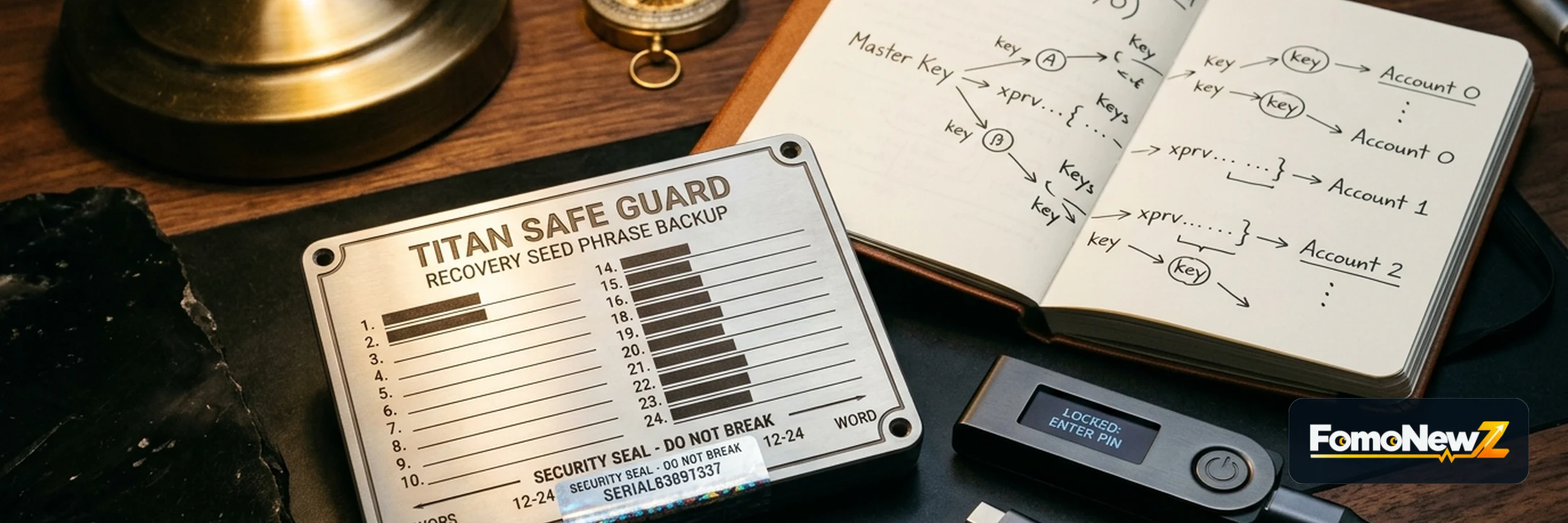
Specialized physical seed storage solutions replace paper with industrial-grade metals. The two primary categories are cassette-style tile systems and solid punch plates. Tile systems (such as Cryptosteel) allow you to slide stamped stainless steel character tiles into slots; punch plates (such as Coldcard Seedplate or Keystone Tablet) require stamping letter indents with a manual center punch.
Opt for high-grade 304 or 316 stainless steel or Grade 5 aerospace titanium. Grade 316 stainless steel withstands temperatures up to 1,400°C (2,550°F) and resists corrosive acids and saltwater exposure. Solid punch plates are mechanically superior to tile cassettes because tile latches can deform under intense mechanical crushing, potentially spilling tiles.
By stamping characters permanently into heavy-gauge metal, the recovery data remains intact even if a home suffers total fire destruction and structural collapse.
Chapter 04
The 25th word: Enhancing recovery phrases with a BIP-39 passphrase
A critical security enhancement supported by BIP-39 is the passphrase feature, often colloquially called the '25th word'. A passphrase is an arbitrary string of characters that you define personally. In cryptographic derivation, the passphrase is added to the 24 words as a salt in the PBKDF2 HMAC-SHA512 key stretching function.
Each unique passphrase produces an entirely separate, mathematically distinct set of wallet addresses. This creates two powerful defenses: first, if someone discovers your physical steel plate with the 24 words, they cannot access your funds without the secret passphrase. Second, it enables plausible deniability under physical duress: you can maintain a decoy wallet with a minimal balance under a secondary passphrase while your true holdings remain hidden.
However, memorization discipline is paramount: if you forget your custom passphrase, the 24 words alone can never recover your wallet.
Chapter 05
Shamir Secret Sharing (SLIP-0039): Multi-share quorum recovery
Standard single-phrase backups suffer from an inherent security paradox: consolidating all words onto one plate creates a single point of failure for theft, while splitting the phrase in half (e.g. 12 words in two locations) reduces security entropy exponentially, enabling brute-force attacks.
Shamir Secret Sharing (implemented in the SLIP-0039 standard pioneered by Trezor and SatoshiLabs) solves this using polynomial threshold cryptography. The master seed is split into N separate shares with an M-of-N quorum threshold (for example, a 3-of-5 setup). Any 3 shares can mathematically reconstruct the wallet, but 2 shares reveal zero information. This allows safe geographic distribution across separate homes, trusted family members, or safe deposit vaults.
Chapter 06
Storage hygiene, tamper evidence, and digital isolation rules
Under no circumstances should you ever type a seed phrase on an internet-connected keyboard, photograph it with a smartphone, store it in an encrypted password manager, save it in cloud storage, or photocopy it. Digital exposure permanently breaks cold storage integrity.
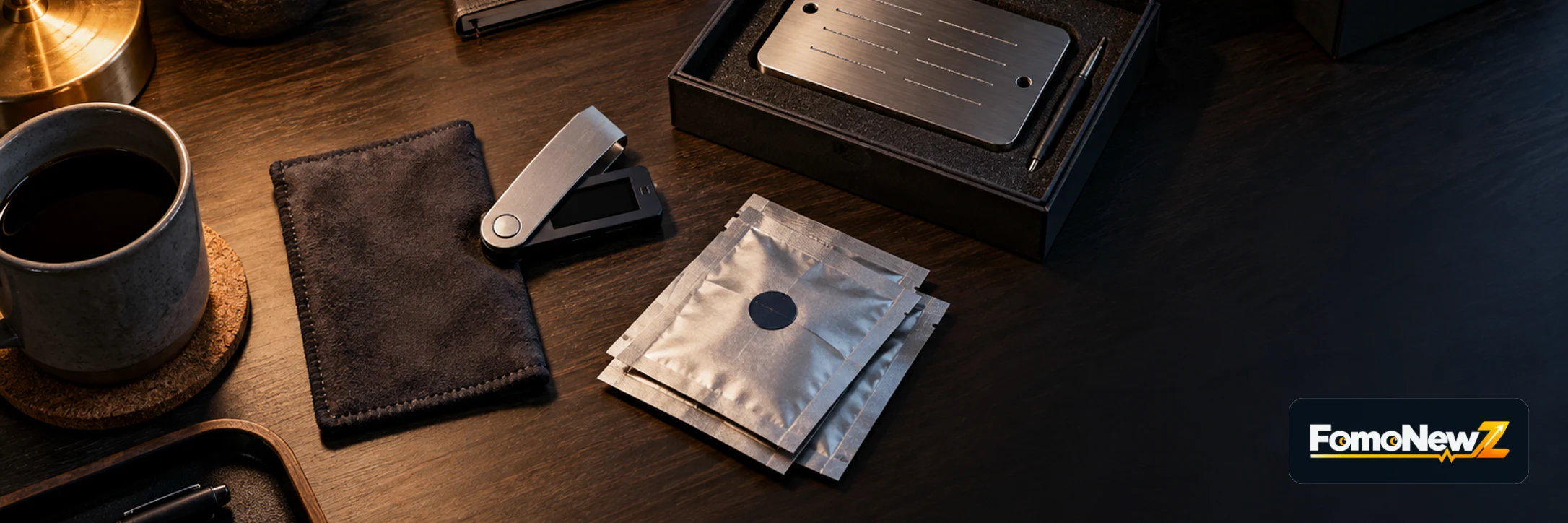
Store your metal plates inside tamper-evident numbered security bags (such as SecurTrek bags). Inspect the bag seal periodically; if the seal indicates 'VOID', you know someone accessed the plate and you must migrate funds immediately to a fresh seed before an attacker can deploy the stolen words. Pair this physical hygiene with clear, sealed legal estate instructions for inheritance.