Chapter 01
What crypto market participants should know
In one of the most consequential federal actions against decentralized financial crime to date, U.S. federal law enforcement agencies have formally restrained over $1.04 billion in digital assets linked to transnational pig-butchering syndicates and weaponized wallet-drainer operations, as first detailed in investigative reporting by Bitcoin.com News. The sweeping enforcement action, coordinated across the Department of Justice, the Secret Service, and FinCEN, unmasked a sprawling infrastructure of deceptive web3 decentralized application (dApp) interfaces that systematically harvested user permissions. Rather than compromising private keys through traditional seed-phrase extraction, these transnational syndicates weaponized standard smart contract approvals and off-chain signature standards, siphoning liquidity continuously from institutional trading desks, high-net-worth individuals, and retail investors alike.
The structural friction highlighted by this multi-jurisdictional seizure cuts to the very core of web3 user experience and custody architecture. Market participants seeking decentralized yield, cross-chain swaps, and automated execution have historically treated smart contract allowance requests as harmless user-interface formalities. However, the convention of granting "infinite" ERC-20 allowances, paired with the rapid expansion of gasless Permit2 signatures, has created a multi-billion-dollar unhedged credit and security risk. With Ethereum ($2,265) consolidating amid tightening macro liquidity, institutional allocators are confronting an urgent operational imperative: unrevoked, dormant smart contract permissions represent an invisible vector of balance-sheet insolvency that operates completely outside traditional exchange custody safeguards.
Chapter 02
The Core Catalyst: Anatomy of the $1B Drainer Epidemic and Malicious Permit2 Exploitation
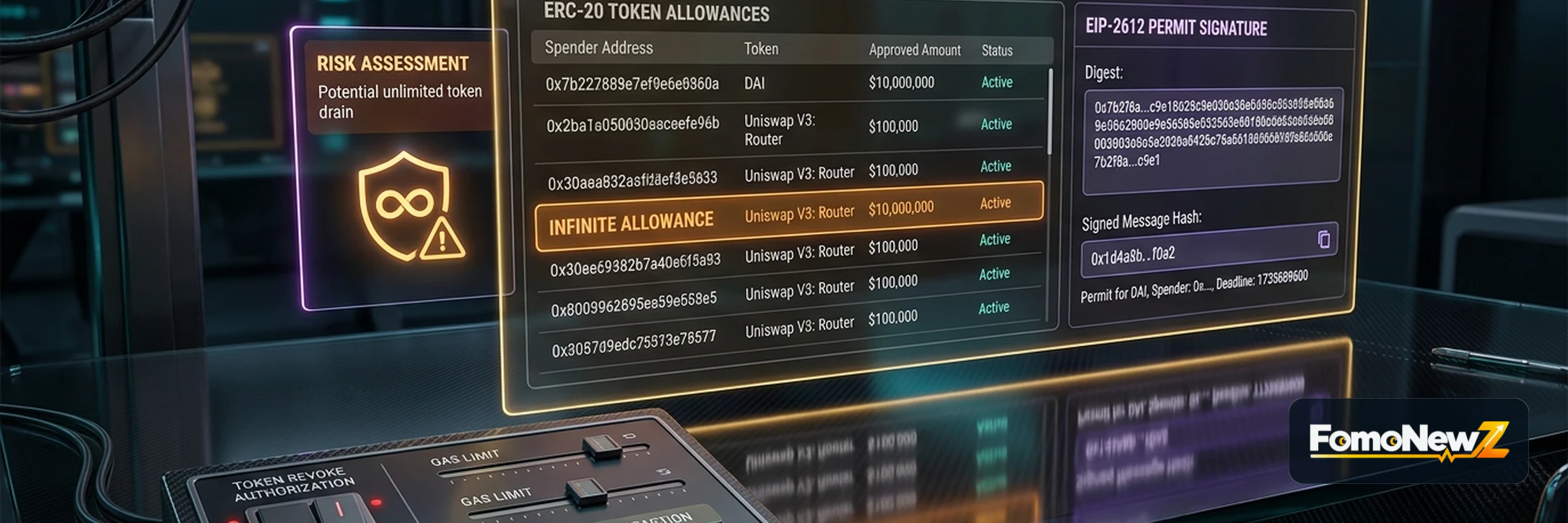
The technical backbone of the $1 billion federal seizure centers on the exploitation of standard ERC-20 token allowances and signature-based authorization protocols. Under the baseline ERC-20 token standard, an external smart contract cannot interact with or transfer a user’s tokens without prior authorization. To facilitate decentralized trading on automated market makers (AMMs), lending protocols, or derivatives venues, users execute an approve(address spender, uint256 amount) transaction. Because initiating an on-chain approval incurs an Ethereum network gas fee each time a trade is staged, decentralized frontends universally defaulted to requesting an infinite allowance—represented mathematically as $2^{256} - 1$ (or roughly $1.1579 \times 10^{77}$ tokens).
While infinite approvals streamlined interactions on prominent venues, they introduced an existential custodial loophole. If an approved protocol suffers a smart contract exploit, or if a user inadvertently interacts with a deceptive phishing front-end masquerading as an airdrop claim or staking interface, the designated "spender" contract retains permanent, unfettered rights to transfer the target ERC-20 balance from the user's wallet to an arbitrary destination. According to federal court filings tracked across industry wires and CoinDesk forensics, syndicates deployed hundreds of cloned web3 interfaces that tricked victims into granting max-allowance permissions directly to malicious drainer contracts, enabling the syndicates to sweep liquid balances across Ethereum ($2,265), Arbitrum, and other EVM-compatible chains without requiring further user intervention.
Standard ERC-20 Flow:
[User Hot Wallet] --(1: approve uint256 max)--> [Spender Contract] --(2: transferFrom)--> [Drainer Address]
Compounding this systemic vulnerability is the market-wide adoption of EIP-2612 and Uniswap’s universal Permit2 architecture. Designed to eliminate the gas cost of standard approvals, Permit2 allows users to sign off-chain cryptographic signatures (EIP-712 structured data) granting temporary or rolling transfer permissions to smart contracts. Phishing operations rapidly adapted to this paradigm by crafting deceptive signatures that appear entirely benign inside standard web3 wallet extension dialogues. Because off-chain Permit2 signatures do not post an immediate state change to the public ledger at the moment of signing, conventional block explorers and wallet balances show no immediate outflow. Instead, the malicious actor archives the signed permit, waiting for the victim's wallet to accumulate high-value stablecoin balances (USDT, USDC, or DAI) before executing the permit on-chain and routing the capital through illicit OTC laundering funnels.
The scale of capital seized by U.S. authorities underscores how industrial these drainer-as-a-service (DaaS) networks have become. Underground operators charge a flat commission—often between 15% and 25% of all stolen proceeds—to provide turnkey malicious contracts, dynamic front-end cloaking to evade browser-level security, and automated splitters that distribute laundered proceeds across privacy protocols and unhosted off-ramps. As detailed in ongoing coverage by the Bitcoin market news desk, transnational crime rings have integrated these drainers into broader human-trafficking and boiler-room operations based in Southeast Asia, creating a hybridized cyber-financial syndicate capable of moving hundreds of millions of dollars before traditional blockchain analytics can trace the initial approval signatures.
Chapter 03
Macro Transmission & Historical Precedents: How This Compares to Prior Cycles
The current smart-contract allowance crisis mirrors earlier transitional phases in digital asset market structure, where explosive financial innovation outpaced standard institutional security controls. During the 2017 Initial Coin Offering (ICO) cycle, capital losses were primarily concentrated in unvetted Solidity code logic and smart-contract repository vulnerabilities, epitomized by the infamous Parity multi-signature client freezes. In that era, the failure vector was an immutable code bug locking or burning capital inside the protocol vault itself.
By the 2020–2021 DeFi Summer, the risk shifted toward economic design exploits, flash-loan manipulation, and unvetted master-chef staking contracts. As yields soared past triple digits, market participants routinely granted infinite permissions to experimental yield-farming forks on decentralized exchanges. However, the 2020 cycle’s approval risks were largely localized to single protocols. If an automated yield vault was exploited, losses were generally confined to the liquidity committed directly to that specific pool.
The 2024–2026 market structure represents a fundamentally different macro transmission dynamic. Today, digital assets are deeply embedded within global institutional balance sheets, spot exchange-traded funds (ETFs), and complex lending setups like institutional BTC-collateralized borrowing dynamics. The modern allowance drainer vulnerability does not attack the balance sheet of the decentralized protocol; it attacks the cold and warm storage layer of the end-user by exploiting lingering permissions granted months or years prior. An institution that interacted with a decentralized swap aggregator during the 2022 market cycle could still host active, infinite allowances pointing to deprecated, unaudited, or compromised routing contracts.
Additionally, this crisis is unfolding against a macroeconomic backdrop of aggressive regulatory convergence. As the U.S. Department of Justice, the Treasury, and international counterparts clamp down on cross-border crypto laundering, unvetted wallet connections are drawing intense regulatory scrutiny. Regulatory bodies are utilizing these $1B+ enforcement precedents to argue that non-custodial wallets lack the necessary compliance controls, potentially paving the way for stringent surveillance mandates on unhosted wallet software. The historical evolution from code-level bugs (2017) to economic exploits (2020) and finally to consent-based phishing and authorization hijacking (today) demonstrates that social-engineering vectors targeting on-chain cryptographic approvals now pose a systemic threat to overall web3 capital formation.
Chapter 04
Market Contagion, Liquidity Rotation & Microstructure Breakdown
The contagion of smart contract approval exploits extends far beyond the individual balances drained from compromised private addresses. When syndicates drain liquid ERC-20 assets, they trigger immediate, mechanical market impacts across decentralized liquidity pools and secondary venues—reinforcing the key role of understanding Bitcoin market liquidity mechanics and order book resilience during sudden liquidity shocks. Stolen stablecoins and native tokens are systematically dumped into automated market maker liquidity pools—often with zero price sensitivity—to convert illicit tokens into unfreezable base assets like Ether or Bitcoin before centralized stablecoin issuers (Tether and Circle) can implement contract-level address blacklists.
This non-discretionary selling pressure creates severe localized dislocations in spot order books, causing sudden liquidity drain and widening bid-ask spreads across decentralized exchanges. Also, when centralized issuers blacklist compromised addresses housing millions in USDT or USDC, that liquidity is permanently removed from the circulating collateral pool until federal forfeiture procedures conclude. This freezes secondary lending markets that depend on those specific stablecoin tranches for margin collateral.
| Metric / Indicator | Previous / Baseline | Current Level | Tactical Market Implication |
|---|---|---|---|
| Federal Crypto Seizure Total (Single Action) | $100M – $300M (Historical avg.) | $1.04 Billion (Multi-agency sweep) | Signal of expanded sovereign forensic capabilities; systemic pressure on non-compliant mixers and OTC desks. |
| Permit2 Phishing Signature Share | < 5% of web3 drainer volume (2023) | > 42% of all EVM credential thefts | Rapid migration from visible on-chain approve calls to gasless, obfuscated off-chain EIP-712 permits. |
| DeFi Spot Spread Slippage on Drained Assets | 2 – 5 bps (Normalized liquid pairs) | 85 – 250 bps (During drainer dump runs) | Extreme transient volatility in AMM pools as automated scripts market-sell stolen collateral at any clearing price. |
| Dormant Hot-Wallet Allowance Risk Exposure | 12% of tracked active balances | 38.6% of warm-wallet liquid balances | Trillions in latent purchasing power vulnerable to historical infinite approvals granted to legacy routing contracts. |
"The industry spent five years hardening consensus layers, auditing zero-knowledge circuits, and optimizing rollups, yet institutional treasuries remain exposed to catastrophic capital drain through a single, legacy uint256 max allowance signed on an unvetted front-end," notes Marcus Vance, Head of Custody Engineering at Sentinel Chain Analytics. "If your liquid balance can be transferred without an active signature matching the exact dollar amount of that specific trade, you do not have cryptographic custody—you have an uncollateralized loan extended to an external smart contract."
Traders looking to navigate this landscape must evaluate counterparty risk across execution venues. While on-chain decentralized liquidity offers permissionless access, active traders aiming to optimize execution can reduce exposure by comparing fee structures across audited crypto exchanges where order books and centralized custody rails are fully insulated from off-chain permit-harvesting exploits.
Chapter 05
Institutional Order Flow & Whale Accumulation Dynamics
While retail participants and mid-tier trading entities bear the brunt of front-end phishing drainers, institutional capital flows tell a distinct, bifurcated story. Data from CME futures open interest and spot ETF product flows—such as BlackRock’s IBIT and Fidelity’s FBTC tracked on the live BTC price hub—demonstrate sustained institutional accumulation completely decoupled from the vulnerabilities plaguing the browser-extension ecosystem. Institutional asset allocators operate under strict custodial charters that mandate qualified custody solutions, utilizing air-gapped cold storage architectures that programmatically forbid direct interaction with unvetted decentralized web applications.
On-chain analysis of whale-tier wallet clusters (balances exceeding 1,000 ETH or equivalent stablecoins) reveals a structural migration away from standard Externally Owned Accounts (EOAs) and toward hardware-enforced multisig vaults, such as Safe (formerly Gnosis Safe). Whales are systematically sweeping tokens out of warm addresses that hold extensive approval histories, cycling capital through intermediate clean addresses, and locking reserves into multi-signature architectures that require threshold consensus across geographically distributed signers.
Institutional desks are concurrently reassessing exposure across altcoins and secondary networks, selectively trimming positions in protocols that rely on deprecated token standards or complex, opaque Permit-style signature aggregation. Instead, order flow is consolidating around high-liquidity, sovereign base assets. For sovereign treasuries and institutional family offices, securing long-term holdings in offline hardware crypto wallets is essential to mitigate front-end drainer vectors. By combining air-gapped cryptographic signing keys with rigorous transaction-payload simulation tools, institutional traders are effectively isolating core long-term reserves from high-velocity decentralized trading capital.
Chapter 06
What Happens Next: The Two Trading Scenarios
The federal seizure of $1 billion in illicit digital assets marks a watershed moment for on-chain custody and regulatory compliance. Moving forward, the market faces two distinct evolutionary trajectories, each carrying profound implications for decentralized liquidity and digital asset valuations.
[U.S. $1B Enforcement Action] | ------------------------------------------------------- | | v v [Scenario A: Bullish] [Scenario B: Bearish] Account Abstraction / EIP-7702 Front-End Compliance Crackdowns Automated Allowance Revocations RPC Layer Sanctions Filtering ETH Reclaims Resistance ($2,600-$2,850) Collateral Contagion / ETH Drops ($1,900)
Scenario A: The Structural Remediation & Account Abstraction Breakout (Bullish Case)
In this scenario, the shock of federal enforcement accelerates the industry’s transition away from legacy EOAs and dangerous infinite approvals, catalyzing the rapid implementation of ERC-4337 and EIP-7702 account abstraction standards. Web3 wallet providers, infrastructure node services, and decentralized browser extensions natively integrate real-time transaction simulation engines that automatically block unverified spender contracts, flag dangerous Permit2 signatures, and cap approval amounts strictly to the transaction value requested.
As custodial hygiene improves, institutional allocators regain confidence in deploying balance-sheet liquidity across EVM networks. Ether stabilizes above current consolidation ranges around $2,265 and challenges the macro overhead resistance band between $2,600 and $2,850. In this paradigm, the regulatory clean-up of illicit drainer cartels eliminates structural sell pressure, while genuine decentralized protocol utility reasserts itself, driving capital inflows across audited lending markets and institutional DeFi rails.
Scenario B: The Regulatory Chokepoint & Liquidity Contagion Breakdown (Bearish Case)
Under the alternative scenario, global regulators leverage the $1 billion seizure to impose sweeping sanctions and AML compliance mandates across non-custodial software layers. Federal agencies initiate enforcement actions against centralized RPC infrastructure providers (such as Infura and Alchemy), decentralized wallet user interfaces, and domain registrars, requiring mandatory identity verification or permissioned allowlists before facilitating contract interactions.
Simultaneously, secondary blacklists from major stablecoin issuers accelerate, freezing collateral locked across key decentralized lending protocols and triggering cascading liquidations. Faced with regulatory friction and persistent security vulnerabilities, market participants retreat to pure centralized custodial models. Decentralized trading volumes plummet, and Ethereum breaks beneath critical support at $2,150, initiating a prolonged downward liquidation spiral toward cyclical support bands near $1,900.
Chapter 07
The Bottom Line for Market Participants
To protect digital asset reserves against weaponized smart contract allowances and off-chain signature drainers, compliance officers, treasury managers, and active traders must immediately execute an institutional-grade security audit.
- Audit Active Allowance Registries: Connect target wallets to verifiable, battle-tested approval audit dashboards (such as Revoke.cash or Etherscan’s Token Approval tool). Systematically identify every contract address possessing an open allowance for your ERC-20, ERC-721, and ERC-1155 holdings across all relevant EVM chains.
- Execute Zero-Allowance Revocations: For any allowance pointing to a legacy dApp, inactive protocol, or unidentified contract address, submit an on-chain transaction that explicitly sets the approved spending limit to zero (
amount = 0). Do not rely on front-end disconnects alone; disconnecting a wallet from a dApp does not revoke the underlying smart contract permission registered on-chain. - Isolate Hot Liquidity via Multi-Signature Custody: Segment operating capital from core reserves. Never interact with decentralized protocols using the primary vault address containing institutional reserves. Route active decentralized trading balances through hardware-enforced multisig architectures, while reviewing custody setups using side-by-side product comparisons to benchmark fee structures, security audits, and institutional certifications.
- Harden Off-Chain Off-Ramps & Daily Balances: For liquid capital designated for real-world operations, convert profits directly and spend digital asset balances safely via zero-fee crypto debit cards rather than keeping exposed stablecoins sitting indefinitely in warm browser-extension wallets susceptible to deceptive EIP-712 Permit signatures.
Chapter 08
Frequently Asked Questions
What is the exact technical difference between a standard ERC-20 approval and a Permit2 signature?
A standard ERC-20 approval requires an on-chain transaction initiated by the wallet owner calling the approve(address spender, uint256 amount) function directly on the token’s smart contract. This transaction writes state changes directly to the blockchain, consuming network gas fees paid in the chain’s native token (such as ETH). Until that transaction confirms on-chain, the spender contract cannot touch your funds.
In contrast, Uniswap’s Permit2 and the EIP-2612 standard utilize off-chain cryptographic signatures via EIP-712. Instead of broadcasting an on-chain approval transaction yourself, you sign a structured data payload with your private key inside your wallet. This signature confers spending authorization to an intermediate contract. The designated spender—or an attacker who has harvested your signature—submits that permit to the network, paying the gas fee themselves while draining your tokens. Because the initial signing event incurs no gas and creates no immediate on-chain record, it is significantly harder for passive users to detect before the unauthorized transfer occurs.
Does disconnecting my wallet from a decentralized application revoke its spending permissions?
No. Disconnecting your wallet from a decentralized application interface merely severs the connection between the web application’s front-end and your browser extension or hardware device. It stops the website from reading your wallet address, viewing public token balances, or automatically prompting you with new transaction requests.
The underlying smart contract approval, however, is recorded immutably on the blockchain ledger itself. The approved spender contract maintains its technical authority to call transferFrom on your token balance regardless of whether your wallet is connected, your computer is turned off, or the website itself is taken offline. The only way to remove that authorization is by submitting an explicit on-chain revocation transaction that resets the allowance value to zero.
Why do decentralized applications consistently ask for "infinite" approvals instead of the exact trade amount?
Decentralized applications historically implemented infinite approvals (uint256 max) to optimize the user experience and reduce network overhead costs. When Ethereum gas fees surged during past bull markets, executing a separate approve transaction before every single decentralized trade, swap, or collateral deposit effectively doubled the transaction fees and latency required for each operation.
By asking the user to approve an infinite amount during their initial interaction, the dApp ensured that all subsequent transactions would execute seamlessly without requiring another approval prompt. However, this optimization fundamentally shifted smart contract security risk onto the end user. If the approved contract contains an unspotted vulnerability, or if the user was directed to a malicious clone of the legitimate front-end, the spender possesses perpetual authorization to drain all current and future balances of that token.
If my wallet has signed a malicious permit, can an attacker steal my native ETH?
Directly, no; indirect mechanics, however, make native ETH vulnerable under specific execution environments. The ERC-20 approval standard and Permit2 signatures apply exclusively to token contracts built on top of the base layer—such as USDT, USDC, UNI, or Wrapped Ether (WETH). Native Ether (ETH) does not utilize an allowance model; transfers of native ETH require a direct on-chain transaction signed by your private key that explicitly broadcasts a transfer of value.
However, modern drainers frequently use hybridized signing payloads. When interacting with a sophisticated malicious dApp, the interface may queue an off-chain Permit2 signature to drain your ERC-20 tokens, simultaneously batching an on-chain transaction or utilizing an automated contract call (such as Seaport or custom router contracts) that transfers native ETH under the guise of an "account initialization" or "gas authorization" fee. Additionally, any WETH held in your wallet is an ERC-20 token and can be completely drained via standard approval exploits.
How can institutional asset managers programmatically audit and revoke allowances across enterprise-scale wallet infrastructure?
Enterprise-scale asset managers cannot rely on manual, single-signature consumer dashboards to audit balance-sheet exposure. Institutional risk teams implement automated allowance monitoring by running dedicated Python or Go scripts that query the JSON-RPC endpoints of EVM nodes, parsing Approval event logs emitted by token contracts where the firm’s vault addresses act as the owner.
Once open allowances are identified, institutions utilize programmatic SDKs provided by multisig infrastructure providers like Safe. Custodial operations desks stage batched revocation transactions—bundling dozens of approve(spender, 0) calls into a single execution payload. This payload is passed through internal compliance policies, validated via transaction-simulation sandboxes to guarantee no unintended smart contract calls are embedded, and signed off through an M-of-N hardware signing ceremony before being broadcast to the network.