


Chapter 01
The mechanics of the ERC-20 allowance standard
Unlike native blockchain base currencies (such as Bitcoin on the Bitcoin network or native ETH on Ethereum) which transfer directly between addresses, ERC-20 and ERC-721 tokens on EVM networks are managed by smart contracts. For a decentralized exchange (like Uniswap) or a lending market (like Aave) to interact with your tokens, the smart contract must be granted explicit permission to withdraw tokens from your account.
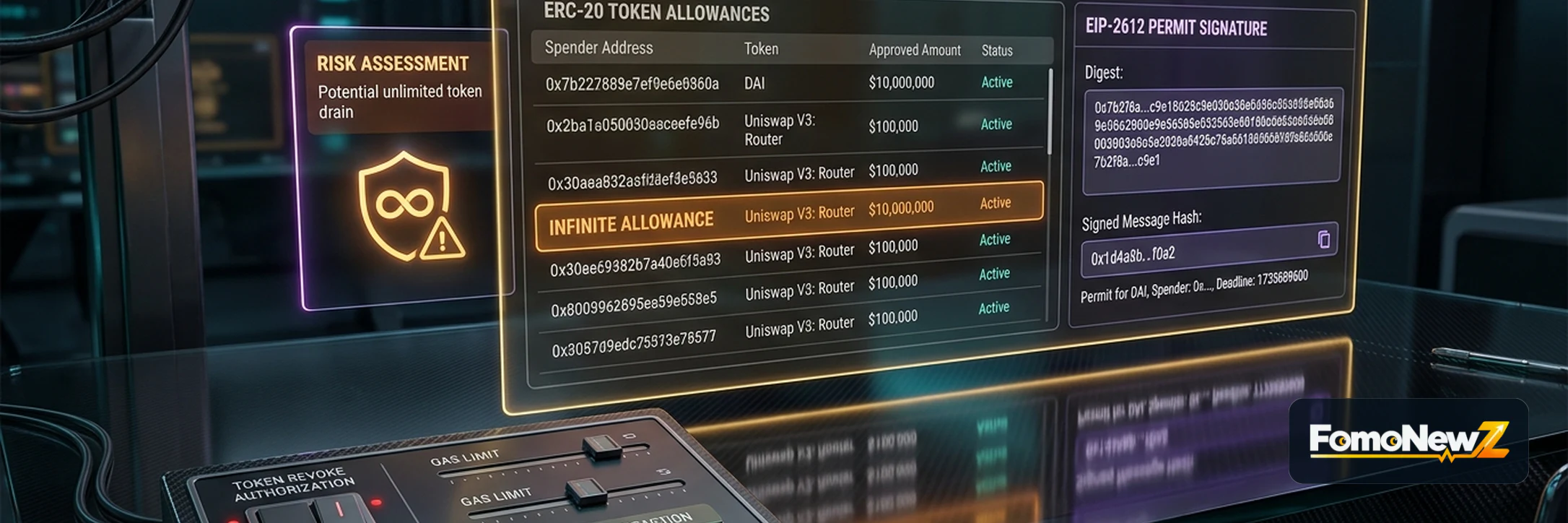
This mechanism is executed through the ERC-20 standard's approve(spender, amount) function. Calling this function writes an authorization into the token contract's state mapping: allowance[owner][spender] = amount. Once recorded, the designated spender contract can invoke transferFrom() to move tokens up to that authorized ceiling without requiring additional user signatures.
Understanding that allowances live inside the token contract's state rather than inside your personal wallet app is fundamental: deleting or reinstalling your wallet software does nothing to cancel or reset open on-chain approvals.
Chapter 02
The security peril of default infinite allowances
To optimize user convenience and eliminate redundant gas fees, most decentralized application frontends request an 'infinite allowance' by default—setting the approved amount to 2^256 - 1 (a number with 77 digits). This ensures you never have to pay gas to approve that specific contract again for future swaps.
However, this convenience creates an open security vulnerability. If that decentralized protocol suffers a smart contract exploit, private key compromise, or malicious governance takeover months or years later, the compromised contract can drain every token in your wallet up to the infinite allowance limit, even if you have not used the application in over a year.
Numerous high-profile DeFi security incidents have occurred where hackers targeted legacy router contracts that held dormant infinite approvals from thousands of historical users, draining millions from unsuspecting long-term holders.
Chapter 03
Off-chain signature traps: EIP-2612 Permit and drainer kits
Malicious phishing actors rarely rely on standard on-chain approve() transactions today because modern wallet extensions display prominent warning banners. Instead, threat actors deploy sophisticated gasless off-chain signature schemes governed by EIP-2612 (Permit) and EIP-712 structured data.
Under EIP-2612, a user signs an off-chain cryptographic message containing authorization parameters. The phishing site's backend relayer collects this signature, submits it directly to the token contract on-chain, pays the gas fee itself, and transfers your assets instantaneously. Because off-chain signatures feel innocuous to non-technical users, drainer kits harvest millions through fake airdrop and NFT mint pages using this exact vector.
Always scrutinize off-chain signature requests. If a prompt mentions 'Permit', 'setApprovalForAll', or unknown contract allowances, reject the signature immediately.
Chapter 04
Auditing active allowances using on-chain revoke scanners
Securing your wallet requires conducting regular smart contract allowance audits. Dedicated open-source scanning services—such as Revoke.cash, Etherscan Token Approval Checker, and Rabby Wallet's built-in security dashboard—query the blockchain directly to list every external contract that currently holds spending permissions over your tokens.
When inspecting your allowances, review three critical fields: the token contract, the authorized spender address, and the remaining allowance balance. Any allowance granted to an unverified dApp, an outdated protocol version (such as deprecated Uniswap V2 routers), or an unknown contract address must be immediately reset to zero.
Conducting this audit on a monthly basis ensures that your wallet does not harbor lingering permission vectors that could be exploited in future zero-day protocol breaches.
Chapter 05
Safe interaction protocol: Exact amounts and burner accounts
To prevent future vulnerabilities, adopt two essential operational habits. First, whenever a dApp prompts for an approval, decline the default infinite option. In modern wallets (including MetaMask and Rabby), click 'Edit Permission' and input the exact amount of tokens required for that specific transaction.
Second, maintain strict account isolation. Perform high-frequency DeFi interactions, token claims, and experimental mints using disposable 'burner' addresses that hold minimal funds. Only transfer your principal assets into cold storage addresses that maintain zero open smart contract allowances.
Chapter 06
Emergency incident response: What to do if compromised
If you accidentally sign a malicious signature or notice unauthorized token transfers from your wallet, act within seconds. First, immediately navigate to a trusted revoke tool (like Revoke.cash) and submit transactions to set all open allowances to 0.
However, recognize the critical distinction: revoking allowances only neutralizes compromised contracts. If an attacker stole your 12- or 24-word recovery seed phrase, revoking approvals will not help, as the attacker holds the master private key. In seed compromise scenarios, you must immediately sweep all remaining native and token balances to a completely newly generated, clean wallet address.