


Chapter 01
An audit evaluates code logic at a single point in time
In crypto marketing materials, the word "Audited" is frequently displayed alongside security badges to imply that an asset has been certified safe, endorsed, or insured. This interpretation fundamentally misrepresents what a security audit is designed to accomplish.
A smart contract audit is a specialized code inspection conducted by security engineers to identify programming flaws, logic vulnerabilities, and divergences from specification. Auditors examine code for known vulnerability vectors—such as reentrancy, integer overflow/underflow, improper access controls, denial-of-service loops, and cryptographic signature malleability.
Crucially, an audit is a snapshot. It evaluates a specific codebase at a single, documented Git commit hash. If developers alter one line of code before deploying to mainnet, the deployed bytecode diverges from the audited repository, and the audit's conclusions no longer apply. Verifying that the verified on-chain bytecode matches the audited commit hash is the essential first step of any security review.
Chapter 02
Code correctness versus administrative power
A smart contract can be 100% bug-free and mathematically sound while remaining completely centralized and dangerous to investors. Auditors examine code execution; they do not dictate governance models.
For example, a token contract may include an administrative pause function: "pauseTransfers() external onlyOwner". If this function is implemented properly according to standard patterns, an auditor will not flag it as a code bug. They may note it under "Centralization Risks" or "Privileged Roles," but the code itself is functionally correct. Yet, this exact function allows the contract owner to halt all trading at will.
Similarly, functions that allow owners to mint new supply, alter trading taxes, change oracle addresses, or blacklist wallets are often intentional architectural choices. Having an audit does not prevent an anonymous developer from exercising their documented administrative powers to drain a pool or trap investor capital.
Chapter 03
Upgradeable proxies and off-chain execution risks
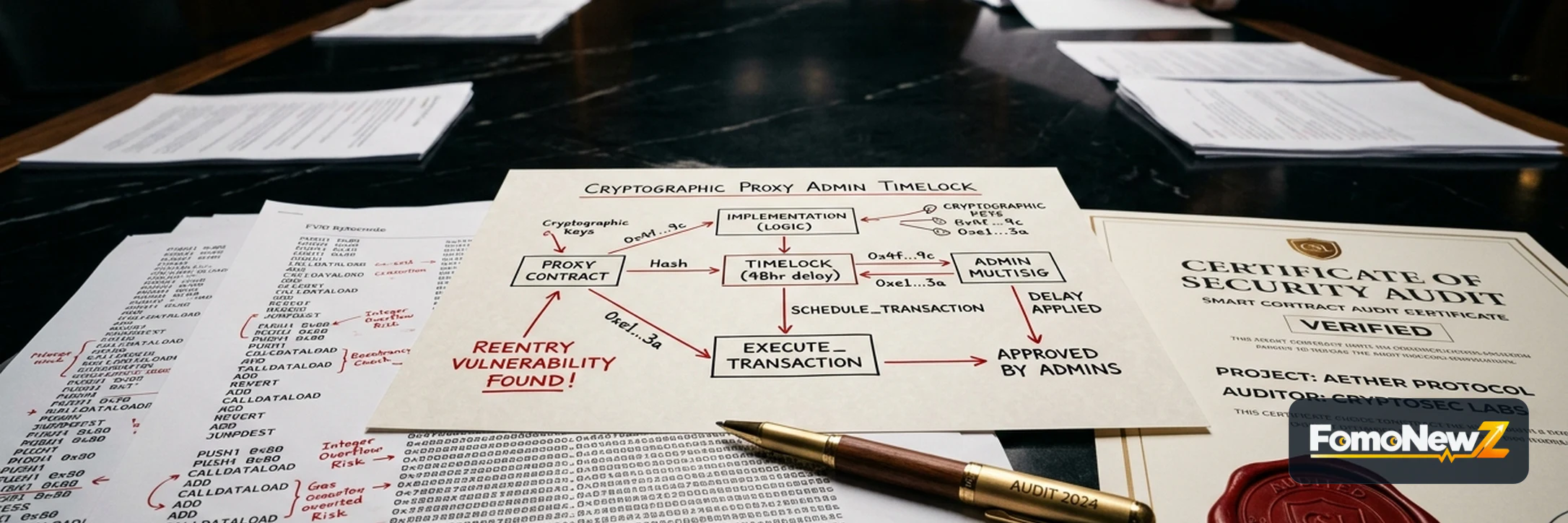
Many modern decentralized applications and token ecosystems utilize Upgradeable Proxy Patterns (such as ERC-1967 Transparent or UUPS proxies). In an upgradeable architecture, users interact with a proxy contract that delegates all function calls to an underlying implementation logic contract.
This design introduces a massive security caveat: 1. The project team can hire an auditor to audit Implementation Version 1. 2. The team deploys Version 1 and advertises their clean audit report to the public. 3. Once sufficient liquidity has entered the protocol, the team submits an upgrade transaction pointing the proxy to an unaudited Implementation Version 2 containing a malicious backdoor.
Unless the upgrade authority is burned, governed by a trustless decentralized DAO, or bound by a lengthy multi-day timelock that allows users to exit before changes activate, an audit on a proxy contract provides zero long-term guarantee of safety.
Chapter 04
What falls completely outside an audit's scope
Investors often assume an audit evaluates the entirety of a project's operational environment. In truth, an audit strictly bounds its scope to the repository files submitted. The following critical risks fall entirely outside standard smart contract audits:
- Economic and Mechanism Design: Auditors generally do not model whether a token's incentive structure is economically viable or mathematically doomed to hyperinflation.
- Frontend and DNS Infrastructure: A protocol's smart contracts may be bulletproof while its web interface is vulnerable to DNS hijacking, malicious RPC injections, or third-party analytics compromise.
- Private Key Operational Security: If the developer's deployment key or multisig signer keys are stored insecurely or phished, attackers can execute privileged functions regardless of code quality.
- Market Liquidity and Trading Solvency: Audits do not evaluate whether a token has sufficient liquidity reserves to prevent total capital loss.
Chapter 05
How to read an audit report independently
When reviewing a project’s published audit, ignore marketing summaries and inspect the report directly:
1. Match the Commit Hash: Check the repository commit hash listed in the audit header against the deployed smart contract verification tab on a block explorer. 2. Review the Findings Matrix: Count the number of Critical, High, Medium, and Low severity issues identified by the auditors. 3. Inspect the Resolution Status: Did the development team actually fix the identified issues ("Resolved"), or did they merely dismiss them with developer comments ("Acknowledged")? 4. Identify Privileged Roles: Read the Centralization and Governance section to identify which addresses hold admin privileges, what keys control them, and whether a timelock is present.
Explore our meme-coin research desk and our self-custody security guide for ongoing technical verification frameworks.
Chapter 06
Static analysis vs formal verification and dynamic symbolic execution
Smart contract security audits employ multiple distinct analytical methodologies to identify software vulnerabilities:
1. Automated Static Analysis: Tools such as Slither, Mythril, and Securify parse contract Abstract Syntax Trees (AST) and Control Flow Graphs (CFG) to detect common vulnerability patterns, including reentrancy vulnerabilities, uninitialized storage variables, integer overflows, and missing access control modifiers. 2. Dynamic Symbolic Execution and Fuzzing: Frameworks such as Echidna and Foundry invariant testing execute contract functions with thousands of semi-random inputs, attempting to violate pre-defined system invariants (such as ensuring total supply never exceeds deposited collateral). 3. Formal Verification: Mathematical proofs that model smart contract bytecode against formal functional specifications (utilizing languages such as Certora Prover), mathematically proving that specified properties can never be violated under any execution state.
However, an audit report represents an evaluation of code at a single git commit hash. It does not certify that the code is completely bug-free, nor does it guarantee economic solvency, oracle manipulation resilience, or market integrity.
Chapter 07
Post-audit upgradeability and admin key governance risks
A severe vulnerability in modern decentralized application architecture involves the widespread utilization of upgradeable proxy patterns (such as OpenZeppelin Transparent Upgradeable Proxies and UUPS EIP-1822 proxies). Under this model, user transactions interact with a fixed proxy contract that delegates execution calls ("DELEGATECALL") to an underlying implementation logic contract.
Proxy Contract Structure: User Transaction -> Proxy Contract (Stores State) --[DELEGATECALL]--> Implementation Contract (Logic)
If the proxy's administrative keys ("ProxyAdmin") are controlled by a single developer's private key or an unvetted multi-sig wallet, the developers can unilaterally deploy a new, un-audited implementation contract containing malicious draining logic at any moment. Security audits must clearly delineate whether the audited code is immutable or upgradeable; auditing an upgradeable contract without evaluating the governance and timelock mechanisms controlling the upgrade keys provides zero assurance of future security. Responsible protocols implement timelock delays of at least 48 to 72 hours on all contract upgrade proposals.