


Chapter 01
The recovery method is the first feature to inspect
A self-custody wallet gives the holder exclusive operational responsibility for the cryptographic credentials that authorize transactions. That responsibility is not defined by a four-digit device PIN, biometric face scan, or browser extension password. The recovery phrase—typically a 12-word or 24-word list conforming to BIP-39—alongside any configured passphrase (the "25th word"), can restore complete control of all derived addresses across any compatible hardware or software client. Anyone who obtains this recovery material can immediately move funds, rendering physical possession of the hardware device irrelevant.
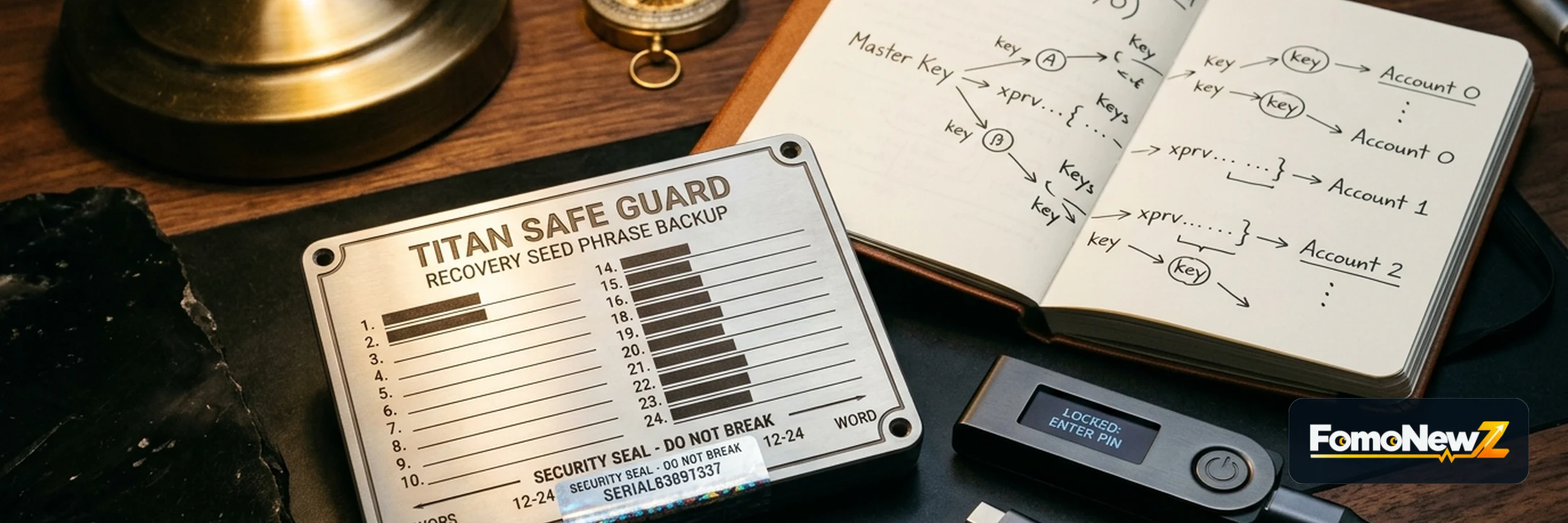
Set up a new wallet yourself from an uninitialized state. Never trust a device with a pre-printed recovery card, a seed phrase supplied in packaging, or credentials delivered via direct message. Record the recovery material on physical, offline media—such as acid-free paper stored in fireproof containers or stamped stainless steel plates resistant to heat and water damage. Before transferring any substantial balance, perform a disaster recovery drill: wipe the device or configure a secondary device from the written seed words to verify that the derived public addresses match expected accounts. Never store the recovery phrase in digital notes, cloud backups, or camera rolls, and never type it into an online prompt. Legitimate customer support agents will never ask for your seed words.
Chapter 02
Separate key isolation from transaction display safety
A dedicated hardware wallet keeps private keys isolated inside a secure element or protected microcontroller, ensuring cryptographic secrets never touch the memory of an internet-connected operating system. This architecture provides vital protection against malware, clipboard hijackers, and remote keyloggers. However, key isolation alone cannot guarantee that an on-screen transaction is benign. The holder remains responsible for verifying destination addresses, transferred values, network chain IDs, and asset tickers on the device's physical screen before confirming.
Software wallets (desktop and mobile browser extensions) provide convenient interfaces for frequent decentralized finance interactions and low-value transactions. However, their security boundary is coextensive with the host device. A compromised operating system can present a deceptive front-end interface, altering the intended recipient address moments before signature generation. Evaluating wallet safety requires balancing operational complexity against capital at risk: use cold, isolated signing devices for treasury reserves and segregated software accounts for day-to-day onchain interactions.
Chapter 03
Treat smart contract approvals as persistent operational exposure
Interacting with decentralized exchanges, lending pools, and automated protocols requires granting token allowances. Many decentralized applications prompt users for unbounded approvals (often requesting 2^256 - 1 tokens) to avoid repeated gas fees on subsequent trades. This convenience introduces permanent counterparty risk. An approval does not terminate when you close the application; it remains an open permission recorded on the blockchain until explicitly revoked.
If an approved smart contract contains an undiscovered reentrancy flaw, access control vulnerability, or malicious upgrade path, an attacker can siphon tokens directly from your account without requiring additional signatures. Implement strict permission hygiene: manually adjust transaction allowance prompts to match the exact trade amount, utilize segregated burner accounts for unfamiliar protocols, and perform scheduled monthly audits using trusted block explorer approval dashboards to revoke obsolete permissions.
Chapter 04
Mitigating address poisoning and network look-alikes
Modern onchain attackers routinely execute address poisoning attacks: broadcasting zero-value transactions from vanity addresses that share the same leading and trailing characters as your frequent counterparties. Unsuspecting users copying addresses from transaction histories often send funds directly to the adversary. Always verify the full alphanumeric string of the recipient address, verify supported destination networks, and utilize address book whitelisting features supported by modern wallet firmware.
Before committing capital to any self-custody solution, evaluate key generation entropy, open-source firmware audit status, physical tamper resistance, multi-signature compatibility, and documentation transparency. Use the wallet comparison desk to review verified hardware and software evaluations, and remember that true self-custody replaces institutional trust with rigorous personal verification.
Chapter 05
Hierarchical Deterministic derivation paths and entropy generation
Modern self-custodial wallets implement Hierarchical Deterministic (HD) key generation defined by the BIP-32, BIP-39, and BIP-44 standards. When initializing a wallet, true random entropy (typically 128 to 256 bits generated by a hardware random number generator) is converted into a mnemonic sequence of 12 or 24 words selected from the standardized 2,048-word BIP-39 English wordlist.
Entropy (128-256 bits) -> Mnemonic Sentence -> PBKDF2 stretching -> 512-bit Seed -> Master Private Key
A critical and often misunderstood element of wallet recovery is the derivation path standard. Deriving child private keys from the master seed depends on protocol-specific derivation strings: - Legacy P2PKH addresses utilize derivation path "m/44'/0'/0'/0/0". - Nested SegWit P2SH addresses utilize derivation path "m/49'/0'/0'/0/0". - Native SegWit P2WPKH addresses utilize derivation path "m/84'/0'/0'/0/0". - Taproot P2TR addresses utilize derivation path "m/86'/0'/0'/0/0". - Ethereum addresses utilize derivation path "m/44'/60'/0'/0/0".
If an operator restores a 24-word seed phrase into a wallet client that defaults to legacy derivation paths ("m/44'"), modern Native SegWit ("m/84'") balances will not appear in the interface. The funds are not lost; the wallet simply derived addresses along a different mathematical branch of the derivation tree.
Chapter 06
Cold storage disaster recovery runbook and operational auditing
Ensuring long-term access to self-custodied digital assets requires establishing an immutable physical disaster recovery runbook:
1. Physical Medium Verification: Paper seed backups degrade from water exposure, fire, and UV radiation. Critical seed phrases should be stamped into marine-grade 304 or 316 stainless steel plates resistant to temperatures exceeding 1,200 degrees Celsius. 2. The 25th Word (Passphrase) Protocol: Utilizing an optional BIP-39 passphrase creates an entirely separate mathematical wallet derived from the same 24 words. If an attacker discovers the physical metal plate, they cannot access the vault without the off-site passphrase. Crucially, entering an incorrect passphrase does not trigger an error message; it silently generates a valid, empty wallet. 3. Periodic Recovery Verification Drills: Once per calendar year, operators should conduct a non-destructive recovery drill using an isolated, air-gapped test device to confirm the mnemonic phrase and passphrase successfully recreate the expected master public key (xpub). Documenting this recovery protocol without recording the actual seed words ensures trusted family members or estate fiduciaries can execute wealth transfer without exposing private keys to third-party custody risks.