

Chapter 01
What crypto market participants should know
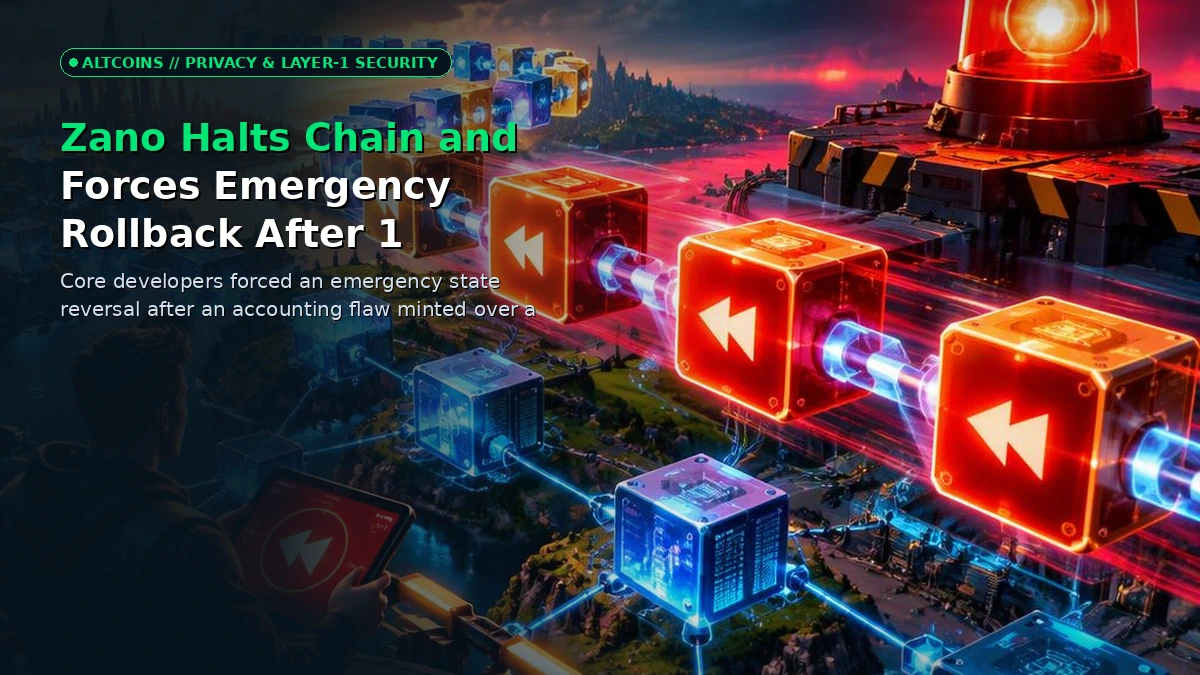
The privacy-focused Layer-1 network Zano has executed an emergency blockchain rollback after an unidentified exploiter successfully minted an astronomical, hyper-inflationary sum of over one quadrillion unauthorized fUSD tokens, as detailed in reports from Cointelegraph. The flaw, rooted in a critical accounting vulnerability within Zano's confidential asset emission logic, instantly threatened to shatter the economic integrity of the entire ecosystem by injecting a near-infinite supply of unbacked synthetic currency into circulation. As liquidity pools flashed warning signals and cross-chain bridges began halting operations, the sheer magnitude of the exploit forced core developers into a high-stakes, real-time coordination effort with node operators to halt the chain, orphan the malicious blocks, and force a state reversal to a pre-exploit block height, as covered by Bitcoin.com. Risk remains elevated.
This dramatic intervention lays bare the existential architectural friction inherent to privacy-centric blockchains: the diametric opposition between absolute financial confidentiality and protocol self-preservation. Because Zano’s native ring signatures, stealth addresses, and shielded asset framework mathematically obscure sender, receiver, and transaction amounts, core developers and validators found themselves powerless to execute targeted blacklists or freeze the ill-gotten funds at the smart contract level, a challenge further analyzed by CoinDesk. Unlike transparent chains where rogue balances can be isolated and quarantined with surgical precision, a privacy-first environment treats all coins as functionally identical, leaving an emergency state rollback as the nuclear option of last resort. For readers tracking developments across our altcoins intelligence desk, this incident serves as a watershed moment for how decentralized networks navigate catastrophic code failures. The shift was immediate.
Chapter 02
The Core Catalyst: Anatomy of a Quadrillion-Token Inflation Event
The genesis of the Zano crisis lies in the intricate machinery of its confidential asset architecture, a framework designed to allow users to issue custom tokens with the same privacy guarantees as the native Zano coin. Within this asset emission logic, a subtle validation oversight allowed the exploiter to manipulate supply issuance parameters, bypassing the cryptographic checks and balances intended to restrict token creation to authorized minting events. By exploiting this flaw in the fUSD stablecoin contract layer, the attacker generated a staggering total exceeding one quadrillion tokens—an amount that instantly rendered the asset's economic model completely meaningless. Markets reacted swiftly.
In a transparent ledger environment, such an anomalous minting operation would immediately light up mempool analytics tools, allowing validators, automated monitoring bots, and centralized exchanges to flag and blacklist the offending addresses within seconds. However, Zano’s cryptographic shielding layer successfully concealed the destination and distribution path of the newly minted fUSD. The illicit tokens were instantly blended into the privacy pool, becoming mathematically indistinguishable from legitimate user balances held by ordinary network participants. This anonymity shield transformed what would have been a contained containment exercise into an ecosystem-wide emergency. Execution remains paramount.
Faced with the imminent collapse of the fUSD peg and the contamination of decentralized exchange liquidity pools, core developers initiated an emergency protocol shutdown. Validators and node operators across the globe were urged to halt their software clients and coordinate a manual state rollback to a block height established just prior to the exploit transaction. While successful in purging the phantom quadrillion from the ledger, the maneuver immediately ignited fiery debates within the broader crypto community regarding decentralization, censorship resistance, and the dangerous precedent of rewriting blockchain history to bail out protocol design flaws. Caution dictates strategy.
Chapter 03
Macro Transmission & Historical Precedents: How This Compares to Prior Cycles
The Zano rollback incident echoes some of the most profound existential crises in distributed ledger history, drawing immediate parallels to the famous DAO hack on Ethereum in 2016, which similarly forced a contentious hard fork and state reversal to recover stolen funds. Just as the Ethereum community fractured over the philosophical violation of code-is-law immutability—giving birth to Ethereum Classic—privacy networks face an even steeper philosophical hill. When privacy protocols introduce administrative safety valves or rely on coordinated social consensus to execute rollbacks, they risk undermining the core value proposition that attracts capital in the first place: absolute censorship resistance and trustlessness. Capital preserves optionality.
In the context of the broader market structure, this event arrives as institutional capital and retail participants alike are re-evaluating the risk-reward profiles of alternative Layer-1 networks, echoing findings from recent analysis on KB Securities Taps Optimism and Securitize to Bridge $350B Into Layer-2 Rails. During prior cycles, such as the 2020 DeFi summer or the 2024 ETF-driven liquidity wave, network failures were frequently met with either decentralized governance votes or protracted insurance fund liquidations. However, as the altcoin ecosystem matures, the tolerance for protocol-level systemic risk has evaporated. Traders navigating these turbulent waters are increasingly turning to audited crypto exchanges that maintain rigorous listing standards and real-time risk monitoring to protect against sudden asset de-pegging and volatility shocks. Volatility persists.
Additionally, the macro environment—characterized by shifting interest rate expectations and fluctuating risk appetite across digital asset classes—exacerbates the sensitivity of smaller cap altcoins. When a niche privacy coin experiences a foundational crisis of this magnitude, liquidity flees the ecosystem with alarming velocity. Capital rotates rapidly out of secondary privacy assets and flows into blue-chip anchors like Bitcoin, monitored closely by our Bitcoin newsdesk, or stablecoins residing on high-throughput public ledgers where transaction finality is transparent and auditable.
Chapter 04
Market Contagion, Liquidity Rotation & Microstructure Breakdown
The immediate aftermath of the Zano exploit and subsequent chain rollback triggered a violent microstructure breakdown across decentralized and centralized order books. As rumors of the quadrillion-token mint spread through Telegram channels and real-time latest market wires, automated arbitrage bots and market makers abruptly pulled their liquidity from Zano-paired trading pools. This sudden evaporation of depth caused severe slippage for any remaining holders attempting to exit their positions, resulting in temporary price dislocations that defied standard rational valuation models.
Perpetual futures markets, where applicable, experienced aggressive cascading liquidations as leveraged long positions were caught on the wrong side of the halted chain state. Funding rates swung wildly into negative territory before exchanges intervened to suspend trading pairs, locking in positions and preventing further disorderly price discovery. The inability to verify account balances during the network halt created a severe information asymmetry, trapping trader capital and freezing margin accounts until consensus could be re-established.
| Metric / Indicator | Previous / Baseline | Current Level | Tactical Market Implication |
|---|---|---|---|
| fUSD Peg Stability | 1.00 USD (Tight bounds) | De-pegged / Halted | Complete loss of confidence; requires structural re-issuance or backing audit. |
| Network Hashrate / Validation | Nominal distributed nodes | Coordinated Halt & Rollback | Centralized coordination required; questions raised regarding true decentralization. |
| DEX Liquidity Depth | Moderate order book depth | Near-Zero / Withdrawn | Extreme slippage risk; execution impossible without dedicated market maker support. |
| Exchange Inflows | Balanced bidirectional flow | Suspended / Restricted | Inability to deposit or withdraw assets, stranding retail and institutional capital. |
"The Zano incident underscores the brutal trade-off at the heart of privacy technology: the very features that protect user financial sovereignty also create insurmountable barriers when systemic code failures occur. When you cannot see the poison in the pool, draining the entire reservoir becomes your only survival mechanism." — Senior Privacy Protocol Security Researcher
Chapter 05
Institutional Order Flow & Whale Accumulation Dynamics
While large-cap altcoins and institutional products—such as spot Bitcoin exchange-traded funds issuing daily net inflow metrics via issuers like BlackRock IBIT and Fidelity FBTC—operate in heavily regulated, transparent environments, niche privacy coins exist in a parallel liquidity universe, mirroring liquidity rotations highlighted in recent analysis on Grayscale Zcash Trust Surges as XRP Benchmark Sparks 1,500% ZEC Rotation. Whales and private syndicates operating within privacy ecosystems typically rely on over-the-counter (OTC) desks and decentralized atomic swaps to manage large allocations without telegraphing their intentions to public order books. However, an exploit of this scale disrupts even the most discreet accumulation strategies, forcing major stakeholders to re-evaluate their exposure to shielded asset protocols.
On-chain analysis of whale wallet clustering prior to the Zano rollback revealed notable repositioning, with several large addresses attempting to offload shielded assets into alternative privacy coins or base-layer assets before the network freeze took effect. This flight to safety exacerbated the downward pressure on secondary market valuations. For high-net-worth individuals and family offices holding digital assets across multiple chains, safeguarding holdings against such systemic protocol failures requires rigorous cold storage protocols. Utilizing air-gapped hardware crypto wallets remains the gold standard for insulating private keys from smart contract exploits and network-level consensus disruptions.
Additionally, institutional risk management desks are increasingly applying stringent due diligence frameworks to altcoin infrastructure. The inability to audit token supply dynamically in privacy networks introduces a tail risk that traditional financial institutions are unwilling to underwrite. As regulatory scrutiny tightens globally around privacy-enhancing technologies, incidents like the Zano fUSD minting exploit provide ammunition for critics arguing that shielded architectures inherently lack the transparency required for institutional adoption, pushing developers to explore novel cryptographic compliance mechanisms such as view keys and zero-knowledge audit proofs.
Chapter 06
What Happens Next: The Two Trading Scenarios
As Zano developers and node operators work to stabilize the network post-rollback, market participants are divided into two distinct camps regarding the asset's medium-term viability. Understanding the potential trajectories requires mapping out exhaustive scenario modeling based on technical recovery milestones and broader market sentiment indicators.
Bullish Recovery Scenario
In a best-case recovery scenario, the coordinated state rollback successfully purges the inflationary fUSD tokens without causing permanent damage to core ledger integrity. Developer transparency reports, coupled with a comprehensive security audit of the asset emission contract, restore baseline confidence among community members. As trading pairs are systematically re-enabled across audited crypto exchanges, pent-up demand and bargain hunters step in to accumulate Zano at depressed valuations. Key technical resistance bands near prior consolidation levels are tested, and if macro privacy narratives regain momentum, the asset could experience a relief rally targeting a 30% to 50% recovery from post-exploit lows.
Bearish Invalidation Scenario
Conversely, the bearish scenario envisions a protracted loss of market confidence from which the ecosystem struggles to recover. The precedent of executing a chain rollback shatters the immutable narrative that underpins privacy coins, leading to permanent reputational damage and developer attrition. Liquidity providers refuse to return to vulnerable pools, and centralized platforms delist the token to mitigate regulatory and operational liabilities. Under this pressure, price action breaks below critical historical support floors, resulting in a slow bleed toward zero volume and total liquidity evaporation as capital migrates permanently to more resilient privacy solutions like Monero or Zcash, allowing traders to evaluate execution venues via product comparisons.
Chapter 07
The Bottom Line for Market Participants
Navigating the turbulent waters of alternative Layer-1s and privacy technology requires eternal vigilance, robust risk management, and a clear understanding of the trade-offs inherent in bleeding-edge cryptography. To protect capital against unforeseen protocol exploits and sudden chain halts, market participants should execute the following operational checklist:
- Actionable Takeaway 1: Immediately audit all holdings in niche privacy tokens and assess whether protocol teams maintain emergency rollback capabilities that could compromise decentralization assumptions.
- Actionable Takeaway 2: Move active trading capital off centralized and decentralized venues when network anomalies or exploit rumors emerge, utilizing secure hardware crypto wallets for cold storage protection.
- Actionable Takeaway 3: Diversify exposure away from single-asset dependencies by comparing execution venues and liquidity depth across established audited crypto exchanges.
- Actionable Takeaway 4: For everyday liquidity management and spending needs, leverage non-custodial solutions or secure crypto debit cards that allow seamless off-ramping without locking capital in vulnerable exchange-native pools.
Chapter 08
Frequently Asked Questions
Question 1?
Why couldn't Zano developers simply freeze the exploiter's addresses instead of rolling back the entire blockchain? Zano’s core architecture relies on advanced cryptographic primitives—including ring signatures, stealth addresses, and confidential transactions—which are specifically engineered to obscure transaction metadata, sender identities, receiver addresses, and transferred amounts. Because these shielded privacy features are baked into the foundational protocol layer, individual balances and transaction paths are mathematically hidden from public view. Consequently, neither developers nor validators possess the technical capability to target, isolate, or freeze specific addresses or illicit token balances. When a catastrophic inflation event occurs in such a privacy-first environment, core operators are left with no surgical instruments, forcing them to choose between a total network shutdown with a state rollback or watching the asset's economic model collapse entirely.
Question 2?
What are the long-term implications of executing a blockchain rollback for a privacy-focused network? Executing a chain rollback strikes at the philosophical heart of decentralized ledger technology: the principle of immutability and "code is law." For privacy coins, whose primary value proposition is absolute censorship resistance, trustlessness, and freedom from central authority intervention, demonstrating that a small group of core developers and node operators can rewrite blockchain history creates a profound credibility crisis. It signals to the market that the network is ultimately governed by human social consensus and administrative emergency powers rather than immutable mathematical rules. This precedent can alienate purist communities, deter institutional capital that demands predictable finality, and invite increased regulatory scrutiny regarding the degree of centralization present in supposedly decentralized protocols.
Question 3?
How did the exploiter manage to mint over one quadrillion fUSD tokens without triggering early automated alarms? The vulnerability exploited in this incident resided within the custom asset emission logic governing confidential secondary assets (fUSD) on the Zano network. Unlike native coins with fixed emission schedules, custom shielded assets allow issuers and contract interactions to define emission parameters. A subtle logical flaw in the input validation checks allowed the attacker to craft a transaction that bypassed the cryptographic constraints limiting token creation, successfully injecting a hyper-inflationary supply directly into the shielded pool. Because the emission transaction utilized the protocol's native privacy wrappers, the massive influx of tokens was instantly masked, preventing standard mempool monitoring tools and exchange deposit scanners from detecting the anomaly until economic discrepancies manifested in downstream liquidity pools.
Question 4?
What steps should retail holders and liquidity providers take when an altcoin network experiences an emergency halt? When an altcoin network undergoes an emergency halt or coordinated rollback, retail holders and liquidity providers must prioritize capital preservation above all else. The immediate priority is to cease all interacting transactions, cancel pending bridge transfers, and monitor official developer communications through verified channels rather than speculative social media rumors. If funds are currently deposited in decentralized liquidity pools or vulnerable smart contracts, users should prepare to withdraw or migrate capital the moment network operations resume, keeping in mind that extreme slippage and volatility are virtually guaranteed. Long-term storage should be immediately secured offline in air-gapped hardware crypto wallets to prevent exposure to secondary exploits or lingering chain instability.
Question 5?
How do privacy-preserving Layer-1 networks balance the need for user confidentiality with the necessity of emergency risk management? Balancing absolute user confidentiality with the pragmatic need for emergency risk management is one of the most difficult engineering challenges in modern cryptography. Emerging privacy protocols are actively researching and implementing advanced architectural features—such as programmable privacy, view keys, threshold governance multi-sigs for emergency pauses, and zero-knowledge compliance frameworks—that aim to allow selective transparency without compromising day-to-day user anonymity. However, each compromise introduces new attack surfaces and philosophical debates regarding potential backdoors. Until a bulletproof paradigm is established, the crypto industry continues to learn hard lessons through events like the Zano exploit, proving that absolute privacy and absolute financial safety remain locked in a perpetual, high-stakes tension.