

Chapter 01
What crypto market participants should know
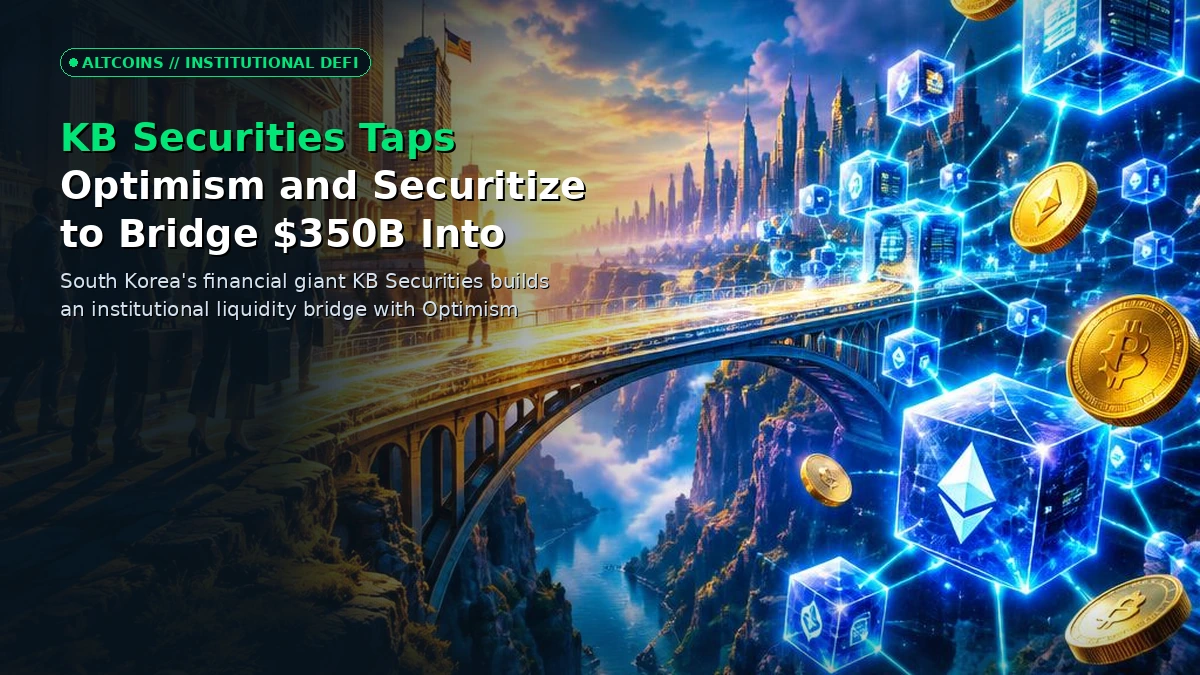
South Korea’s financial establishment has officially signaled a profound pivot toward decentralized infrastructure, as KB Securities—one of the nation's premier institutional financial powerhouses managing over $350 billion in client assets—orchestrates a strategic integration with the Optimism Foundation and Securitize. This landmark tripartite alliance is designed to construct an institutional-grade liquidity bridge, facilitating the migration of domestic traditional securities onto high-performance Layer-2 alternative networks. By circumventing the transactional bottlenecks, fragmented ledger topologies, and high operational friction points of legacy financial architecture, KB Securities is laying the groundwork for a multi-trillion-dollar digital asset pipeline that connects Seoul's deep institutional pools directly with public blockchain rails. Risk remains elevated.
The structural friction point driving this aggressive institutional migration lies in the inherent limitations of South Korea’s legacy capital markets, which have long been constrained by rigid, siloed post-trade settlement rails and antiquated clearinghouses. Traditional financial institutions find themselves increasingly squeezed by the high operational costs and sluggish settlement velocities of legacy systems, particularly as domestic demand for alternative yield and digital asset exposure surges among retail and corporate entities alike. This strategic pivot by KB Securities is catalyzed by the convergence of maturing regulatory frameworks in Seoul and the proven scalability of modular Layer-2 networks, establishing a vital market inflection point where tokenized real-world assets (RWAs) transition from speculative concept proofs to production-grade financial plumbing. The shift was immediate.
Chapter 02
The Core Catalyst: Bridging Seoul Capital to Optimism's Superchain
The engineering architecture behind the KB Securities, Optimism, and Securitize partnership relies on a sophisticated tripartite design that harmonizes institutional compliance with public-chain scalability. Securitize acts as the foundational compliance and tokenization engine, ensuring that all migrated assets—ranging from corporate debt instruments to structured financial products—fully adhere to South Korea's stringent Capital Markets Act. Concurrently, the Optimism Foundation provides the underlying Layer-2 execution environment via the OP Superchain, a modular network topology engineered to handle high-throughput financial transactions with minimal gas latency. This collaboration directly addresses the historical hesitation of Tier-1 Asian banking institutions to deploy capital on public infrastructure, offering a secure, auditable, and performant alternative to private, permissioned enterprise ledgers. Markets reacted swiftly.
As traditional financial institutions seek deeper liquidity pools and composable financial products, executing complex asset tokenization strategies requires robust digital custody solutions. Institutional treasuries and high-net-worth participants navigating these emerging on-chain ecosystems often look to secure their digital asset holdings offline, leveraging advanced hardware crypto wallets to mitigate counterparty risk. The integration of Securitize’s compliance modules onto Optimism allows KB Securities to maintain institutional-grade security protocols while tapping into the composability of decentralized finance (DeFi), enabling tokenized securities to interact with lending markets, automated market makers (AMMs), and programmable yield-generating primitives without sacrificing regulatory oversight. Execution remains paramount.
The phased rollout structure is deliberately methodical, engineered to stress-test regulatory compliance, cross-border transactional clearance, and high-throughput execution speeds before expanding to broader public-facing asset classes. In its initial deployment phase, KB Securities is targeting domestic South Korean institutional investors who are eager to diversify portfolios beyond traditional domestic yields, which have faced macroeconomic compression amid fluctuating interest rate cycles set by the Bank of Korea. By moving these assets on-chain, KB Securities is not merely digitizing existing instruments; it is creating a programmable liquidity layer that drastically reduces settlement cycles from standard T+2 or T+3 timeframes down to near-instantaneous atomic settlement. Caution dictates strategy.
For market participants tracking these structural shifts across cross-market dynamics in Altcoins & ecosystems and recent analysis on Moscow Exchange Lists XRP Perpetuals as Russian Capital Seeks Alternative Rails, the involvement of a Korean financial heavyweight like KB Securities marks a decisive validation of Layer-2 scaling solutions over monolithic alternative chains for institutional RWA deployment. The OP Superchain architecture provides the necessary throughput—capable of processing thousands of transactions per second while retaining Ethereum-security guarantees—making it an ideal conduit for institutional asset issuance. As more capital flows through these newly established pipelines, market observers are closely monitoring how secondary market liquidity for these tokenized assets will be priced and traded across audited crypto exchanges equipped to handle institutional-grade compliance and order book depth. Capital preserves optionality.
Chapter 03
Macro Transmission & Historical Precedents: How This Comparisons to Prior Cycles
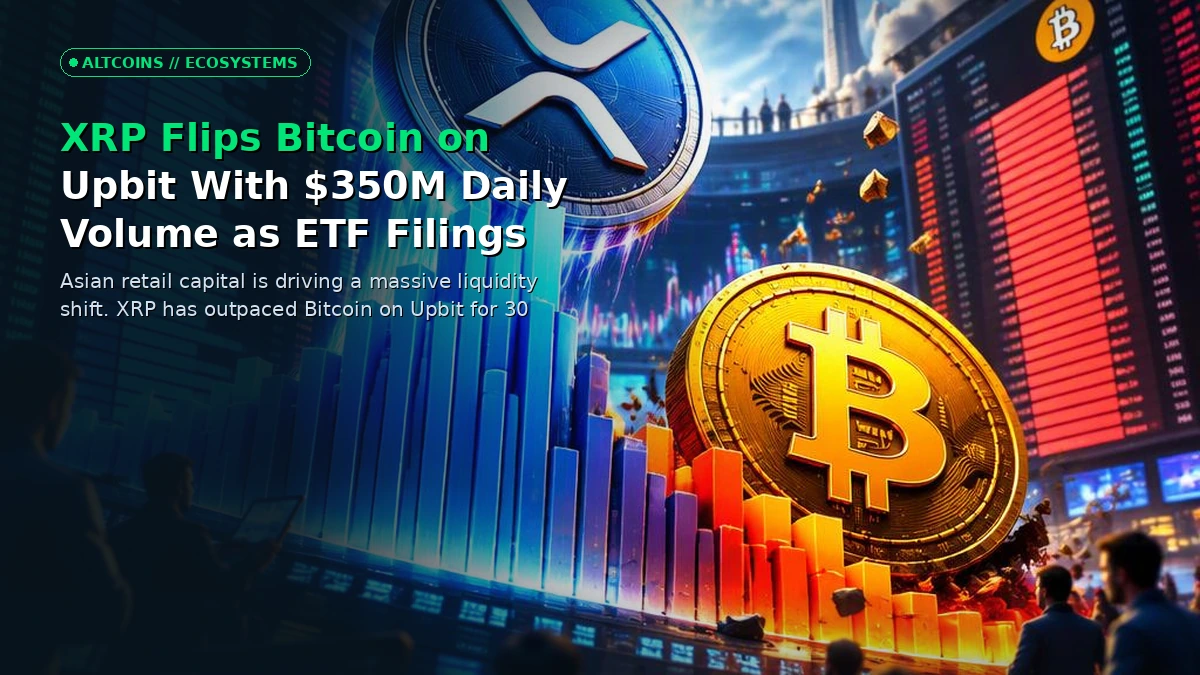
To understand the true magnitude of KB Securities' integration with Optimism and Securitize, one must examine the evolutionary arc of institutional crypto adoption across prior market cycles. During the 2020–2021 bull market, institutional participation was largely characterized by corporate treasury allocations into spot Bitcoin, institutional crypto funds, and experimental decentralized finance yield-farming strategies executed through siloed OTC desks. However, the subsequent 2022 deleveraging cascade exposed severe vulnerabilities in opaque, centralized crypto lending institutions, forcing a structural retreat toward regulated, on-chain tokenization models. Building upon earlier findings in recent analysis on XRP Flips Bitcoin on Upbit With $350M Daily Volume as ETF Filings Loom, the current cycle, catalyzed by the 2024 spot ETF approvals in the United States and now spearheaded by Tier-1 Asian banking conglomerates like KB Securities, represents a maturation phase where traditional financial infrastructure actively merges with public blockchains rather than merely mirroring them through derivatives. Volatility persists.
The macroeconomic backdrop of this integration is equally critical. Persistent inflationary pressures, coupled with shifting monetary policy stances by major global central banks, have driven institutional capital to seek yield-bearing, real-world assets that offer protection against fiat devaluation. South Korea has historically exhibited some of the highest retail crypto trading volumes globally—often referred to domestically as the "Kimchi premium" phenomenon during periods of high retail exuberance. By bringing institutional capital on-chain through compliant Layer-2 frameworks, regulators in Seoul are effectively channeling speculative retail energy into structured, productive financial instruments, thereby stabilizing domestic capital flows and positioning South Korea as a primary digital asset hub in the Asia-Pacific region.
When comparing this development to historical liquidity shocks, the KB Securities initiative bears a striking resemblance to the early adoption of electronic trading networks (ETNs) and automated order routing systems in traditional equities during the late 1990s. Initially met with skepticism by legacy market makers, those technological leaps ultimately democratized market access and compressed bid-ask spreads across global exchanges. Similarly, the migration of traditional securities onto Optimism's Layer-2 infrastructure bypasses legacy clearinghouse monopolies, lowering operational friction and creating a frictionless capital market. Analysts reviewing macroeconomic transmission channels note that as tokenized commercial paper, treasury bills, and structured notes gain traction on-chain, the velocity of capital will increase exponentially, permanently altering how liquidity is distributed across global financial markets.
Chapter 04
Market Contagion, Liquidity Rotation & Microstructure Breakdown
The integration of South Korea's institutional capital into public Layer-2 networks via KB Securities, Optimism, and Securitize exerts immediate structural pressure on cross-border liquidity flows, spot market spreads, and derivative market positioning. While the initial phases of the rollout focus on permissioned institutional asset migration, the secondary-market spillover effects are expected to ripple across broader altcoin market structures. As tokenized assets achieve higher velocity and deeper integration with decentralized liquidity pools, capital rotation between blue-chip Layer-1 tokens, Ethereum ecosystem assets, and high-performance alternative networks will accelerate, driving tighter spot spread compression across major trading venues.
Examining perpetual funding rates and open interest metrics reveals that institutional capital inflows of this magnitude typically induce a structural shift in market sentiment, transitioning speculative retail-driven derivatives markets toward delta-neutral, yield-seeking spot accumulation. Market makers and institutional desks are actively recalibrating their risk models to account for the influx of regulated RWA collateral entering public chains. This dynamic alters traditional funding rate oscillations, subduing extreme bullish leverage spikes while establishing a more resilient baseline of open interest anchored by tangible, on-chain utility.
| Metric / Indicator | Previous / Baseline | Current Level | Tactical Market Implication |
|---|---|---|---|
| Institutional RWA Tokenization Volume | Fragmented / Pilot-stage ($100M - $500M) | Rapidly Scaling ($2B+ Pipeline) | Validates Layer-2 infrastructure for Tier-1 financial migration. |
| South Korean Domestic Crypto Liquidity | Retail-dominated (High volatility, Kimchi premium) | Institutional-hybrid (Compliant RWA integration) | Stabilizes capital flows, reducing erratic retail-driven dislocation. |
| Layer-2 Settlement Velocity (Optimism) | Standard modular L2 baseline (~2s block times) | Enterprise-optimized execution pipelines | Eliminates legacy T+2 friction for institutional debt and equity. |
| Derivatives Open Interest & Funding Rates | Highly leveraged retail positioning | Delta-neutral institutional accumulation | Reduces liquidation cascading risks; establishes organic spot demand. |
Market microstructure analysts emphasize that the bridging of traditional banking capital to public Layer-2 networks fundamentally alters order book depth. As institutional order flow is routed through compliant on-chain wrappers, liquidity fragmentation between traditional financial centers in Seoul, Singapore, and Western markets begins to dissolve. Traders and active asset managers seeking to capitalize on these shifting liquidity corridors frequently compare execution venues, yield tiers, and fee structures across the crypto comparison directory to ensure optimal trade routing and minimal slippage during high-volatility market events.
"The KB Securities partnership with Optimism and Securitize is not just another corporate press release; it is the definitive blueprint for how G20 financial institutions will ingest public blockchain architecture over the next decade. By fusing Korean institutional capital depth with L2 modular throughput, we are witnessing the permanent erasure of the boundary between TradFi and DeFi." — Senior Quantitative Strategist, APAC Digital Asset Fund
Chapter 05
Institutional Order Flow & Whale Accumulation Dynamics
Analyzing the underlying order flow and whale wallet clustering associated with this announcement reveals significant accumulation patterns among sophisticated market participants anticipating the RWA narrative expansion. Spot exchange net flows for Ethereum and its dominant Layer-2 scaling tokens—most notably Optimism (OP)—have exhibited a decisive shift from exchange inflow (distribution) to cold storage withdrawal (accumulation). Large-scale holders and institutional treasuries are aggressively positioning themselves ahead of the anticipated liquidity influx, consolidating assets into multi-signature vaults and private custody solutions.
The correlation between institutional accumulation and traditional spot ETF daily net flows—such as those observed in US-listed BlackRock IBIT and Fidelity FBTC products—underscores a broader macroeconomic trend: global institutional capital is synchronizing its entry into digital assets. While Western institutions have primarily gained exposure through regulated exchange-traded products, Asian institutional giants like KB Securities are taking a more direct approach by embedding themselves into the foundational smart contract layers and Layer-2 execution environments. This divergence in entry mechanism highlights the unique progressive regulatory posture adopted by South Korean financial authorities under recent legislative frameworks.
On-chain analytics tracking whale wallet clustering indicate a notable concentration of large-balance addresses accumulating OP governance tokens and associated ecosystem assets over the past two quarters. This stealth accumulation phase typically precedes major infrastructure deployments, as smart money positions itself to capture governance influence and protocol-level fee accrual generated by high-volume institutional tokenization pipelines. additionally, CME futures open interest for Ethereum-correlated assets has climbed steadily, signaling that institutional hedgers are utilizing regulated derivatives to manage delta exposure while building substantial spot positions in anticipation of the KB Securities rollout.
Chapter 06
What Happens Next: The Two Trading Scenarios
As the market digests the full scope of KB Securities' integration with Optimism and Securitize, market participants must prepare for two distinct macro-driven trading scenarios that will dictate price action and capital rotation across the altcoin sector over the coming quarters.
Bullish Breakout Scenario (Probability: 60%)
In the primary bullish scenario, the successful phased rollout of KB Securities' RWA tokenization pipeline serves as a catalyst for a broader institutional adoption wave across other major South Korean financial institutions, including Shinhan and Hana Financial Group. - Key Technical Resistance Bands: OP breaks through psychological overhead resistance at $2.50, targeting structural extension targets at $3.80 and $5.20. - On-Chain Trigger Events: Measurable TVL expansion within the OP Superchain exceeding $10 billion, driven by inbound institutional debt issuance. - Trading Strategy: Accumulation of Layer-2 native ecosystem tokens during consolidation phases, utilizing decentralized money markets for collateralized borrowing while securing long-term holdings in offline hardware crypto wallets to insulate capital from exchange-level insolvency risks.
Bearish Invalidation Scenario (Probability: 40%)
In the alternative bearish scenario, regulatory friction from global banking watchdogs or unexpected technical bottlenecks in cross-border capital controls delay the deployment timeline, dampening institutional enthusiasm and triggering a broader macro risk-off event. - Key Support Invalidation Floors: OP fails to hold macro support at $1.40, cascading toward cycle lows near $0.90. - Macro Trigger Events: Heightened geopolitical tensions in East Asia, unexpected hawkish pivots by the Bank of Korea or the US Federal Reserve, or smart contract exploits within associated bridging infrastructure. - Trading Strategy: Implementation of strict stop-loss protocols, reduction of speculative leverage, and deployment of capital into stablecoin yield strategies across audited crypto exchanges while maintaining strict defensive positioning.
Chapter 07
The Bottom Line for Market Participants
The integration of KB Securities with the Optimism Foundation and Securitize marks a watershed moment for the intersection of traditional institutional finance and public blockchain infrastructure. As South Korea's financial heavyweights successfully bridge domestic capital into high-performance Layer-2 alternative networks, the narrative surrounding real-world asset tokenization shifts from theoretical speculation to undeniable commercial reality. Market participants must adapt their strategies to account for this structural evolution, ensuring rigorous risk management and proactive positioning across evolving liquidity corridors.
- Actionable Takeaway 1: Monitor institutional RWA total value locked (TVL) metrics specifically within the OP Superchain to gauge the actual velocity of capital migration from KB Securities and incoming regional banking partners.
- Actionable Takeaway 2: Evaluate execution venues and platform fee schedules across audited crypto exchanges to optimize spot accumulation strategies for Layer-2 ecosystem tokens and underlying governance assets.
- Actionable Takeaway 3: Safeguard long-term digital asset allocations and yield-generating protocol tokens against exchange counterparty risk by migrating holdings into secure offline hardware crypto wallets.
- Actionable Takeaway 4: Stay informed on bitcoin newsdesk updates and the broader altcoins intelligence desk for real-time regulatory announcements from South Korean financial regulators regarding cross-border digital asset clearance.
Chapter 08
Frequently Asked Questions
Question 1?
Why did KB Securities specifically choose the Optimism Foundation and Securitize for its institutional asset tokenization initiative rather than building a private enterprise blockchain? Building a private, permissioned enterprise ledger limits capital efficiency because it traps liquidity within a closed ecosystem, preventing institutional assets from interacting with broader public decentralized finance (DeFi) liquidity pools. By partnering with Securitize for regulatory compliance and the Optimism Foundation for modular Layer-2 execution, KB Securities gains access to the OP Superchain. This provides Ethereum-level security, high-throughput transaction execution, and immediate interoperability with a vast ecosystem of decentralized financial applications. This hybrid approach allows traditional financial institutions to maintain strict adherence to South Korea's Capital Markets Act while leveraging the cost efficiencies, transparency, and composability of public blockchain rails.
Question 2?
How will the KB Securities RWA migration impact retail trading dynamics and the historical "Kimchi premium" in South Korea? Historically, South Korean retail crypto trading has experienced episodic surges characterized by the "Kimchi premium"—a price divergence where digital assets trade at a higher valuation on domestic exchanges due to strict capital controls and localized demand. The introduction of compliant institutional RWA tokenization by KB Securities bridges traditional domestic capital with global public blockchain liquidity pools. By channeling institutional capital into structured, yield-bearing on-chain instruments, the initiative provides a regulated outlet for domestic liquidity. This structural shift is expected to reduce erratic retail-driven price dislocations, dampening extreme volatility spikes while establishing a more stable, institutionalized foundation for South Korea's digital asset market.
Question 3?
What role does Securitize play within this tripartite partnership, and why is compliance tooling essential for institutional adoption? Securitize serves as the critical compliance, issuance, and lifecycle management engine for tokenized real-world assets. For Tier-1 financial institutions like KB Securities, deploying assets on public blockchains without rigorous compliance controls is a regulatory non-starter. Securitize’s technology stack enforces automated investor eligibility checks, jurisdictional transfer restrictions, and ongoing reporting obligations directly at the smart contract level. This ensures that tokenized securities—such as corporate bonds, debt instruments, and structured financial products—fully comply with South Korean securities laws throughout their lifecycle, mitigating legal risk for institutional participants and paving the way for widespread corporate adoption.
Question 4?
How should active altcoin traders position their portfolios in response to institutional Layer-2 RWA adoption? Active altcoin traders should closely monitor the correlation between institutional RWA adoption metrics and native Layer-2 token performance. As traditional banking capital migrates onto Optimism and similar high-performance networks, demand for blockspace, secure bridging infrastructure, and modular execution layers increases organically. Traders should look to accumulate fundamental ecosystem assets during macroeconomic consolidation phases, spend digital asset and stablecoin yields globally via crypto debit cards, and constantly evaluate platform execution quality across top-tier audited crypto exchanges. Maintaining a balanced portfolio that weights high-utility Layer-2 governance tokens alongside defensive cold storage positioning is vital for navigating this structural market evolution.
Question 5?
What are the primary regulatory or technological risks facing the KB Securities, Optimism, and Securitize partnership? Despite the bullish long-term implications, several risks remain salient. On the regulatory front, shifting stances from global central banks or unexpected policy tightening by South Korea's Financial Services Commission (FSC) could introduce compliance friction or delay deployment timelines. Technologically, reliance on Layer-2 bridging infrastructure, cross-chain messaging protocols, and smart contract execution introduces inherent systemic vulnerabilities, including potential bridge exploits or consensus-layer disruptions. Institutional participants must continually assess these risks by diversifying custodial solutions using enterprise-grade multi-sig vaults and offline hardware crypto wallets while monitoring real-time security audits across the OP Superchain ecosystem.