

Chapter 01
What crypto market participants should know
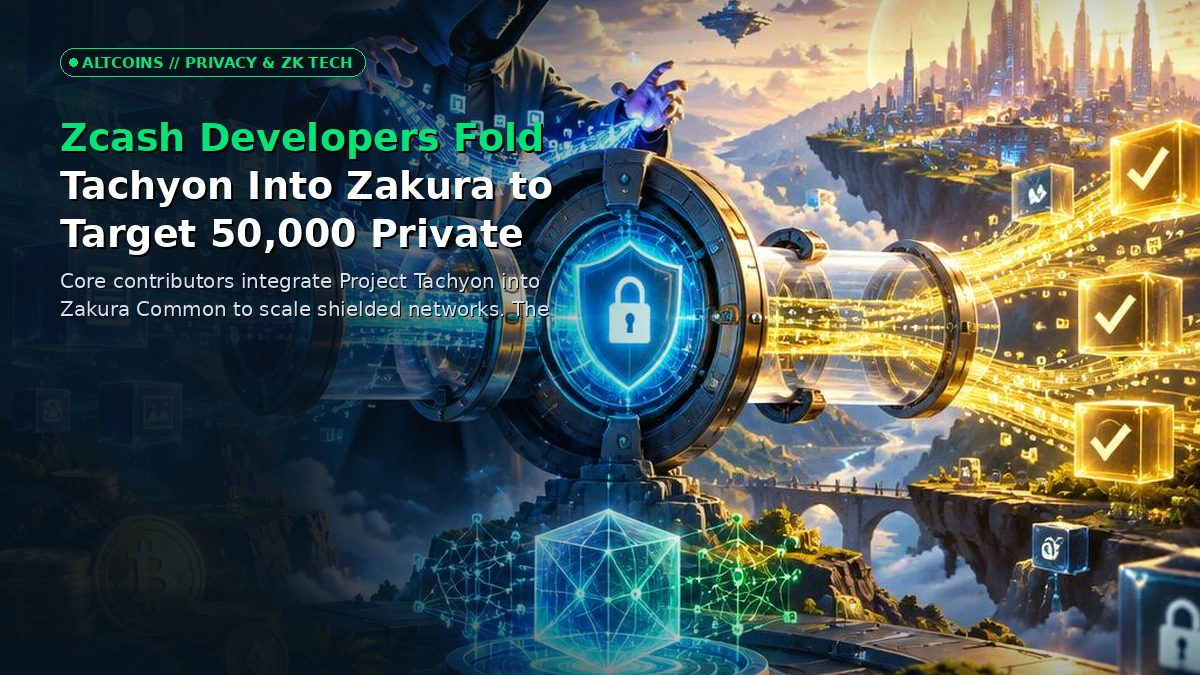
Zcash core developers have formally initiated the integration of Project Tachyon into Zakura Common, setting in motion a high-performance cryptographic pipeline engineered to scale shielded transaction throughput beyond an unprecedented 50,000 private payments per second as detailed in reports by CoinDesk. This architectural breakthrough arrives precisely as global financial regulators tighten the screws on digital asset surveillance, threatening the viability of unshielded networks. As privacy-preserving technologies face institutional headwinds and persistent capital outflows from broader altcoins & ecosystems, Zcash (ZEC) is experiencing a severe market friction point, trading near depressed valuations while core engineering teams race to build infrastructure capable of handling global-scale enterprise payment flows without sacrificing zero-knowledge mathematical guarantees similar to trends highlighted in recent analysis on Zcash extended fund outflows. Risk remains elevated.
The immediate market reaction to this structural engineering milestone has been muted by a punishing macro backdrop characterized by extended sliding price action, systemic U.S. fund outflows, and a broader flight of risk capital away from privacy coins alongside daily movements tracked across the altcoins intelligence desk. While speculative traders chase high-beta narratives across Altcoins & ecosystems and broader market wires, privacy technology assets are caught in a classic institutional squeeze: suppressed native token prices colliding with exponential technological breakthroughs. This divergence between fundamental protocol utility and depressed spot market liquidity represents a classic structural inflection point, forcing market participants to weigh whether generational cryptographic upgrades will eventually overpower short-term regulatory and liquidity pressures. The shift was immediate.
Chapter 02
The Core Catalyst: Tachyon Code Merges into Zakura Common
The integration of Project Tachyon into the Zakura Common software stack represents one of the most ambitious scaling overhauls in the history of zero-knowledge privacy-preserving blockchains. Historically, zk-SNARK protocols have suffered from crippling computational overhead, where generating and verifying cryptographic proofs for shielded transactions required immense CPU cycles, massive memory footprints, and prohibitive latency. Tachyon introduces radical algorithmic optimizations to polynomial commitment schemes and multi-scalar multiplication (MSM) acceleration, allowing validation nodes to process complex zero-knowledge proofs at speeds previously thought impossible for privacy-centric ledgers. Markets reacted swiftly.
By folding this high-performance codebase into Zakura Common, Zcash developers are transforming the network from a niche privacy coin into a hyper-scalable settlement layer capable of competing directly with centralized payment rails and high-throughput monolithic layer-ones building upon recent analysis on Solana Targets HFT Dominance as Alpenglow Testnet Unleashes 150ms Speed. The target metric of over 50,000 private transactions per second (TPS) places Zcash infrastructure orders of magnitude ahead of legacy privacy implementations and even challenges the theoretical limits of modern public blockchains. This leap is achieved by decoupling proof verification bottlenecks and leveraging advanced hardware-accelerated cryptographic pipelines, ensuring that user privacy remains absolute even under maximum network congestion. Execution remains paramount.
This scaling milestone directly addresses the structural limitations that have historically prevented institutional adoption of privacy tech. Enterprises and financial institutions cannot integrate systems prone to network congestion or high transaction latency. With Tachyon-powered Zakura Common, developers are laying the groundwork for institutional-grade compliance-compatible privacy, where transactions can maintain absolute cryptographic confidentiality while processing volumes that rival traditional credit card networks. Detailed technical breakdowns of these protocol updates can be monitored through our Latest market wires, tracking how developer commits translate into network-level upgrades. Caution dictates strategy.
Chapter 03
Macro Transmission & Historical Precedents: How This Compares to Prior Cycles
To understand the current trajectory of privacy assets, one must examine the historical parallels between the 2020 halving cycle and the post-ETF market structure of 2024 and 2025. In previous cycles, privacy coins experienced periods of deep capital starvation during macroeconomic tightening phases, only to experience violent repricing events when liquidity returned to alternative sectors. However, the current cycle differs fundamentally due to the aggressive rise of global regulatory frameworks like the European Union's Markets in Crypto-Assets (MiCA) regulation and intensified scrutiny from the U.S. Securities and Exchange Commission and Financial Crimes Enforcement Network consistent with broader updates outlined in global crypto industry summaries. Capital preserves optionality.
During the 2020 bull run, privacy protocols benefited from a general retail-driven appetite for sovereign financial tools. Today, the landscape is dominated by institutional capital flows that are structurally restricted from interacting with unmanaged privacy pools due to stringent Anti-Money Laundering (AML) and Know-Your-Customer (KYC) mandates. This has created a bifurcated market where baseline liquidity migrates to compliant layer-1 ecosystems, leaving privacy assets starved of organic spot volume. Yet, the introduction of scalable architecture like Zakura Common changes the game theory entirely, offering a technological bridge toward programmable privacy that can satisfy institutional compliance frameworks without compromising user confidentiality. Volatility persists.
Macroeconomic interest rate regimes have further exacerbated this divergence. In a higher-for-longer yield environment, capital demands immediate risk-adjusted returns, driving liquidity toward spot-yielding instruments and institutional-grade treasury assets. Privacy tokens, which do not natively offer staking yields and face severe regulatory delisting pressures from centralized exchanges, have suffered disproportionate capital flight. Nevertheless, historical precedents demonstrate that when foundational scalability milestones are achieved during bear or consolidation phases, the subsequent macro liquidity rotation can trigger exponential repricing once broader market sentiment shifts.
Chapter 04
Market Contagion, Liquidity Rotation & Microstructure Breakdown
The ongoing structural contraction in Zcash liquidity has created severe microstructural imbalances across spot and derivatives order books. Extended slide patterns and persistent U.S. fund outflows have compressed order book depth on primary trading venues, leaving the asset vulnerable to cascading liquidations and localized volatility spikes. Market makers have widened bid-ask spreads to compensate for inventory risk, making large-scale execution difficult for institutional allocators seeking exposure to privacy tech. Traders navigating these volatile conditions often utilize audited crypto exchanges and side-by-side product comparisons to evaluate execution quality and minimize slippage across fragmented liquidity pools.
Perpetual funding rates for privacy assets have hovered near neutral-to-slightly-negative territory, indicating persistent bearish positioning and defensive hedging by leveraged speculators. Spot volume has largely migrated away from major Western exchanges due to compliance pressures, concentrating liquidity on alternative platforms where regulatory oversight is less restrictive. This geographic fragmentation creates distinct arbitrage opportunities but also increases systemic counterparty risk for market participants who fail to secure their assets properly.
| Metric / Indicator | Previous / Baseline | Current Level | Tactical Market Implication |
|---|---|---|---|
| Shielded TPS Capacity | ~25 - 50 TPS | 50,000+ Target (Zakura) | Massive scalability unlocking enterprise-grade throughput |
| U.S. Fund Net Flows | Neutral / Inflow Positive | Extended Outflows | Depressed spot liquidity and persistent selling pressure |
| Exchange Order Book Depth | Moderate Liquidity | Thin / Widened Spreads | High execution slippage; caution required for large orders |
| Derivatives Open Interest | Historical Averages | Compressed / Defensive | Low speculative leverage, reducing sudden liquidation cascades |
"The integration of Project Tachyon into Zakura Common is not merely an incremental software patch; it is a fundamental re-engineering of zero-knowledge throughput. While short-term market participants are fixated on fund outflows and regulatory noise, the protocol's architecture is quietly evolving to handle institutional-scale private payments. When macro liquidity eventually rotates back into privacy tech, the infrastructure will finally match the narrative."
Chapter 05
Institutional Order Flow & Whale Accumulation Dynamics
Institutional participation in privacy assets remains an exercise in paradox. While mainstream spot exchange-traded funds (ETFs) focused on Bitcoin and Ethereum capture billions in daily net inflows—led by heavyweights like BlackRock's IBIT and Fidelity's FBTC—privacy-centric protocols are entirely excluded from traditional ETF wrappers due to regulatory compliance barriers. Consequently, institutional exposure to Zcash and similar privacy tech occurs primarily through over-the-counter (OTC) desks, specialized crypto-native funds, and private venture vehicles targeting underlying protocol development rather than secondary market spot accumulation as noted in recent analysis on KB Securities Taps Optimism and Securitize to Bridge $350B Into Layer-2 Rails.
On-chain analytics reveal a fascinating divergence between retail capitulation and smart money accumulation. While retail wallets associated with centralized exchange deposits have steadily offloaded balances, long-term whale addresses holding between 10,000 and 100,000 ZEC have shown quiet accumulation patterns during prolonged market drawdowns. These large-scale holders appear unfayed by short-term price suppression, positioning themselves ahead of structural network upgrades like Zakura Common. additionally, CME futures open interest for alternative privacy assets remains subdued, indicating that institutional leverage is currently sitting on the sidelines, waiting for clear regulatory signals or definitive technical testnet milestones before deploying capital.
As privacy compliance demands intensify globally, corporations and high-net-worth individuals are increasingly prioritizing operational security. Protecting digital assets against sophisticated exchange hacks, regulatory overreach, and unexpected platform freezes has driven market participants to withdraw capital into offline environments. Utilizing reliable hardware crypto wallets and self-custody solutions ensures that long-term holders retain absolute sovereignty over their cryptographic keys while insulating their portfolios from exchange counterparty risk.
Chapter 06
What Happens Next: The Two Trading Scenarios
As the Zcash developer ecosystem advances Project Tachyon and integrates Zakura Common, market participants must prepare for two distinct macro and technical scenarios over the upcoming quarters.
In the bullish breakout scenario, successful testnet deployments of Tachyon-powered Zakura Common demonstrate flawless execution well ahead of schedule. This technical triumph coincides with a broader macroeconomic shift toward monetary easing, forcing central banks to lower interest rates and reignite risk-on capital flows. Institutional interest rekindles as developers showcase compliance-compatible, enterprise-grade private settlement options. Spot volume surges back into the asset, clearing major overhead resistance bands and driving a rapid re-rating of ZEC toward historical valuation multiples.
In the bearish continuation scenario, persistent regulatory headwinds and tightening compliance mandates across major global jurisdictions prompt further exchange delistings of privacy-centric assets. Macroeconomic conditions remain restrictive, keeping risk capital locked in sovereign debt and compliant ETF products. U.S. fund outflows accelerate, breaking critical multi-year support floors and triggering extended consolidation near cycle lows. In this environment, despite stellar fundamental engineering developments, the spot token price remains severely depressed due to a structural lack of accessible liquidity venues.
Chapter 07
The Bottom Line for Market Participants
Navigating the intersection of advanced privacy technology and depressed market liquidity requires rigorous risk management, disciplined execution, and a clear understanding of long-term protocol fundamentals. Market participants must balance short-term regulatory risks against generational engineering breakthroughs like Project Tachyon.
- Actionable Takeaway 1: Monitor developer repositories and testnet metrics closely to verify the real-world performance benchmarks of Zakura Common and Tachyon integration before committing large capital allocations.
- Actionable Takeaway 2: Optimize your execution strategy and compare liquidity depth, trading fees, and operational security across audited crypto exchanges to minimize slippage during volatile market phases.
- Actionable Takeaway 3: Secure your long-term spot holdings and cryptographic keys away from custodial platforms by utilizing cold storage solutions and hardware crypto wallets to protect against exchange counterparty risk.
- Actionable Takeaway 4: Evaluate competing Layer-1 scaling solutions and privacy-preserving protocols side-by-side using comprehensive product comparisons to ensure optimal portfolio diversification across alternative tech sectors.
Chapter 08
Frequently Asked Questions
What is Project Tachyon and how does it impact Zcash scalability?
Project Tachyon is an advanced cryptographic optimization initiative designed to overhaul the polynomial commitment schemes and multi-scalar multiplication pipelines within zero-knowledge protocols. By integrating Tachyon into the Zakura Common software stack, Zcash developers are systematically eliminating the computational bottlenecks that have historically limited zk-SNARK performance. This architectural leap enables the network to target an unprecedented throughput of over 50,000 private payments per second, bridging the gap between absolute cryptographic privacy and the high-speed demands of global enterprise and retail payment systems.
Why is Zcash experiencing fund outflows despite major technical upgrades?
The divergence between Zcash's fundamental engineering progress and its depressed spot market performance is primarily driven by regulatory friction and macroeconomic liquidity dynamics. Global regulatory bodies have increasingly targeted privacy-preserving protocols with stringent AML and KYC requirements, prompting many mainstream centralized exchanges to restrict or delist privacy coins. additionally, institutional capital is currently concentrated in compliant, yield-bearing, or ETF-wrapped digital assets like Bitcoin and Ethereum, leaving privacy-centric altcoins temporarily starved of organic spot volume and institutional inflows.
How does Zakura Common balance absolute user privacy with regulatory compliance?
Zakura Common is engineered to support programmable privacy features that allow network participants to selectively disclose transaction details to authorized auditing entities without compromising the foundational zero-knowledge cryptography that protects everyday users. This architecture aims to satisfy institutional compliance frameworks—such as travel rule requirements and anti-money laundering mandates—while ensuring that honest network participants retain absolute confidentiality and financial sovereignty against unwarranted mass surveillance.
What are the main risks for traders engaging with privacy assets in the current market?
Traders navigating the privacy tech sector face several distinct risks, including regulatory delisting announcements from major centralized exchanges, thin order book depth resulting in high execution slippage, and prolonged capital starvation during macroeconomic tightening phases. Additionally, the fragmented nature of liquidity venues requires strict adherence to operational security protocols. Utilizing reputable execution venues and securing funds in self-custody environments are critical steps for mitigating these structural market vulnerabilities.
Where can investors track ongoing developments regarding Tachyon and Zakura?
Investors and market analysts can track the latest protocol updates, developer commits, and network milestones by monitoring official developer channels, community governance forums, and dedicated cryptocurrency news desks. Staying informed through verified industry wires ensures that market participants receive accurate, up-to-date intelligence on testnet deployments, hard fork schedules, and evolving regulatory frameworks impacting the privacy technology landscape.