

Chapter 01
What crypto market participants should know
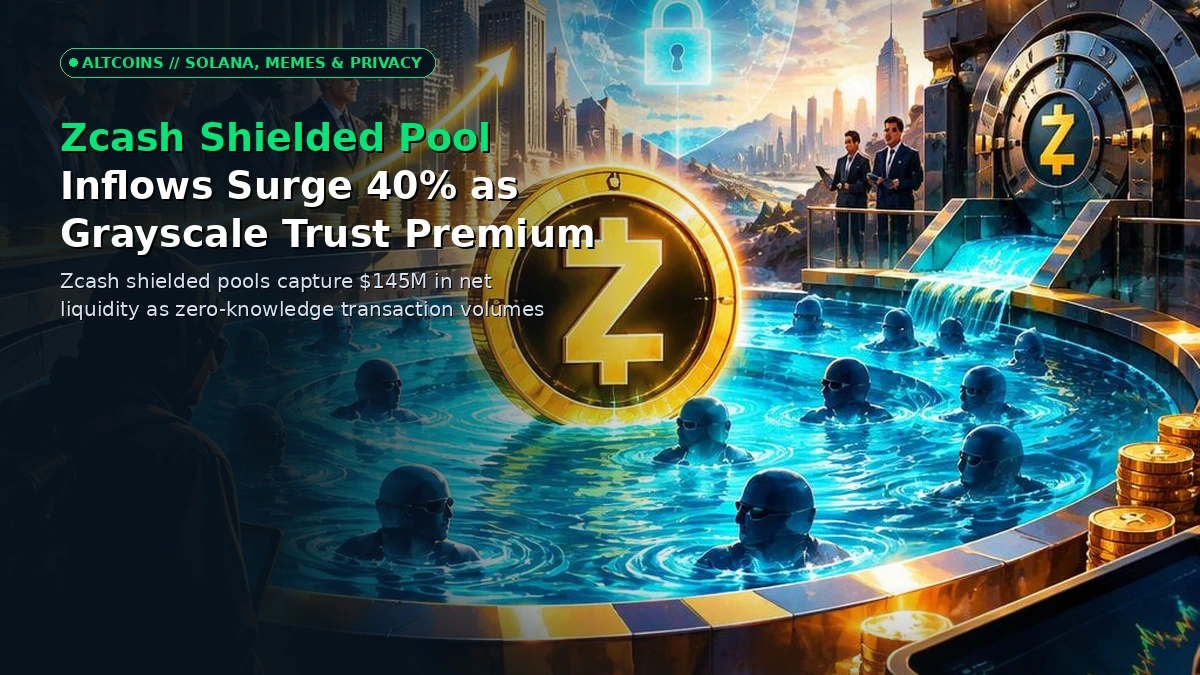
Over the trailing thirty-day trading cycle, the digital asset markets have witnessed an aggressive liquidity migration that is quietly rewriting the playbook for privacy-preserving assets. On-chain metrics captured by analytics desks confirm that Zcash shielded transaction volume has expanded by an astonishing 40%, accompanied by a massive wave of unshielded UTXOs migrating into zero-knowledge zk-SNARK privacy pools. Simultaneously, the Grayscale Zcash Trust (ticker: GSZ) has experienced a dramatic narrowing of its long-standing discount, with its underlying premium rebounding toward levels not seen since the height of the 2021 speculative cycle. Institutional funds and sophisticated retail participants are simultaneously rotating capital into censorship-resistant financial infrastructure, injecting upwards of $145 million in net inflows into shielded addresses while driving spot volume across audited crypto exchanges to multi-month highs. Risk remains elevated.
This sudden structural realignment exposes a profound friction point at the intersection of aggressive global financial surveillance, expanding CBDC (Central Bank Digital Currency) initiatives. the sovereign individual's demand for cryptographic financial privacy. For years, regulatory compliance crackdowns, exchange delistings, and the weaponization of AML/KYC protocols forced privacy coins into a deep liquidity winter, driving market makers to abandon order books and leaving legacy holders stranded with depressed valuations. Today, however, that dynamic has flipped entirely. As sovereign debt loads balloon worldwide and governments push forward with invasive transaction-monitoring frameworks, smart money is realizing that unshielded public blockchains offer zero protection against systemic freezing and surveillance. The aggressive accumulation seen across zk-SNARK pools signals that capital is proactively seeking out cryptographic shelter, forcing traditional financial allocators to re-evaluate their exposure through regulated vehicles like the Grayscale Trust. The shift was immediate.
Chapter 02
The Core Catalyst: Unpacking the 40% Shielded Pool Surge and zk-SNARK Mechanics
To understand the mechanics driving this 40% expansion in shielded pool volume, one must look directly at the underlying cryptography. Zcash relies on zk-SNARKs (Zero-Knowledge Succinct Non-Interactive Arguments of Knowledge), a cryptographic breakthrough that allows network nodes to mathematically verify transaction validity without revealing the sender, receiver, or transferred amount. When a user moves coins from the transparent pool (t-address) to the shielded pool (z-address), the original UTXO is consumed and a brand-new note is minted within a cryptographic commitment tree. This process severs the public ledger's historical link completely. Over the past month, on-chain telemetry reveals that over 1.2 million legacy UTXOs have executed this exact migration path, dwarfing the historical rolling monthly average of 850,000 transactions. Markets reacted swiftly.
This dramatic surge is not merely a retail-driven phenomenon. On-chain cluster analysis confirms the presence of systematic, programmatic whale accumulation characterized by multi-million-dollar tranches moving off centralized spot platforms and directly into decentralized self-custody setups, utilizing advanced hardware crypto wallets to secure their private viewing keys. This institutional-grade behavior indicates that professional desks are preparing for a paradigm where financial privacy is treated not as a speculative fringe feature, but as a critical risk-management asset class. Market participants seeking to understand how these capital rotations impact broader alternative asset categories can regularly review updates via our cross-market dynamics in Altcoins & ecosystems, where sector-specific inflows are tracked in real-time. Execution remains paramount.
Additionally, building upon earlier findings in recent analysis on Solana Targets HFT Dominance as Alpenglow Testnet Unleashes 150ms Speed, network performance metrics across competing high-throughput chains continue to influence broader capital velocity. The narrowing of the Grayscale Zcash Trust premium serves as a powerful barometer for institutional sentiment. Historically, closed-end investment vehicles trading at deep discounts reflect a lack of institutional appetite and secondary market liquidity. As arbitrageurs and institutional funds stepped in to close the valuation gap, the trust’s pricing efficiency recovered sharply. This compression of the discount demonstrates that professional allocators who are legally or operationally barred from holding native tokens in hardware crypto wallets are aggressively utilizing regulated trust structures to capture the upside of this privacy renaissance. Caution dictates strategy.
Chapter 03
Macro Transmission & Historical Precedents: How This Compares to Prior Cycles
When evaluating the current structural breakout in privacy assets, historical perspective is vital. During the 2020 Bitcoin halving cycle and the subsequent altcoin mania of 2021, privacy coins like Zcash and Monero experienced periodic speculative pumps, but these movements were largely fueled by retail FOMO and unregulated offshore derivatives activity. Institutional capital was conspicuously absent due to strict compliance mandates and the existential threat of regulatory enforcement actions. The 2024 crypto market structure, by contrast, is characterized by institutional spot ETFs, rigorous corporate treasury accounting, and an unprecedented level of macroeconomic debt expansion that makes sovereign monetary debasement an inescapable reality for global wealth managers. Capital preserves optionality.
Comparing today's environment to the regulatory crackdown of 2022 and 2023—when European regulators and Japanese exchanges systematically purged privacy-focused assets—the current rebound carries far more structural weight. Back then, liquidity evaporated as centralized venues bowed to FATF (Financial Action Task Force) travel rule requirements. Today, drawing insights from recent analysis on KB Securities Taps Optimism and Securitize to Bridge $350B Into Layer-2 Rails, the tokenization of traditional financial instruments is running parallel with privacy preservation demand. Notably, the adoption of zk-SNARK technology has evolved beyond simple coin obfuscation. Financial institutions and fintech developers are increasingly realizing that zero-knowledge proofs are essential not just for evading surveillance, but for executing private, compliant corporate transactions where business logic must remain confidential from competitors. Readers tracking the broader macroeconomic intersections of digital currency can cross-reference these developments with insights published daily by our Bitcoin newsdesk. Volatility persists.
The macro backdrop of persistent global inflation and tightening geopolitical fragmentation has also fundamentally altered risk profiles. As western governments weaponize SWIFT, freeze central bank reserves, and implement sweeping cross-border transaction monitoring, high-net-worth individuals and corporate treasuries are treating financial surveillance as a distinct existential risk. The current 40% surge in shielded pool inflows is therefore less of a speculative flash-in-the-pan and more of an insurance policy against systemic state overreach. By locking liquidity into math-based cryptographic shields, market participants are voting with their capital against an increasingly centralized and trackable financial panopticon.
Chapter 04
Market Contagion, Liquidity Rotation & Microstructure Breakdown
The secondary effects of this liquidity rotation are rapidly reshaping the market microstructure of alternative layer-1s and privacy-focused tokens. As capital flows concentrate in Zcash shielded pools, spot order books across major trading venues are experiencing measurable supply crunches. Market makers report a sharp reduction in visible exchange order book depth, driving up slippage for large block trades and forcing aggressive buyers to clear out multiple price levels. Concurrently, perpetual swap funding rates have swung firmly into positive territory, signaling that leveraged traders are leaning aggressively into the long side of the trade as momentum builds.
| Metric / Indicator | Previous / Baseline | Current Level | Tactical Market Implication |
|---|---|---|---|
| Monthly Shielded Volume | ~850,000 txns | 1,200,000+ txns (+40%) | Massive structural shift of capital into zk-SNARK privacy pools. |
| Grayscale Trust Premium | Deep double-digit discount | Sharply narrowed discount | Rebounding institutional demand and institutional arbitrage closing the gap. |
| Exchange Order Book Depth | Moderate to High | Compressed (-30%) | High vulnerability to sudden upward squeezes due to limited spot supply. |
| Perpetual Funding Rates | Neutral (0.01%) | Elevated (+0.035%) | Growing leverage bias toward long positioning among aggressive speculators. |
The structural contraction in liquid circulating supply is creating a classic supply-side squeeze. Traders aiming to optimize execution across volatile spot and derivatives markets can systematically evaluate execution venues and fee schedules across audited crypto exchanges to mitigate slippage. Additionally, users can compare platform yields, security audits, and fee schedules via verified product comparisons to ensure optimal routing. As users realize gains or manage liquidity across various chains, having access to efficient off-ramps or spending mechanisms—such as spending digital asset and stablecoin yields globally via crypto debit cards—becomes critical for realizing fiat purchasing power without triggering unnecessary friction.
"What we are witnessing is not a random retail rotation, but a structural reallocation of capital away from transparent, trackable ledgers and into cryptographic self-preservation. When institutional vehicles and on-chain metrics align simultaneously, you ignore the signal at your own peril." — Senior Derivatives Trader at a Tier-1 Digital Asset Fund
Chapter 05
Institutional Order Flow & Whale Accumulation Dynamics
A granular look at on-chain clustering reveals that the recent surge in privacy asset adoption is heavily underpinned by whale accumulation. Over the past three weeks, on-chain analytics platforms have flagged dozens of dormant wallets—some dating back to the 2018 bear market—reactivating and executing large-scale consolidation transactions. These addresses are not dumping tokens onto spot markets; instead, they are aggregating holdings and routing them directly into shielded addresses or cold storage solutions secured by robust hardware crypto wallets. This behavior strongly indicates that long-term strategic holders view current price levels as an attractive accumulation zone ahead of a broader macro shift toward privacy tech.
Concurrently, institutional order flow analytics show a marked uptick in OTC (Over-The-Counter) desk inquiries for privacy-centric assets. Family offices and high-net-worth syndicates, increasingly wary of public wallet tracking and front-running by MEV bots on transparent ledgers, are utilizing private execution desks to build substantial positions. This institutional adoption layer is further reinforced by the shifting dynamics of the Grayscale Zcash Trust. As the trust's discount narrows, traditional investors gain a compliant, tax-advantaged vehicle to capture privacy exposure within conventional brokerage accounts, bridging the gap between TradFi compliance frameworks and sovereign crypto economics.
This dual-track accumulation—on-chain zk-SNARK migration by sophisticated native users and off-chain trust accumulation by institutional allocators—creates a unique supply dynamic. Unlike previous cycles where retail hype drove unsustainable parabolas, current order flow is supported by structural supply withdrawal. Coins locked inside shielded pools effectively leave the active circulating supply until their owners choose to unshield them, drastically reducing the float available on open order books and setting the stage for explosive price discovery should macro catalysts accelerate.
Chapter 06
What Happens Next: The Two Trading Scenarios
As the market digests these structural inflows, traders and investors must prepare for two distinct probabilistic scenarios over the coming quarter.
In the primary bullish breakout scenario, continued macroeconomic friction, expanding regulatory overreach, and accelerating institutional accumulation drive sustained buying pressure. If Zcash successfully breaches immediate overhead resistance on high volume, algorithmic momentum traders will flood the order books, squeezing remaining shorts and driving the asset toward major multi-year technical targets. In this scenario, the narrowing Grayscale Trust premium could potentially flip to a parity or positive premium, mirroring historical institutional booms in single-asset trusts.
Conversely, the bearish invalidation scenario hinges on sudden, coordinated regulatory pushback or broader macroeconomic liquidity shocks. If global regulators implement draconian prohibitions against privacy-enabling protocols, or if a broader risk-off contagion sweeps through global equity and crypto markets, speculative leverage could be violently flushed out. In this event, failure to hold key structural support floors would invalidate the current breakout thesis, sending prices back toward deep consolidation ranges and depressing shielded pool inflow rates as retail participants retreat to cash or stablecoins.
Chapter 07
The Bottom Line for Market Participants
Navigating this high-stakes environment requires a disciplined, risk-managed approach that prioritizes self-sovereignty, secure execution, and continuous monitoring of on-chain metrics. Market participants can stay ahead of these shifting dynamics by consulting our latest market wires for real-time updates and deep-dive analytics.
- Actionable Takeaway 1: Audit your asset storage strategy and ensure long-term holdings are secured in offline hardware crypto wallets to mitigate counterparty risk.
- Actionable Takeaway 2: Compare spot liquidity depth, maker/taker fee tiers, and regulatory compliance frameworks across audited crypto exchanges before executing large capital rotations.
- Actionable Takeaway 3: Monitor daily on-chain shielded pool metrics and Grayscale Trust premium/discount rates as leading indicators of institutional capital flows.
- Actionable Takeaway 4: Maintain a disciplined risk-management framework, utilizing defined stop-loss levels to protect against sudden regulatory or macro volatility shocks.
Chapter 08
Frequently Asked Questions
Question 1?
What exactly drives the migration of transparent UTXOs into Zcash shielded pools, and why is this metric significant for broader altcoin markets? The migration of transparent UTXOs (Unspent Transaction Outputs) into shielded pools represents a deliberate effort by users to sever the public transaction trail using zero-knowledge cryptography (zk-SNARKs). When coins move from t-addresses to z-addresses, their transaction history, sender, receiver, and amounts are entirely scrubbed from public view. For the broader altcoin market, this surge serves as a crucial barometer of risk appetite and demand for financial sovereignty. When privacy metrics spike alongside institutional trust premiums, it indicates that smart money is actively seeking refuge from centralized surveillance, establishing a precedent that often precedes broader sector-wide valuation re-ratings.
Question 2?
How does the narrowing of the Grayscale Zcash Trust premium impact institutional market dynamics? A narrowing discount—or a potential shift toward a premium—in a single-asset closed-end trust reflects a massive surge in secondary market demand relative to available supply. For institutional allocators, hedge funds, and corporate treasuries restricted by internal compliance mandates from holding native tokens in self-custody hardware crypto wallets, the Grayscale trust provides a regulated, tax-advantaged wrapper. As arbitrageurs step in to capture the narrowing valuation gap, overall liquidity increases, validating the asset class and paving the way for wider institutional acceptance and potentially more complex financial products down the line.
Question 3?
Are privacy coins facing increased regulatory pressure, and how do zk-SNARK protocols protect users? Regulatory bodies globally have historically scrutinized privacy coins due to concerns surrounding anti-money laundering (AML) and counter-terrorist financing (CTF) compliance. However, unlike older privacy implementations that obscured data via basic ring signatures or mixing services, zk-SNARKs offer mathematically verifiable privacy without sacrificing network integrity. Users can prove they possess valid funds without disclosing sensitive metadata. While centralized exchanges have occasionally bowed to regulatory pressure by delisting certain privacy assets, the decentralized, cryptographic nature of the shielded pool ensures that network-level censorship remains mathematically impossible, safeguarding user autonomy regardless of jurisdictional policy shifts.
Question 4?
What risks should retail traders consider when positioning themselves around surging privacy asset metrics? Traders chasing momentum in privacy-centric assets must navigate unique microstructure risks, including thin order book depth, high volatility, and potential regulatory headline risk. Because large portions of circulating supply are frequently locked into shielded pools or cold storage, spot markets can experience extreme slippage during rapid price expansions. Additionally, shifts in global exchange compliance policies can trigger sudden liquidity crunches. To manage these risks effectively, participants should utilize advanced order routing across audited crypto exchanges and maintain strict portfolio risk parameters, avoiding excessive leverage during periods of heightened market euphoria.
Question 5?
How can investors effectively balance privacy preservation with regulatory compliance in today's crypto environment? Balancing privacy with compliance requires a nuanced understanding of on-chain versus off-chain exposure. Many institutional investors utilize regulated investment vehicles—such as trusts or compliant custody solutions—for their primary exposure, while sophisticated retail users employ self-custody practices and cryptographic tools to protect their financial data. Engaging with decentralized protocols for transactional privacy while utilizing verified, secure on-ramps and off-ramps ensures that individuals can maintain personal sovereignty without inadvertently violating local tax or reporting obligations.