

Chapter 01
What crypto market participants should know
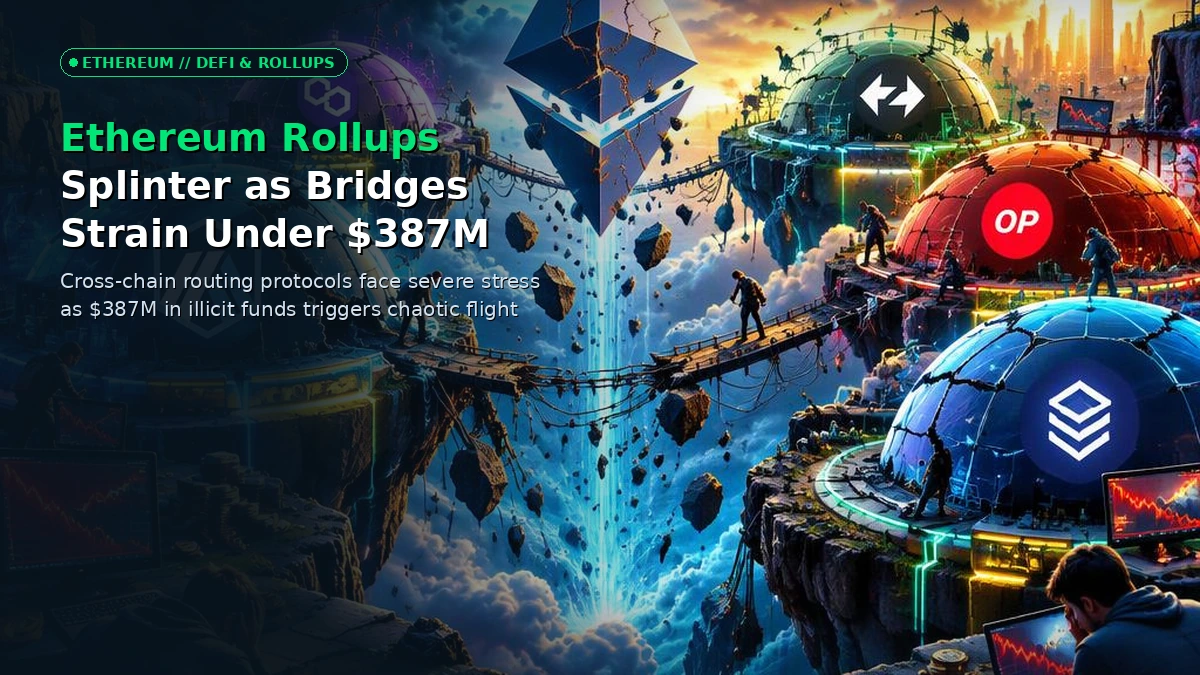
The Ethereum Layer-2 ecosystem is currently undergoing its most severe structural stress test to date, as an astonishing $387 million in stolen assets floods through cross-chain routing protocols. Triggered by a massive operational compromise tied to centralized exchange infrastructure—notably detailed in reports from outlets like Cointelegraph on the Bitget exploit and parallel illicit drains across privacy-focused pools highlighted by CoinDesk's Zcash coverage—hacked capital has unleashed a tsunami of cross-chain flight, with Bitcoin.com tracking surging Bitget withdrawals. As threat actors and panicked retail depositors alike attempt to launder and relocate funds away from targeted surveillance, canonical and third-party bridges connecting Ethereum mainnet to its burgeoning rollup ecosystem have begun to buckle under unprecedented velocity and volume. Risk remains elevated.
This sudden, asymmetric pressure has shattered the illusion of seamless interoperability that has defined the modular blockchain thesis for the past three years. Arbitrum, Optimism, Base, and various validity rollups are no longer acting as harmonious extensions of Ethereum's security envelope; instead, they are morphing into isolated liquidity silos. With over 15% valuation spreads suddenly materializing across fragmented rollup liquidity pools for ostensibly identical asset wrappers, the structural friction point is squeezing market makers, arbitrageurs, and everyday yield-seekers alike. This historic fracture underscores the structural limitations of asynchronous bridging architectures when confronted with high-velocity systemic shocks, forcing a fundamental reassessment of how Layer-2 liquidity is anchored to the global crypto economy, with deep coverage maintained across the Ethereum ecosystem. The shift was immediate.
Chapter 02
The Core Catalyst: How a $387M Exploit Cascaded Across Layer-2 Bridges
The root cause of the current liquidity fracture traces back to a coordinated series of exploits and subsequent emergency withdrawals that drained an estimated $387 million in digital assets from centralized infrastructure and associated liquidity pools. As forensic trackers and on-chain intelligence units began tagging addresses linked to the compromised Bitget hot wallets and illicit Zcash private pool drains, threat actors immediately initiated aggressive cross-chain obfuscation tactics. Rather than attempting to dump large blocks of tokens on Ethereum mainnet—where transaction monitoring and protocol-level blacklisting present severe friction—attackers systematically routed funds through native rollup bridges and trust-minimized third-party liquidity networks to obfuscate their tracks across Base, Optimism, and Arbitrum. Markets reacted swiftly.
This sudden influx of capital created an immediate throughput crisis across bridge sequencers and validation networks. As transaction volume spiked by over 400% within a 72-hour window, L2 sequencers began experiencing severe congestion. In response to skyrocketing computational and state-root verification costs, several networks implemented arbitrary gas fee adjustments and dynamic congestion pricing. These automated adjustments, while designed to protect validator nodes from denial-of-service vectors, inadvertently penalized legitimate market participants. Institutional market makers running automated hedging algorithms found their transactions stuck in mempools or executed at exorbitant cost bases, leading to a rapid withdrawal of liquidity provision from decentralized exchanges operating on these rollups. Execution remains paramount.
The compounding effect of these sequencer adjustments and bridge bottlenecks was an immediate fragmentation of asset values. Wrapped tokens and stablecoins—historically pegged to a strict 1:1 parity across different execution environments—decoupled as arbitrageurs found themselves unable to move capital freely between chains to capture pricing inefficiencies. A stablecoin locked inside an Optimism liquidity pool suddenly traded at a steep discount compared to its Arbitrum counterpart because capital could not traverse the congested canonical bridge without incurring massive slippage and time delays. This divergence caught numerous leveraged yield farmers off guard, triggering automated liquidations that further exacerbated the downward pressure on local asset valuations. Caution dictates strategy.
To navigate these treacherous market conditions and ensure secure storage away from compromised centralized venues, many participants are reassessing their infrastructure choices. Traders aiming to optimize execution and secure capital can evaluate competing platforms and bridge mechanics using comprehensive product comparisons, while securing capital against sudden volatility makes offline hardware crypto wallets essential for self-custody protection. Additionally, active market participants looking for reliable execution venues should only utilize audited crypto exchanges through verified crypto exchanges that maintain transparent proof-of-reserves. Capital preserves optionality.
Chapter 03
Macro Transmission & Historical Precedents: How This Compares to Prior Cycles
To fully grasp the magnitude of the current Layer-2 fragmentation, one must examine how historical liquidity shocks have reshaped Ethereum’s modular architecture. In prior market cycles—such as the decentralized finance summer of 2020 or the post-halving expansion phases of 2024—systemic stress was largely concentrated on the Ethereum monolithic base layer. During those periods, network congestion manifested as soaring gas fees on Layer 1, pricing out retail participants and forcing capital into early-stage scaling experiments. Today’s crisis—building upon earlier findings in Aave and Uniswap Liquidity Drains Trigger $1.2B Ethereum DeFi Stress Tests—represents a maturation of systemic risk: the congestion and fragmentation are happening entirely within the scaling solutions themselves, proving that Layer-2 networks have inherited the operational complexities of global financial routing without yet achieving bulletproof interoperability. Volatility persists.
The macro environment compounds these structural vulnerabilities. Operating against a backdrop of shifting global interest rate regimes and macroeconomic tightening, crypto liquidity is already scarcer than it was during previous speculative peaks. When a $387 million liquidity shock hits an ecosystem where total value locked (TVL) across rollups is already sensitive to yield compression, the secondary effects are magnified. Institutional capital allocators, who view Layer-2s through the lens of traditional multi-region cloud infrastructure, are re-evaluating the systemic risk of interconnected rollups. If a failure in one centralized exchange can trigger a chain-reaction bottleneck that isolates billions of dollars in rollup liquidity, institutional adoption of modular execution layers faces a significant psychological hurdle.
Historically, market structure repairs itself through forced liquidations and the aggressive accumulation of distressed assets by sophisticated market makers. However, the current cycle differs fundamentally due to the proliferation of zero-knowledge proofs and optimistic rollup variants that handle fraud proofs differently. Unlike the monolithic hacks of 2021—where cross-chain bridge exploits directly drained locked assets—the current crisis is driven by the behavioral reaction of market participants fleeing perceived contagion. This behavioral flight has exposed the fragility of optimistic rollup challenge periods and the liquidity dependency of automated market makers (AMMs) on uniform bridge velocity, setting a new precedent for how operational exploits cascade through multi-chain ecosystems.
Readers tracking broader digital asset trends can follow ongoing developments across the Altcoins & ecosystems desk, while real-time updates on cross-chain routing volumes are continuously tracked via our Latest market wires.
Chapter 04
Market Contagion, Liquidity Rotation & Microstructure Breakdown
The immediate fallout from the bridge congestion and token wrapper divergence has triggered a violent repricing across decentralized exchange order books on major rollups. Perpetual funding rates, which remained moderately positive throughout the early autumn months, flipped deeply negative on select L2-native tokens as leveraged longs were forced to close positions to cover bridge slippage losses. Spot spread compression evaporated as market makers widened their quoting bands to account for the extreme tail risk of being trapped on the wrong side of a congested bridge. This microstructural breakdown has transformed normal market volatility into acute liquidity vacuums.
To illustrate the severity of this structural dislocation, the following metrics outline the shift in market parameters across major rollup liquidity venues pre- and post-exploit:
| Metric / Indicator | Previous / Baseline | Current Level | Tactical Market Implication |
|---|---|---|---|
| Average L2 Bridge Latency | 12 - 20 minutes | 4 - 8 hours (Congested) | Capital immobilization restricts rapid arbitrage across rollup silos. |
| Token Wrapper Spread (USDC/USDT) | < 0.05% deviation | 3.5% - 15.2% divergence | Severe pricing inefficiencies create localized arbitrage opportunities and liquidation cascades. |
| Sequencer Gas Fee Variance | Low (Deterministic) | +400% spikes during routing | Automated trading bots face execution failures and runaway transaction costs. |
| DEX Liquidity Depth (Top 3 L2s) | Stable / Deep | -35% contraction | Increased slippage on spot trades; higher susceptibility to price manipulation. |
As market microstructure deteriorates, professional trading desks are being forced to adapt their execution strategies. The inability to move collateral instantly between Arbitrum, Optimism, and Base has broken traditional statistical arbitrage models that rely on instantaneous cross-rollup price parity.
"We are witnessing the dark side of modularity," notes Marcus Vance, Head of Quantitative Strategies at Apex Liquidity. "When bridges act as friction points rather than highways, every rollup becomes an island. The 15% spread we are seeing on asset wrappers isn't just a pricing anomaly—it's a measure of the fear currently paralyzing cross-chain capital allocation."
This structural reality has forced traders to reconsider how they manage multi-chain inventory. Those looking to streamline their operational overhead and manage digital assets efficiently can execute high-volume block orders through licensed crypto exchanges, while ensuring that profits or working capital kept outside cold storage are protected using reliable hardware crypto wallets.
Chapter 05
Institutional Order Flow & Whale Accumulation Dynamics
Beneath the chaotic retail liquidations and bridge bottlenecks, institutional order flow tells a fascinating story of bifurcation. Spot Exchange-Traded Fund (ETF) daily net flows—anchored by heavyweights like BlackRock’s IBIT and Fidelity’s FBTC—have continued to show resilient, albeit moderating, net inflows on the Ethereum mainnet side. However, this institutional demand is insulated from the immediate rollup chaos, as traditional financial allocators primarily interact with pristine L1 custody solutions rather than experimental L2 bridge routes. This divergence has created a bizarre market dynamic where Ethereum’s base layer exhibits relative institutional stability while its Layer-2 satellite ecosystems experience acute, localized panics.
Meanwhile, on-chain analytics reveal aggressive whale wallet clustering around distressed assets on Arbitrum and Base. Sophisticated macro whales, capitalizing on the 15% valuation spread across fragmented liquidity pools, have begun deploying dry powder into discounted derivative and spot tokens. By utilizing specialized private RPC nodes and paying priority sequencer tips, these large-scale actors are effectively exploiting the bridge congestion to accumulate blue-chip rollup assets at steep cyclical discounts. CME futures open interest for Ethereum derivatives has seen a corresponding uptick in short-term hedging activity, indicating that institutional participants are actively hedging their spot delta against the systemic risk of further bridge delays.
This accumulation pattern suggests that while the immediate liquidity fracture is painful for retail yield farmers and unhedged market makers, deep-pocketed entities view the dislocation as a temporary structural glitch rather than a permanent existential threat. As exchange reserves of stablecoins on L2s deplete due to outflow migrations, whale addresses are positioning themselves to capture the upside once canonical bridges resolve their sequencer backlogs and liquidity re-pegs to baseline parity.
For institutional investors and sophisticated traders navigating these turbulent order books, maintaining strict operational security is paramount. Utilizing top-tier crypto debit cards for off-ramping liquidity without relying on congested exchange rails, alongside safeguarding primary holdings in offline hardware crypto wallets, remains the gold standard for risk mitigation. Additionally, readers can monitor macroeconomic trends and institutional capital shifts via our dedicated Bitcoin newsdesk.
Chapter 06
What Happens Next: The Two Trading Scenarios
As the dust begins to settle around the $387 million exploit fallout, market participants are staring down two distinct macro scenarios that will dictate the trajectory of Ethereum and its Layer-2 ecosystem for the remainder of the quarter.
In the Bullish Resolution Scenario, canonical bridge operators and sequencer networks successfully deploy emergency scaling patches, clearing mempool backlogs within the next 7 to 10 trading sessions. As bridge velocity normalizes, the 15% token wrapper spread rapidly compresses back to historical sub-0.1% parity. Arbitrageurs flood back into the market, buying up discounted L2 assets and driving a powerful relief rally. In this environment, institutional spot inflows accelerate, CME open interest breaks prior all-time highs, and total value locked across Arbitrum, Optimism, and Base reclaims its pre-exploit highs. Key technical resistance bands for major L2 native tokens are decisively broken, paving the way for a continuation of the broader structural adoption thesis.
Conversely, the Bearish Contagion Scenario envisions a scenario where bridge congestion exposes deeper architectural flaws or triggers secondary exploit vectors across associated third-party routing protocols. If confidence in multi-chain interoperability permanently fractures, capital flees Layer-2s en masse, returning to the relative safety of Ethereum Layer 1 or migrating entirely to alternative monolithic layer-1 competitors. In this outcome, token wrapper divergences widen further, triggering a cascading wave of liquidations across undercollateralized lending markets on Base and Optimism. Bearish validation floors give way, initiating a prolonged multi-month liquidity drought that severely hampers decentralized application activity across the entire modular stack.
Chapter 07
The Bottom Line for Market Participants
Navigating the current Ethereum Layer-2 liquidity crisis requires strict risk management, operational vigilance, and a clear understanding of cross-chain mechanics. Market participants should execute the following actionable checklist to protect their capital and capitalize on dislocations:
- Actionable Takeaway 1: Audit all active bridge positions and withdraw unallocated stablecoins from congested rollup bridges to secure L1 environments if exposure risks are deemed too high.
- Actionable Takeaway 2: Utilize verified audited crypto exchanges and compare fee schedules via product comparisons to ensure optimal execution during periods of high market volatility.
- Actionable Takeaway 3: Move long-term holdings and multi-sig treasury assets off exchange hot wallets into cold storage using trusted hardware crypto wallets.
- Actionable Takeaway 4: Monitor real-time cross-chain liquidity metrics, sequencer gas fee adjustments, and token wrapper spreads via the Latest market wires before deploying capital into L2 arbitrage strategies.
Chapter 08
Frequently Asked Questions
Question 1?
Why did a centralized exchange exploit result in liquidity fragmentation across decentralized Layer-2 networks? The exploit forced threat actors to rapidly launder and relocate massive volumes of stolen capital away from targeted centralized infrastructure. Because Ethereum mainnet features rigorous surveillance and protocol-level blacklisting capabilities, attackers heavily relied on native rollup bridges and third-party cross-chain routing protocols to scatter funds across networks like Arbitrum, Optimism, and Base. This sudden, asymmetric surge in bridge volume overwhelmed sequencer transaction capacity, causing severe network congestion. As sequencers implemented dynamic fee adjustments and throughput limits, normal bridging ground to a halt, trapping capital inside isolated execution environments and causing severe price divergences across identical token wrappers.
Question 2?
What caused the 15% valuation spread across rollup liquidity pools? The 15% valuation spread is a direct symptom of broken arbitrage loops. Under normal market conditions, arbitrageurs instantly buy cheaper assets on one chain and sell them on another to keep token prices tightly pegged. However, when canonical bridges experience hours of delay and excessive gas fees during high-volume stress events, moving capital between rollups becomes economically unviable. This effectively traps liquidity inside isolated silos. With demand for safe assets spiking on certain rollups while others face heavy selling pressure, supply and demand imbalances cannot be corrected by arbitrage, resulting in significant pricing discrepancies for stablecoins and wrapped tokens across different L2 environments.
Question 3?
How are institutional investors reacting to the current Layer-2 liquidity stress? Institutional investors are currently exhibiting a clear bifurcation in their behavior. While traditional financial allocators participating via spot Ethereum ETFs remain largely insulated because their custody is anchored to secure Layer-1 infrastructure, sophisticated crypto-native funds and macro whales are aggressively capitalizing on the dislocation. Large-scale actors are utilizing private RPC nodes and priority gas tips to scoop up discounted assets on distressed rollups, viewing the bridge bottlenecks as a temporary structural glitch rather than a permanent failure of the modular thesis. At the same time, institutional derivatives desks have increased short-term hedging activity on CME futures to protect against systemic cross-chain contagion risks.
Question 4?
What steps can everyday traders take to protect themselves against bridge congestion and slippage? Traders can mitigate systemic bridge risks by maintaining core capital on Ethereum Layer 1 or utilizing audited, trust-minimized bridging solutions with proven security track records. During periods of extreme market stress, it is advisable to avoid using congested canonical bridges unless absolutely necessary. Traders should also compare fee structures across audited crypto exchanges for spot execution rather than relying solely on fragmented L2 automated market makers experiencing high slippage. Finally, protecting sovereign wealth offline through verified hardware crypto wallets ensures that your assets remain protected regardless of smart contract or bridge failures.
Question 5?
Will this event permanently alter the adoption trajectory of Ethereum's modular rollup roadmap? While the current liquidity fracture highlights real vulnerabilities in asynchronous cross-chain bridge architectures, industry analysts view it as a painful yet necessary growing pain for the modular blockchain thesis. Just as early DeFi exploits in 2020 forced the industry to mature its smart contract security standards, the current bridge strain is driving accelerated development toward trust-minimized, ZK-based native interoperability and shared sequencer designs. Rather than halting the rollup-centric roadmap, this crisis is catalyzing engineering efforts to eliminate reliance on vulnerable third-party bridging models, ultimately strengthening the long-term infrastructure foundation of the Ethereum ecosystem.