

Chapter 01
What crypto market participants should know
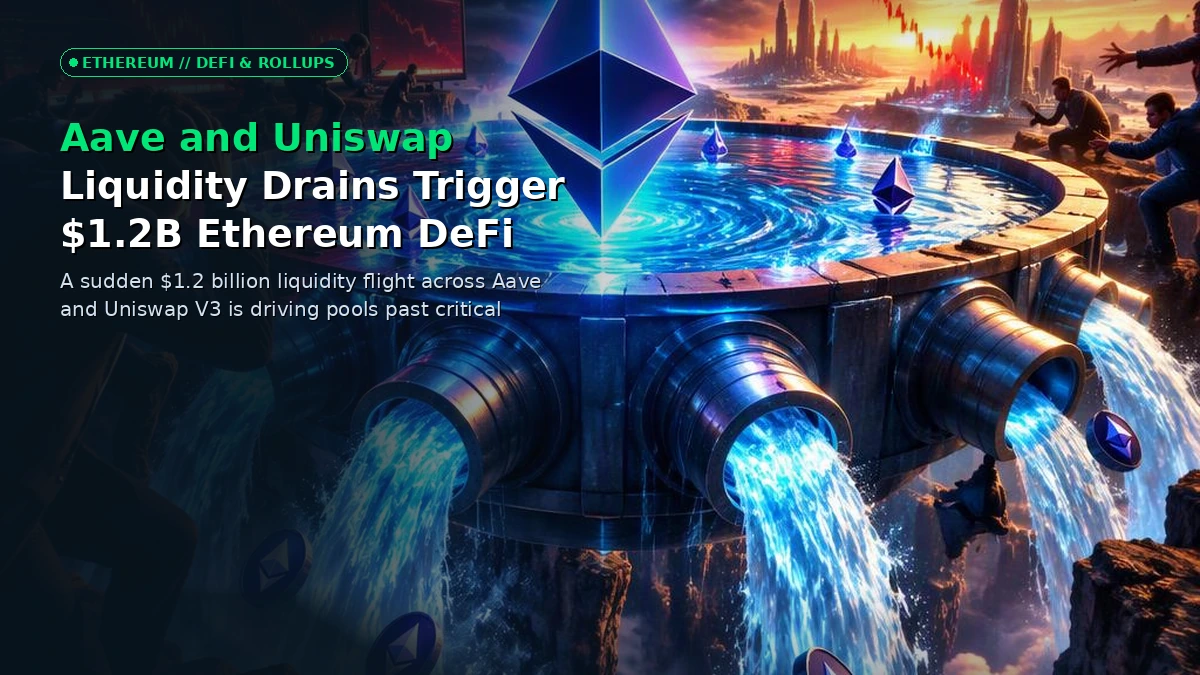
The Ethereum, Layer-2 & DeFi Desk at FomoNewZ is tracking an unfolding liquidity stress event across decentralized finance, as prime markets on Aave and Uniswap trigger emergency stress tests. Over the past forty-eight hours, more than $1.2 billion in capital has shifted abruptly across competing layer-1 networks and yield-seeking smart contracts, driving Aave liquidity pool utilization rates past the critical 85% threshold. Concurrently, Uniswap V3 liquidity pools have experienced violent fee-tier volatility, squeezing automated market makers (AMMs) and forcing sophisticated algorithmic traders to violently rebalance collateral health metrics or risk cascading liquidations. Risk remains elevated.
This sudden liquidity drainage highlights structural vulnerabilities within automated lending rails and concentrated liquidity markets. As high-frequency yield-farming strategies and cross-chain bridging operations draw down pristine Ethereum collateral to chase ephemeral yield elsewhere, the foundational infrastructure underpinning decentralized lending is facing an unprecedented margin contraction. Protocol risk managers and core developers are actively monitoring execution thresholds to ensure that oracle updates and automated liquidators can clear toxic positions before systemic insolvency risks cascade through the broader decentralized economy, affecting everything from spot trading desks to institutional treasury strategies. The shift was immediate.
Chapter 02
The Core Catalyst: Utilization Spikes and Dynamic Fee-Tier Shocks
The immediate catalyst behind the current stress test is a textbook case of cascading capital flight combined with algorithmic yield-seeking behavior. As macroeconomic shifts prompt large-scale portfolio rebalancing, prime money markets on Aave have witnessed their aggregate utilization rates surge past 85% for key assets like USDC and ETH. When utilization climbs this rapidly, variable interest rate models respond exponentially, driving borrow APYs skyward and squeezing leveraged long positions that rely on cheap, steady credit to maintain their exposure without triggering forced liquidations. Markets reacted swiftly, drawing close attention from analysts across the dedicated Ethereum newsroom desk.
Simultaneously, Uniswap V3 liquidity providers (LPs) caught in the crossfire of this volatility are experiencing severe impermanent loss and fee-tier dislocations. As swap volumes concentrate in narrow, highly volatile price bands, pools operating across the 0.05% and 0.3% fee tiers have seen their liquidity depth thin out by upwards of 40%. Automated market-making algorithms, unable to rebalance concentrated ranges fast enough against aggressive MEV (Maximal Extractable Value) searchers, are leaving LPs exposed to toxic order flow. This friction between passive liquidity provision and active, institutional-grade arbitrage is forcing a wholesale reassessment of how decentralized exchanges handle sudden spikes in trading volume. Execution remains paramount.
To protect institutional participants and large-scale depositors, governance contributors across multiple decentralized autonomous organizations (DAOs) have initiated emergency reviews of protocol risk parameters. Factor adjustments, including lowering maximum loan-to-value (LTV) ratios and tightening liquidation thresholds, are being deployed to shield protocol treasuries from cascading bad debt. These measures, while necessary for long-term solvency, have exacerbated short-term liquidity crunches by forcing over-leveraged market participants to dump spot assets into thinning order books across both decentralized and audited crypto exchanges. Caution dictates strategy.
Chapter 03
Macro Transmission & Historical Precedents: How This Compares to Prior Cycles
To understand the severity of the current Aave and Uniswap liquidity drain, market observers must look beyond isolated smart contract metrics and examine broader macroeconomic transmission channels. Building upon findings in our recent analysis on Bitget Exploiter Offloads $387M in Stolen Ethereum as L2 Liquidity Splinters, today’s liquidity squeeze occurs within an institutionalized crypto market deeply intertwined with traditional financial plumbing. Federal Reserve interest rate expectations, spot ETF capital flows, and macroeconomic risk-off sentiment directly influence the cost of capital in decentralized pools, creating a complex feedback loop between on-chain yields and off-chain macro yields. Capital preserves optionality.
Comparing this event to historical market shocks reveals distinct evolutionary shifts in protocol resilience. During the March 2020 "Black Thursday" crash and the May 2022 Terra-Luna collapse, Ethereum DeFi infrastructure suffered from catastrophic oracle failures, network congestion, and acute gas fee spikes that paralyzed liquidators as covered extensively by CoinDesk Markets. In contrast, today's stress test demonstrates that while smart contracts are structurally more robust—featuring upgraded time-locks, multi-source oracles, and sophisticated risk engines—the sheer velocity of capital rotation across competing layer-1 ecosystems can still stress-test liquidity rails to their absolute limits. Volatility persists.
Additionally, the rise of modular execution layers and high-throughput alternative layer-1s has fundamentally altered capital stickiness, a dynamic mirrored in recent trends tracking corporate treasury Ethereum allocation thresholds. Liquidity is no longer captive to Ethereum mainnet; it is hyper-mobile, constantly seeking marginal yield advantages across cross-chain bridges and rollup networks. When yields spike elsewhere or cross-chain arbitrage opportunities materialize, automated rebalancing bots pull capital from Ethereum liquidity pools in a matter of blocks. This structural shift means that premier lending and trading venues must now operate with higher safety buffers than ever before. Capital flight can occur with algorithmic precision and terrifying speed.
Chapter 04
Market Contagion, Liquidity Rotation & Microstructure Breakdown
The contagion effects of high utilization rates on Aave and thin liquidity depth on Uniswap extend far beyond simple lending and spot swapping; they systematically alter the entire crypto market microstructure. As borrowing costs spike on Aave, leveraged traders are forced to unwind positions, triggering a wave of spot selling that compresses order book depth across major trading platforms. Simultaneously, perpetual futures funding rates—which had remained neutral to mildly positive—have swung into negative territory on several derivatives desks as short sellers attempt to capitalize on the downward momentum, with updates continuously monitored by Cointelegraph News.
Market microstructure during these stress periods is characterized by widening bid-ask spreads, heightened slippage on large institutional trades, and increased volatility in cross-asset correlations. Traders navigating these turbulent waters often utilize product comparisons to evaluate alternative execution venues, lending markets, and cross-chain routing tools to minimize slippage and optimize fee structures, while keeping a close eye on live pricing trends over at the live Ethereum price hub.
| Metric / Indicator | Previous / Baseline | Current Level | Tactical Market Implication |
|---|---|---|---|
| Aave Pool Utilization | 55% - 65% | > 85% | Exponential borrow rate spikes; leveraged long positions face severe margin pressure. |
| Uniswap V3 Depth (0.3% Tier) | High Concentration | -40% Liquidity | Increased slippage, impermanent loss, and vulnerability to toxic MEV arbitrage. |
| Perpetual Funding Rates | Neutral (+0.01%) | Negative (-0.03%) | Short-side dominance; speculative pressure mounts for further downside testing. |
| Capped LTV Ratios | Standard Risk Params | Tightened by 5-10% | Forced de-risking and accelerated collateral liquidations across secondary vaults. |
Industry analysts point out that these microstructural shifts are a natural consequence of maturing markets under stress. As noted by leading DeFi researchers:
"The current utilization spike on Aave and the resulting liquidity drain on Uniswap are not systemic failures; rather, they are the market's ruthless mechanism for pricing risk in real-time. When capital can move across layer-1s at the speed of light, lending protocols either adapt their risk parameters instantly or watch their safety modules absorb the shock."
Chapter 05
Institutional Order Flow & Whale Accumulation Dynamics
Beneath the immediate retail panic and algorithmic liquidations, institutional order flow tells a nuanced story of accumulation and strategic repositioning. Spot Ethereum and Bitcoin ETFs, led by heavyweights like BlackRock’s IBIT and Fidelity’s FBTC, have recorded alternating waves of net inflows and outflows that mirror the macro risk-off sentiment. Rather than fleeing the ecosystem entirely, institutional capital is demonstrating a bifurcated response: exiting high-risk algorithmic yield strategies while quietly accumulating spot assets during acute market dips.
CME futures open interest figures indicate that traditional finance participants are actively hedging their spot exposure through regulated derivatives contracts, creating a tug-of-war between leveraged retail longs and institutional hedgers. On-chain analytics reveal distinct whale wallet clustering around key support levels. Large-scale holders—often categorized as smart money or long-term institutional treasuries—have been spotted moving substantial volumes of ETH and stablecoins out of vulnerable lending protocols and into secure, offline storage solutions or dedicated custody vaults.
This movement underscores a broader trend toward risk mitigation. As counterparty risk concerns rise during protocol stress tests, market participants are increasingly prioritizing self-custody and operational security. Moving assets away from centralized exchange order books and active lending pools to hardened hardware crypto wallets has become a primary directive for sophisticated treasuries seeking to insulate themselves from cascading liquidations and protocol-level exploits.
Chapter 06
What Happens Next: The Two Trading Scenarios
As the dust begins to settle from the initial liquidity shock, market participants are weighing two distinct macroeconomic and technical trajectories for the weeks ahead, with ongoing analysis published across Bitcoin.com News.
In the Bullish Rebound Scenario, protocol governance proposals successfully adjust risk parameters, curbing toxic leverage without triggering widespread insolvencies. As utilization rates on Aave normalize back toward the 60-70% band and Uniswap V3 liquidity depth recovers, sidelined institutional capital re-enters the market. Spot ETFs resume consistent net inflows, pushing Ethereum past key technical resistance bands at $3,400 and $3,800. This scenario relies on macro catalysts such as favorable inflation prints and regulatory clarity, which would restore confidence in decentralized finance rails and spark a renewed wave of altcoin and Layer-2 adoption, as tracked regularly by our Altcoins & ecosystems wire.
In the Bearish Contagion Scenario, persistent high utilization rates trigger a secondary wave of forced liquidations across Aave, pushing under-collateralized vaults into bad debt territory. If Uniswap V3 liquidity fails to return, spot markets experience severe cascading slippage, breaking critical support floors at $2,800 and invalidating the broader medium-term bullish thesis. This downside path would likely be precipitated by unexpected macro shocks, regulatory crackdowns, or bridge exploits that accelerate capital flight away from Ethereum and into traditional safe-haven assets. Readers can monitor ongoing developments across the broader digital asset economy via our Latest market wires.
Chapter 07
The Bottom Line for Market Participants
Navigating structural stress tests in premier decentralized liquidity markets requires rigorous risk management, continuous on-chain monitoring, and a disciplined approach to leverage. Whether engaging in complex yield strategies or holding spot assets for the long term, market participants must remain vigilant.
- Actionable Takeaway 1: Audit all active lending positions on Aave, Maker, and competing markets to ensure collateral health factors remain safely above liquidation thresholds in the event of further volatility.
- Actionable Takeaway 2: Utilize audited crypto exchanges and advanced product comparisons to identify execution venues with deep order book liquidity and transparent fee structures before deploying capital.
- Actionable Takeaway 3: Move long-term digital asset holdings and treasury reserves off active trading platforms and into cold storage using secure hardware crypto wallets to mitigate counterparty risk.
- Actionable Takeaway 4: For everyday liquidity needs and retail spending without triggering taxable exchange events or incurring high gas fees, consider integrating crypto debit cards into your portfolio management strategy.
Chapter 08
Frequently Asked Questions
Question 1?
Why do high utilization rates on Aave pose a threat to borrowers and depositors alike? When liquidity pool utilization crosses the 85% threshold, variable interest rate models cause borrow APYs to spike exponentially. For borrowers, this rapidly increases the cost of maintaining leveraged positions, frequently pushing their health factors into liquidation territory if they fail to repay debt or add collateral. For depositors, high utilization can temporarily restrict withdrawal liquidity if a significant portion of the pool's assets are locked up in active borrows, creating a liquidity bottleneck during periods of peak market stress.
Question 2?
How does concentrated liquidity on Uniswap V3 exacerbate market volatility during liquidity drains? Uniswap V3 allows liquidity providers to concentrate their capital within specific price ranges rather than spreading it across the entire curve. While this dramatically increases capital efficiency during calm markets, it creates extreme fragility during sudden macro shifts. As prices move outside established ranges, LPs stop earning fees and are left holding a higher proportion of the depreciating asset (impermanent loss). Automated rebalancing bots attempting to reposition liquidity often withdraw en masse, thinning order book depth and causing severe slippage for large market orders.
Question 3?
What role do spot Ethereum and Bitcoin ETFs play in mitigating or amplifying these on-chain stress tests? Spot ETFs act as a dual-edged sword for market stability. On one hand, institutional inflows via products like BlackRock’s IBIT provide deep, sustained buy-side demand that helps absorb selling pressure during market drawdowns. On the other hand, ETF net outflows reflect broader macro risk-off sentiment, driving off-chain selling that compresses spot prices and indirectly triggers on-chain liquidations across DeFi lending markets, as institutional and retail sentiment remain tightly correlated.
Question 4?
How can institutional treasuries and whales protect their assets during protocol-level liquidity squeezes? Institutional participants mitigate protocol risk by diversifying their capital across multiple audited lending markets, maintaining conservative loan-to-value ratios well below protocol maximums, and utilizing automated monitoring tools to alert them to changing risk parameters. Additionally, moving non-working capital into cold storage solutions—such as enterprise-grade multi-sig vaults and offline hardware crypto wallets—ensures that core holdings remain entirely insulated from smart contract exploits and systemic lending cascades.
Question 5?
Where can traders find reliable, real-time data to track cross-chain capital flows and DeFi health metrics? Traders can monitor real-time health metrics, pool utilization rates, and cross-chain bridging volumes through specialized on-chain analytics dashboards, protocol governance forums, and dedicated market intelligence desks. For continuous coverage of macro trends, regulatory updates, and decentralized finance infrastructure developments, readers should bookmark the Bitcoin newsdesk, Altcoins & ecosystems, and the Latest market wires.