

Chapter 01
Issued assets are IOUs, not native protocol tokens
The XRP Ledger supports two distinct categories of value: the native protocol asset (XRP) and issued assets (often called IOUs or issued tokens). XRP exists purely on the ledger with no counterparty risk and no issuer controls. Any other asset—whether a fiat-backed stablecoin, a tokenized commodity, or an ecosystem community token—is an issued asset created by an issuing account.
An issued asset represents a bilateral debt relationship. When an account holds 1,000 USD or 1,000 RLUSD issued by a gateway, the ledger records that the issuing account owes that balance to the holder. The value and safety of that token do not derive from the XRPL consensus algorithm; they depend entirely on the issuer’s creditworthiness, regulatory standing, legal terms, and off-chain reserve backing.
Chapter 02
How trust lines work: credit limits and reserve requirements
Because issued assets represent counterparty risk, an XRPL account cannot be forced to receive an arbitrary token without consent. An account can only hold an issued token if it explicitly establishes a Trust Line to that specific issuing account.
A trust line is created using a TrustSet transaction. When creating a trust line, the holder specifies: - The currency code (a 3-character ASCII string like USD or a 160-bit hex representation). - The exact address of the issuing account. - The Limit Amount: the maximum balance of this token that the holder is willing to accept.
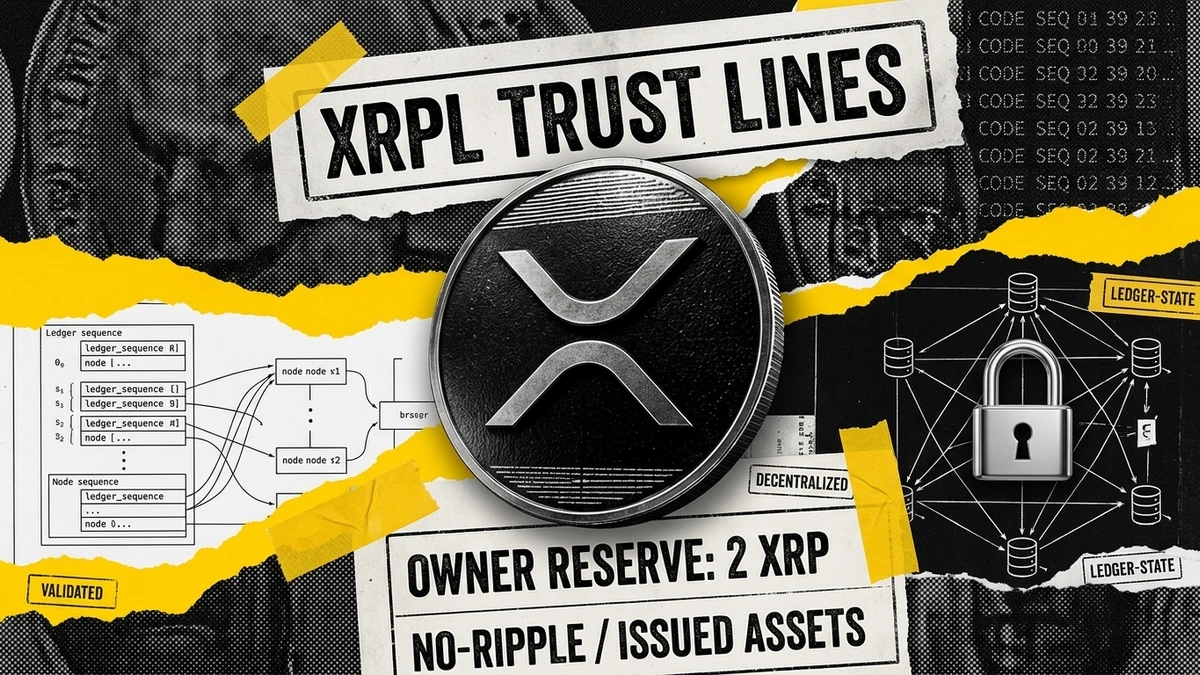
Establishing a trust line consumes an owner reserve on the holder's account (currently locking 2 XRP). If an account does not hold sufficient available XRP above its base reserve, it cannot create new trust lines. If the holder later disposes of all tokens and sets the trust line limit back to zero, the owner reserve of 2 XRP is unlocked.
Chapter 03
Issuer controls: Global Freeze, Individual Freeze, and Authorized Trust Lines
The XRP Ledger provides built-in compliance and risk-management flags for asset issuers. While essential for regulated financial institutions issuing stablecoins, these features also grant issuers substantial administrative power:
- Global Freeze (asfGlobalFreeze): An issuing account can freeze all outstanding trust lines for its issued currency at once. When a global freeze is active, no accounts can trade or transfer that token across the network, though holders can still send tokens directly back to the issuer.
- Individual Freeze: An issuer can freeze a specific account's trust line, preventing that individual user from transferring or trading their token balance while other users remain unaffected.
- No Freeze (asfNoFreeze): An issuer can permanently forfeit its ability to freeze funds by enabling the NoFreeze flag. This action is cryptographically irreversible; once set, neither the issuer nor anyone else can ever freeze tokens issued by that account.
- Authorized Trust Lines (asfRequireAuth): An issuer can require explicit authorization before any account can hold its token, creating a closed-loop or permissioned environment.
Holders should always verify whether an issuer has enabled NoFreeze or retains freeze authorities before acquiring issued tokens.
Chapter 04
The rippling setting and cross-account liquidity paths
A foundational feature of XRPL trust lines is Rippling. Rippling allows accounts that hold balances from the same issuer to settle payments through intermediate accounts. While powerful for currency gateways facilitating liquidity, rippling can create unexpected counterparty exposure for ordinary retail holders.
If Alice holds USD from Gateway A and has rippling enabled, Bob can send USD from Gateway A to Charlie using Alice's account as an intermediary settlement hop. While Alice’s net balance remains unchanged, her trust line exposure could be shifted across different credit lines if multiple issuers are involved. To prevent this, non-issuing accounts should unconditionally ensure that the NoRipple flag is enabled on all their trust lines.
Chapter 05
Checklist before setting a trust line on XRPL
Before signing a TrustSet transaction to acquire any issued token on XRPL:
1. Obtain the issuer account address from official project documentation; never trust a link or address copied from social media. 2. Verify the issuer’s account flags on a public explorer: does the account retain individual freeze or global freeze powers? 3. Confirm that NoRipple is enabled on your side of the trust line to prevent your balance from acting as an intermediary liquidity bridge. 4. Remember that each active trust line locks 2 XRP of your available ledger reserve. 5. Review our parent XRP news desk and stablecoin reserve verification guide for deep dives into regulated on-chain assets.
Chapter 06
TrustSet transaction mechanics and reserve requirements
Tokens on the XRP Ledger (such as issued currencies, fiat stablecoins, and community tokens) are issued directly through native protocol trust lines rather than through independent, third-party smart contracts. An account cannot receive an issued asset unless the account owner has explicitly submitted a "TrustSet" transaction establishing a cryptographically authorized credit relationship with the issuing account.
A TrustSet transaction specifies: - TransactionType: TrustSet - Account: rUserAccountAddress... - LimitAmount: currency code (3-character ISO or 40-character hex), issuer address, and maximum balance ceiling - Fee: base network fee in drops
Establishing a trust line consumes ledger state and therefore requires the account to lock an owner reserve (currently 2 XRP) per active trust line. This reserve remains locked for the duration of the trust line's existence. Once an account's token balance returns to zero, the user can submit a new "TrustSet" transaction setting the limit to zero, which permanently deletes the trust line from the ledger state and immediately unlocks the 2 XRP owner reserve back into the liquid balance.
Chapter 07
The Global Freeze, Individual Freeze, and No Ripple flags
The XRPL incorporates robust native compliance and liquidity controls directly at the ledger protocol level:
1. Global Freeze (asfGlobalFreeze): An issuing account can enable a global freeze to halt all transfers of its issued tokens across the entire network simultaneously. While frozen, accounts can still hold the token, but cannot trade, send, or redeem it. Global freezes are commonly utilized during security breaches, smart contract migrations, or regulatory compliance freezes. 2. Individual Freeze (asfIndividualFreeze): An issuer can freeze the trust line of a specific counterpart account without affecting other token holders, typically executed in response to legal court orders or identified fraudulent activity. 3. No Freeze Permanence (asfNoFreeze): Token issuers who wish to prove that their tokens can never be frozen or censored can enable the immutable "asfNoFreeze" flag. Once enabled, the freeze capability is permanently destroyed for that issuing account and cannot be restored under any circumstances. 4. No Ripple Flag (asfDefaultRipple): Prevents third-party balances from being automatically routed or "rippled" across unrelated accounts, protecting user privacy and preventing unexpected balance conversions across multiple credit pathways. Understanding these flags allows users to assess the counterparty risk of any XRPL asset before establishing trust lines.