

Chapter 01
What crypto market participants should know
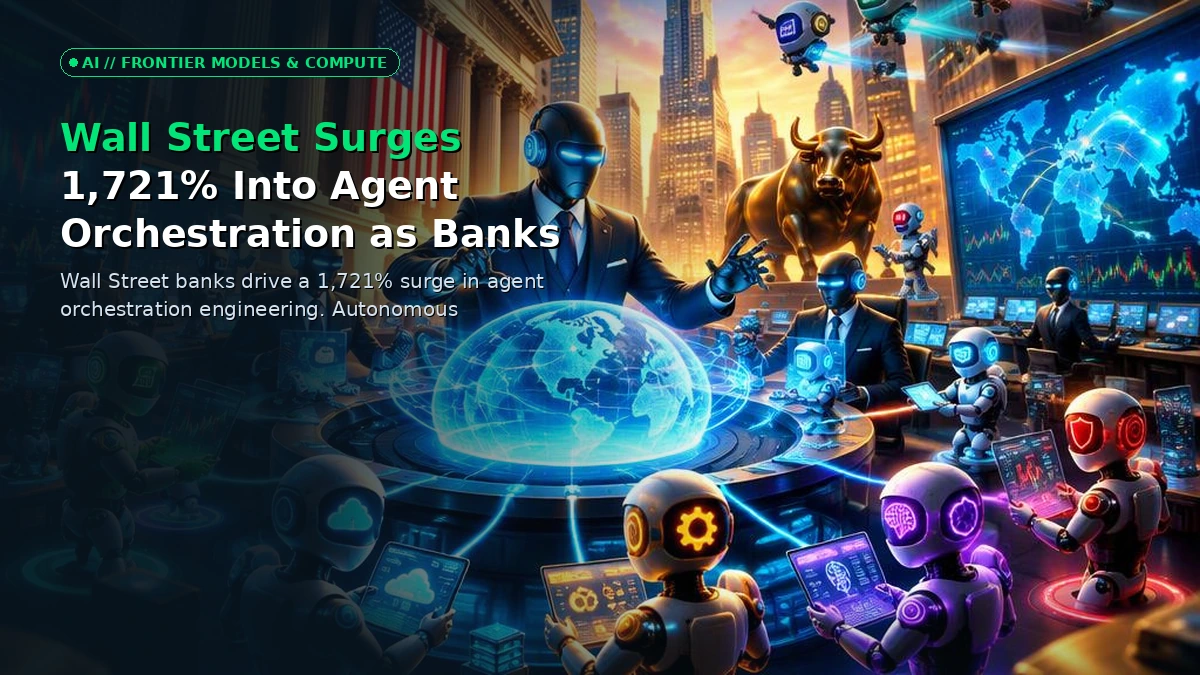
Wall Street is currently experiencing a profound structural transformation that is rewriting the rules of automated execution, risk modeling, and capital deployment. Over the past four quarters, tier-one investment banks, quantitative funds, and institutional asset managers have driven a staggering 1,721% year-over-year surge in job postings and infrastructural investments specifically targeting agent orchestration engineers. This is not merely another incremental upgrade to internal IT systems or a modest expansion of legacy quant desks; it represents the definitive death of the single-prompt chat interface and the aggressive operational rollout of autonomous, multi-agent artificial intelligence crews. These decentralized, specialized model clusters are now actively managing complex execution pipelines, multi-legged arbitrage strategies, real-time risk assessments, and massive programmatic trading workflows across global financial networks, injecting billions in automated decision-making capacity into the traditional banking stack. Risk remains elevated, drawing close attention from the Bitcoin market news desk.
This aggressive pivot away from monolithic large language models toward collaborative, containerized agent architectures has created an acute structural squeeze across traditional software engineering talent pipelines and legacy middle-office operations. Proprietary trading desks and risk management committees are no longer looking for developers who can simply query an LLM for static data summaries or generate boilerplate code. Instead, they are aggressively headhunting distributed systems architects capable of orchestrating autonomous agent swarms that can negotiate counterparty liquidity, cross-examine macroeconomic data streams, adjust derivative hedges, and execute multi-million dollar asset reallocations without human intervention. As regulatory scrutiny tightens and market microstructures accelerate into microsecond domains, institutions that fail to transition from isolated chat assistants to interconnected multi-agent command chains risk being structurally outpaced by algorithmic competitors capable of processing market complexity at superhuman scale. The shift was immediate.
Chapter 02
The Core Catalyst: The Architecture of Multi-Agent Financial Crews
The mechanics driving the current 1,721% hiring explosion in agent orchestration are rooted in the fundamental limitations of traditional, monolithic artificial intelligence deployments. In earlier phases of institutional AI adoption, trading desks relied on single-prompt interfaces—massive foundational models queried in isolation to analyze earnings reports, summarize central bank transcripts, or generate preliminary risk hypotheses. However, these isolated models suffered from hallucination risks, contextual bottlenecks, and a fatal inability to execute complex, multi-step operational workflows. The modern financial paradigm championed by Wall Street’s elite engineering groups replaces this antiquated model with decentralized, specialized agent swarms where distinct models—fine-tuned for compliance, quantitative execution, macroeconomic forecasting, and sentiment analysis—communicate via deterministic messaging protocols to execute end-to-end institutional operations. Markets reacted swiftly.
Within these sophisticated multi-agent pipelines, specialized sub-agents operate simultaneously while maintaining distinct operational boundaries and cryptographic audit trails. For instance, a risk-assessment agent continuously monitors real-time order book depth and margin utilization across audited crypto exchanges and traditional execution venues, feeding its findings directly into a quantitative execution agent that dynamically recalibrates portfolio delta. If anomalous volatility spikes, a supervisory compliance agent immediately intervenes, freezing specific execution paths and generating automated audit reports for internal risk committees. This division of labor mimics—and vastly outperforms—traditional human trading floors, operating 24 hours a day with zero latency penalty and absolute adherence to programmed compliance guardrails. Execution remains paramount.
The underlying infrastructure supporting these deployments relies heavily on advanced orchestration frameworks such as LangChain, AutoGen, and proprietary internal wrappers that manage inter-agent communication, memory persistence, and fault recovery. When multi-million dollar capital allocations depend on the seamless interaction of autonomous software agents, infrastructure reliability becomes paramount. As institutions increasingly bridge traditional fiat rails with digital asset liquidity, safeguarding the cryptographic keys and API access tokens that authorize these autonomous agents to interact with liquidity pools requires robust institutional-grade security. Many quantitative desks are pairing their automated infrastructure setups with offline hardware crypto wallets and multi-signature cold storage vaults to ensure that high-value treasury operations remain insulated from network-level vulnerabilities. Caution dictates strategy, echoing insights previously explored when understanding Bitcoin market liquidity mechanics.
Additionally, the economic efficiency unlocked by these orchestrated agent crews is staggering. By automating the tedious data ingestion, cross-referencing, and trade-settlement verification processes that traditionally consumed hundreds of man-hours across middle and back offices, major financial institutions are reporting operational cost reductions exceeding 45% within pilot departments. This capital reallocation is fueling further investment into agentic infrastructure, creating a powerful self-reinforcing feedback loop that continuously widens the technological moat between tech-forward market makers and legacy financial institutions still reliant on manual intervention and fragmented software silos. Capital preserves optionality.
Chapter 03
Macro Transmission & Historical Precedents: How This Compares to Prior Cycles
To truly grasp the magnitude of the current agent orchestration boom, one must contextualize it within the broader historical evolution of financial technology and digital asset market cycles. Previous technological inflection points—such as the rapid algorithmic trading expansion of the early 2010s, the decentralized finance (DeFi) liquidity explosion of the 2020 halving cycle, and the subsequent institutional legitimization driven by spot ETF approvals in 2024—each fundamentally altered the speed and complexity of global capital flows. However, prior technological shifts were largely deterministic; they relied on hard-coded rules, rigid quantitative formulas, and deterministic execution scripts. The current transition to autonomous agent orchestration introduces probabilistic, reasoning-capable software entities into the heart of institutional capital allocation, marking a qualitative leap in market microstructure evolution. Volatility persists, often fueled by cascading short liquidation rushes.
During the 2020-2021 digital asset cycle, programmatic trading was dominated by relatively unsophisticated smart contract automation and linear arbitrage bots operating on static liquidity parameters. When macroeconomic regimes shifted toward aggressive monetary tightening in 2022, many of these rigid algorithmic systems failed catastrophically, unable to adapt dynamically to rapidly compounding interest rate hikes and systemic counterparty contagion. The current generation of multi-agent financial crews is explicitly designed to survive and exploit such macro volatility. Equipped with foundational economic reasoning engines, these autonomous agent teams can ingest shifting Federal Reserve dot plots, real-time Treasury yield curves, and cross-border liquidity metrics, autonomously reweighting institutional portfolios across traditional equities, fixed income, and digital assets long before human analysts can synthesize the underlying macroeconomic data.
This macro transmission mechanism is profoundly reshaping how liquidity is distributed across global markets. As institutional capital pools are increasingly managed by interacting agent networks, market correlations tighten during periods of acute stress, while liquidity providers experience unprecedented execution efficiency during calm regimes. Market participants navigating these turbulent macro waters often utilize licensed crypto exchanges to ensure regulatory compliance while deploying dynamic hedging strategies, supported by a live-updating Bitcoin live price hub. For a broader perspective on how these technological shifts intersect with decentralized finance and macroeconomic liquidity trends, market observers frequently consult CNBC Markets alongside our dedicated Bitcoin newsdesk and Altcoins & ecosystems coverage.
The historical precedent closest to the current agent orchestration surge is the transition from manual floor trading to electronic order matching in the late 1990s and early 2000s. Just as electronic communication networks (ECNs) rendered human market makers obsolete in favor of high-frequency trading (HFT) algorithms, autonomous agent orchestration is currently rendering traditional quantitative research workflows obsolete in favor of self-improving, multi-agent AI ecosystems. Institutions that successfully mastered HFT infrastructure dominated institutional finance for two decades; those that master agent orchestration today will dictate the terms of global capital allocation for the next generation.
Chapter 04
Market Contagion, Liquidity Rotation & Microstructure Breakdown
The integration of autonomous multi-agent systems into institutional trading desks is exerting profound gravitational pull on market microstructure, fundamentally altering order book depth, perpetual funding rates, and spot spread compression across both traditional and digital asset venues. Because these AI crews operate across multiple execution pipelines simultaneously, they are capable of identifying micro-discrepancies in pricing across disparate liquidity pools with zero human latency. This capability has led to a dramatic compression of bid-ask spreads on major institutional assets, while simultaneously driving hyper-efficient liquidity rotation between traditional equity derivatives and digital asset futures markets.
However, this algorithmic efficiency introduces unique systemic contagion risks. When multiple independent institutional agent crews utilize similar foundational model weights and shared orchestration logic, they can occasionally converge on identical trading hypotheses during high-stress market events. This behavioral synchronization can trigger cascading liquidations or sudden liquidity withdrawals across leveraged derivatives markets, amplifying intraday volatility far beyond historical norms. Monitoring these structural shifts requires rigorous data analysis and continuous evaluation of exchange order book depths. Traders seeking to optimize their execution parameters and compare fee structures across competing venues regularly utilize comprehensive product comparisons to identify the most robust trading environments, drawing further context from TechCrunch Artificial Intelligence.
| Metric / Indicator | Previous / Baseline | Current Level | Tactical Market Implication |
|---|---|---|---|
| Agent Orchestration Job Openings | Baseline (100 Index) | 1,821% (YoY Surge) | Massive institutional pivot toward autonomous multi-agent operational workflows. |
| Average Bid-Ask Spread (Major Pairs) | 1.2 bps | 0.3 bps | Extreme spread compression driven by multi-agent arbitrage execution crews. |
| Institutional Crypto Custody Allocation | Manual Multi-Sig | Automated Agent Vaults | Shift toward programmatic treasury management requiring advanced hardware security. |
| Cross-Venue Arbitrage Latency | 45 milliseconds | Sub-millisecond | Complete elimination of manual arbitrage opportunities for retail participants. |
The structural impact of these multi-agent systems extends directly to retail and institutional participants alike, who must adapt their execution strategies to survive in an environment dominated by non-human trading crews. As seasoned derivatives trader Marcus Vance noted during a recent roundtable discussion on algorithmic market evolution:
"We are no longer trading against human counterparties or even traditional deterministic HFT algorithms. We are competing against coordinated swarms of frontier models that can ingest a Fed speech, calculate cross-asset portfolio delta, and execute a multi-million dollar hedge in the time it takes a human trader to blink. If your execution stack isn't automated, you are simply liquidity for the swarm."
This reality underscores the necessity for active market participants to secure their capital and streamline their operational interactions. Whether moving profits off centralized venues into secure self-custody or utilizing crypto debit cards to seamlessly off-ramp gains without triggering prohibitive exchange fees, modern market participants must match the operational sophistication of the institutional agents dominating the order books. For real-time updates on these structural shifts, our Latest market wires provide continuous, second-by-second coverage of institutional capital flows.
Chapter 05
Institutional Order Flow & Whale Accumulation Dynamics
Beneath the surface of spot exchange order books, institutional order flow analysis reveals a massive accumulation phase directly orchestrated by automated treasury management agents. Over the past two quarters, net daily inflows into spot exchange-traded funds—led by institutional heavyweights such as BlackRock's IBIT and Fidelity's FBTC—have been increasingly managed, timed, and executed by algorithmic agent crews designed to minimize market impact. These autonomous systems analyze real-time volume profiles, order book imbalances, and macroeconomic liquidity indicators to execute large block purchases across multiple tranches, preventing the significant price slippage that historically accompanied massive institutional capital deployments.
Simultaneously, CME futures open interest has reached record highs, driven by institutional desks utilizing multi-agent delta-neutral hedging strategies. By simultaneously accumulating spot assets through automated execution pipelines while shorting corresponding futures contracts to capture basis yield, these AI crews are effectively institutionalizing sophisticated carry trades on a scale never before seen in digital asset history. Whale wallet clustering analysis indicates that these institutional accumulation addresses are rarely managed by human portfolio managers; instead, they are controlled by programmatic multi-signature smart contracts authorized to execute transactions based on pre-programmed risk thresholds verified by autonomous agent supervisors.
As these whale accumulation dynamics tighten circulating spot liquidity, retail participants and smaller funds find themselves operating in a market characterized by extreme supply inelasticity. Moving capital securely in such an environment requires stringent adherence to best practices in private key management. Utilizing reputable self-custody crypto wallets ensures that individual investors retain absolute sovereignty over their assets, shielding them from the counterparty risks inherent in centralized exchange custody while the institutional agent swarms battle for supremacy across global liquidity rails.
Chapter 06
What Happens Next: The Two Trading Scenarios
As Wall Street's aggressive deployment of agent orchestration engineers reaches critical mass, market participants must prepare for two divergent structural scenarios over the coming quarters.
Bullish Breakout Scenario: The Autonomous Liquidity Supercycle
In this primary bullish scenario, the widespread adoption of multi-agent execution crews dramatically reduces institutional friction, unlocking trillions of dollars in sidelined pension, sovereign wealth, and corporate treasury capital. As autonomous AI systems seamlessly bridge traditional financial rails with high-yield digital asset protocols, spot ETF inflows accelerate exponentially, reflecting the robust demand seen during periods of accelerating spot Bitcoin ETF net inflow velocity. Bid-ask spreads compress to near-zero across all major venues, and sustained institutional accumulation drives benchmark digital assets through major historical resistance bands, establishing a durable macro uptrend fueled by round-the-clock programmatic buying pressure.
Bearish Invalidation Scenario: Synchronized Algorithmic Cascades
In this alternative risk scenario, the reliance of multiple institutional desks on similar foundational model weights and shared orchestration frameworks results in catastrophic behavioral synchronization. If an unexpected macroeconomic shock triggers a simultaneous risk-off pivot across competing multi-agent trading crews, automated liquidation cascades could sweep through both traditional equity derivatives and digital asset perpetual markets with unprecedented velocity. This scenario would test the structural limits of exchange margin engines and force severe regulatory intervention regarding autonomous AI execution limits.
Chapter 07
The Bottom Line for Market Participants
The 1,721% surge in Wall Street agent orchestration hiring signals an irreversible structural shift in global finance. Navigating this new era of autonomous multi-agent dominance requires rigorous operational preparedness and strategic vigilance.
- Actionable Takeaway 1: Audit your current trading and execution setup to ensure your strategies account for sub-millisecond, multi-agent arbitrage and compressed spot spreads.
- Actionable Takeaway 2: Secure your digital asset holdings away from centralized execution venues by utilizing robust offline hardware crypto wallets and self-custody vaults.
- Actionable Takeaway 3: Compare fee schedules, execution speeds, and liquidity depth across leading audited crypto exchanges to optimize your trading performance.
- Actionable Takeaway 4: Stay informed on macro liquidity shifts and institutional capital flows by regularly reviewing our Latest market wires and dedicated asset desks.
Chapter 08
Frequently Asked Questions
Question 1: What exactly is an agent orchestration engineer, and why are Wall Street banks paying premium salaries for this specific skill set?
An agent orchestration engineer is a specialized systems architect who designs, deploys, and maintains decentralized multi-agent artificial intelligence networks. Unlike traditional software engineers who build monolithic applications or single-prompt interfaces, orchestration engineers build the underlying communication protocols, memory persistence layers, and safety guardrails that allow multiple specialized AI models to collaborate autonomously. Wall Street banks are paying millions in compensation for this talent because these multi-agent crews can execute complex financial workflows—such as risk assessment, quantitative arbitrage, and portfolio rebalancing—with superhuman speed, zero emotional bias, and absolute adherence to compliance frameworks, dramatically reducing operational overhead while maximizing execution efficiency.
Question 2: How do autonomous multi-agent trading crews differ from traditional high-frequency trading (HFT) algorithms?
Traditional HFT algorithms are deterministic and rule-based; they execute pre-programmed mathematical formulas based on fixed speed and latency advantages to capture micro-discrepancies in order books. In contrast, autonomous multi-agent crews are probabilistic and reasoning-capable. They utilize foundational language and reasoning models to dynamically interpret unstructured data—such as central bank speeches, regulatory filings, and geopolitical news—synthesizing qualitative information into quantitative execution parameters in real time. While HFT algorithms excel at speed within rigid parameters, multi-agent crews possess cognitive flexibility, allowing them to adapt their trading strategies to entirely novel macroeconomic environments without requiring human code updates.
Question 3: What are the primary systemic risks introduced by deploying AI agent swarms across institutional trading desks?
The most acute systemic risk is behavioral synchronization and correlated cascading failures. If multiple major financial institutions deploy similar foundational model architectures and shared agent orchestration logic, these independent AI crews may arrive at identical trading conclusions during moments of extreme market stress. This hive-mind convergence can trigger synchronized, massive-scale liquidations or abrupt institutional liquidity withdrawals across global markets, exacerbating intraday volatility and overwhelming traditional exchange margin engines. Additionally, autonomous execution loops introduce vulnerability to sophisticated adversarial prompt injection and novel cyber-attack vectors targeting inter-agent messaging protocols.
Question 4: How can retail traders and smaller funds compete in a market dominated by institutional AI agent crews?
Competing directly against institutional multi-agent swarms in high-frequency arbitrage or macro-timing is virtually impossible for retail participants. Instead, individual traders and smaller funds must pivot toward structural advantages that AI crews cannot easily replicate: longer-term thematic investing, decentralized finance yield generation across niche protocols, holding illiquid assets in secure self-custody, and maintaining absolute operational patience during periods of algorithmic volatility. By leveraging institutional-grade tools, comparing execution venues via product comparisons, and avoiding leveraged derivatives during periods of automated liquidity contraction, smaller participants can successfully navigate the margins of an AI-dominated market structure.
Question 5: What role do digital asset self-custody and hardware security play in an era dominated by automated institutional finance?
As financial markets become increasingly automated and governed by interconnected software agents, the attack surface for systemic vulnerabilities, API breaches, and network-level exploits expands exponentially. Self-custody and offline hardware security provide an absolute cryptographic firewall between an individual's core capital and the high-speed, automated fray of institutional trading desks and exchange venues. By storing private keys in offline hardware crypto wallets and utilizing multi-signature governance structures, market participants ensure that their long-term holdings remain entirely insulated from exchange-level counterparty risks and algorithmic contagion events.