

Chapter 01
What crypto market participants should know
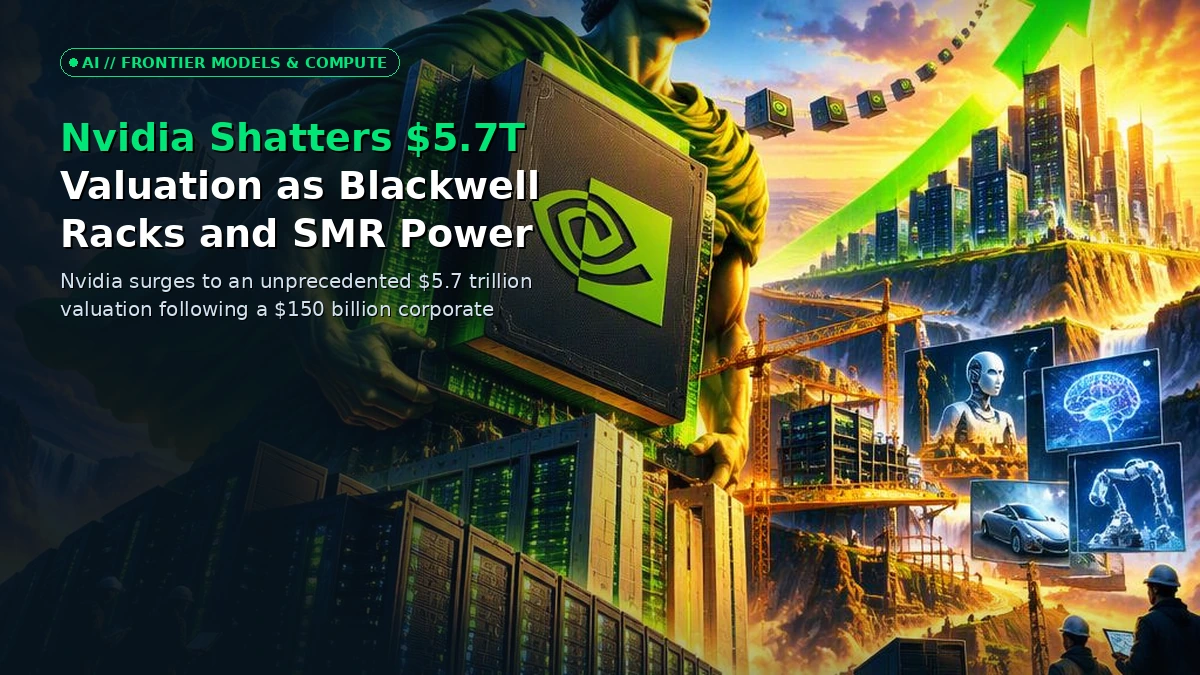
Nvidia’s market capitalization has officially shattered historical boundaries, surging to an unprecedented $5.7 trillion valuation following a potent cocktail of a fresh $150 billion corporate buyback, softening macroeconomic monetary conditions, and an unquenchable global thirst for artificial intelligence compute, as detailed in reports from Decrypt. This breathtaking financial milestone is not merely evidence of Jensen Huang’s silicon empire; it marks the definitive arrival of the infrastructure supercycle, where the physical reality of chip manufacturing meets the brutal limitations of global power grids. As Wall Street institutional desks adjust their models to price in near-infinite AI scaling, the entire technology ecosystem is undergoing a violent structural reallocation of capital away from legacy enterprise software and directly into high-density hardware, advanced packaging, and baseload energy procurement. Risk remains elevated.
The structural friction point now gripping the global markets is no longer whether foundation models can scale to tens of trillions of parameters—it is whether humanity can build, cool, and power the physical machinery required to run them. Hyperscale cloud providers, sovereign AI initiatives, and tier-one data center operators are currently engaged in a frantic capital expenditure arms race, deploying billions of dollars into liquid-cooled Blackwell GB200 server racks while simultaneously bypassing public utilities to lock in direct nuclear Small Modular Reactor (SMR) power purchase agreements, echoing trends covered by CNBC Markets. This bottleneck shift—from silicon compute to thermodynamics and grid-scale electrons—is reshaping asset allocation across traditional equities, commodities, and digital asset markets, creating ripple effects that savvy investors are tracking closely via our latest market wires. The shift was immediate.
Chapter 02
The Core Catalyst: Blackwell Architecture and the Liquid-Cooling Revolution
The engine driving Nvidia's valuation into the stratosphere is the large-scale commercial rollout of the Blackwell B200 and GB200 NVL72 server architectures. Unlike the preceding Hopper generation, which relied primarily on air-cooled chassis and traditional server rack designs, the Blackwell ecosystem is an engineering marvel designed explicitly for multi-trillion-parameter frontier models and real-time generative inference, aligning with analysis from TechCrunch AI. A single GB200 rack houses 36 Grace CPUs and 72 Blackwell GPUs, interconnected by second-generation NVLink switches that deliver a staggering 1.8 terabytes per second of bidirectional bandwidth per GPU. This hyper-dense configuration generates unprecedented heat loads, forcing data center operators to abandon legacy air-conditioning paradigms in favor of advanced closed-loop liquid-to-chip cooling systems. Markets reacted swiftly.
This hardware evolution has completely transformed the procurement pipelines of hyperscalers like Microsoft, Amazon Web Services, Google, and Meta. Capital expenditure guidance across these tech giants has been repeatedly revised upward, with total annual AI infrastructure spending now projected to clear the $300 billion threshold. Institutional analysts monitoring these capital flows often evaluate cross-sector equity and derivative exposure by comparing fee structures across audited crypto exchanges and institutional trading desks to hedge systemic volatility or capture cross-asset momentum. The sheer physical weight, power density, and thermal dissipation requirements of Blackwell racks mean that traditional data centers built over the last decade are rapidly becoming obsolete, triggering a massive real estate and infrastructure construction boom. Execution remains paramount.
Compounding the hardware frenzy is Nvidia’s aggressive capital allocation strategy, highlighted by a staggering $150 billion share buyback authorization. This massive return of capital to shareholders, combined with stabilizing macro conditions and falling central bank interest rates, has compressed equity risk premiums and drawn institutional capital back into mega-cap growth equities. Yet, as compute density increases exponentially, the ultimate constraint on the artificial intelligence revolution has shifted from silicon wafers to electrons. Without reliable, continuous, 24/7 baseload power, these multi-billion-dollar clusters risk sitting idle in warehouses—a realization that has triggered an unprecedented corporate marriage between tech giants and the nuclear energy sector. Caution dictates strategy.
Chapter 03
Macro Transmission & Historical Precedents: How This Prior Cycle Compares
To understand the magnitude of Nvidia’s $5.7 trillion valuation, one must examine the historical analogues of prior liquidity and technological supercycles. During the 2020-2021 pandemic monetary expansion, digital assets experienced a parabolic surge driven by zero-interest-rate policies and massive fiscal stimulus, with Bitcoin leading an altcoin mania that tested the limits of global liquidity, building upon earlier findings in Bitcoin market liquidity mechanics. However, unlike the speculative retail-driven frenzy of prior crypto cycles or the dot-com bubble of 2000—where companies traded on empty promises and projected future eyeballs—Nvidia’s valuation is backed by concrete, highly visible, recurring institutional cash flows, massive gross margins exceeding 75%, and undeniable enterprise demand. Capital preserves optionality.
The macroeconomic transmission mechanism today mirrors the early maturation phases of the internet or mobile internet eras, but compressed into hyper-speed. Central banks are delicately balancing quantitative tightening with the necessity of supporting sovereign debt markets, creating a bifurcated liquidity environment where capital flees sluggish consumer-facing sectors and concentrates heavily in monopolistic infrastructure providers. Market participants navigating these complex macroeconomic crosscurrents frequently utilize offline hardware crypto wallets to insulate their digital asset treasuries from exchange counterparty risk while positioning for liquidity spillovers into alternative tech ecosystems, as tracked meticulously on our altcoins & ecosystems desk. Volatility persists.
Additionally, the integration of nuclear Small Modular Reactors (SMRs) into data center power procurement strategies represents a fascinating macro convergence between heavy industry, clean energy, and artificial intelligence. For years, tech companies pursued simple corporate power purchase agreements (PPAs) with wind and solar farms. However, the intermittent nature of renewables is fundamentally incompatible with the continuous uptime requirements of LLM training runs that can last for months uninterrupted. By contracting directly with nuclear reactor developers to power dedicated campuses, hyperscalers are creating a new asset class of energy-backed digital infrastructure, establishing a structural floor for energy commodities and uranium markets that will reverberate for decades.
Chapter 04
Market Contagion, Liquidity Rotation & Microstructure Breakdown
The sheer dominance of Nvidia in global equity indices has fundamentally altered the microstructure of traditional and digital financial markets. As passive funds, exchange-traded funds (ETFs), and active institutional portfolios rebalance to accommodate Nvidia's outsized market capitalization, liquidity is systematically pulled away from broader mid-cap equities and speculative risk assets. This gravitational pull creates distinct volatility regimes across asset classes. When mega-cap tech rallies aggressively on Blackwell delivery confirmations, risk-on sentiment often spills over into speculative technology, high-beta altcoins, and decentralized finance protocols, though the correlation remains highly sensitive to Treasury yield fluctuations.
Market makers and derivatives desks have had to adapt to unprecedented gamma exposure associated with single-stock options and index futures tied to Nvidia and its primary supply chain partners, including Taiwan Semiconductor Manufacturing Company (TSMC) and ASML. The following breakdown illustrates the structural shift in market metrics between the previous generation computing cycle and the current Blackwell-driven infrastructure supercycle:
| Metric / Indicator | Previous / Baseline | Current Level | Tactical Market Implication |
|---|---|---|---|
| Hyperscaler CapEx Growth | +18% YoY (Air-cooled focus) | +55% YoY (Liquid-cooled Blackwell focus) | Massive revenue visibility for Tier-1 hardware suppliers and power infrastructure providers. |
| Data Center Power Density | 10–15 kW per rack | 100–120+ kW per rack (GB200 NVL72) | Legacy data center obsolescence; mandatory transition to nuclear SMR and direct grid tie-ins. |
| Nvidia Market Cap | $1.0T – $2.0T (2023 baseline) | Record $5.7 Trillion | Unprecedented index concentration risk and massive portfolio rebalancing flows. |
| Corporate Buyback Velocity | Modest historical buybacks | $150 Billion authorized program | Compression of equity risk premiums and strong price support during macro pullbacks. |
Reflecting on this structural market evolution, senior macro strategist Liam Vance noted in a recent institutional briefing:
"We are no longer trading a standard cyclical tech boom. The $5.7 trillion valuation of Nvidia represents the capitalization of the foundational ledger upon which the next global economic operating system is being written. The real bottleneck isn't software algorithms anymore; it's securing liquid cooling supply chains and gigawatts of clean baseload nuclear energy before your competitors do."
Chapter 05
Institutional Order Flow & Whale Accumulation Dynamics
Institutional order flow dynamics surrounding the AI infrastructure trade have evolved into a sophisticated game of multi-asset hedging and supply chain positioning. While retail traders focus on daily price swings in equity tickers, institutional desks—operating across traditional prime brokers and licensed crypto exchanges—are executing complex basis trades, convertible bond arbitrage, and long-dated options strategies to capture the volatility spread of the AI supercycle. Daily net inflows into tech-focused ETFs and semiconductor baskets continue to absorb floating supply, creating a persistent upward drift in underlying asset prices despite elevated macro interest rates.
Whale accumulation patterns in the broader financial ecosystem reveal a distinct correlation between high-net-worth liquidity events in AI equities and subsequent capital rotation into hard assets and self-custodied digital currencies. As founders, early investors, and institutional funds realize multi-billion-dollar gains from semiconductor holdings, a significant percentage of this capital is funneled into private wealth vehicles, real estate, and decentralized storage or compute networks. Investors looking to manage their cash flow and off-ramp liquidity without triggering prohibitive traditional banking fees often rely on zero-fee crypto debit cards for real-world purchasing power.
Also, the depth of order books across major institutional execution venues indicates that downside volatility is consistently met with aggressive institutional dip-buying. This structural bid is underpinned by the massive share buyback programs enacted by cash-rich tech titans. Unlike previous market cycles where speculative excess was fueled entirely by leveraged retail margin, the current bull run in AI infrastructure is heavily collateralized by pristine corporate balance sheets generating tens of billions of dollars in free cash flow every single quarter, shielding the broader market from catastrophic systemic cascades.
Chapter 06
What Happens Next: The Two Trading Scenarios
As Nvidia consolidates its gains near the historic $5.7 trillion valuation milestone, market participants must prepare for two distinct macroeconomic and technical scenarios over the coming quarters.
Scenario A: The Bullish Infrastructure Supercycle Expansion (Probability: 65%) In this primary scenario, hyperscaler demand for Blackwell GB200 server racks outpaces supply constraints, while initial pilot projects for nuclear SMR-powered data centers secure regulatory approval. Nvidia continues to beat quarterly earnings expectations by wide margins, driving its market capitalization toward the $7 trillion threshold. Liquidity overflows into secondary semiconductor plays, optical networking components, and decentralized artificial intelligence protocols tracked by deep reporting from the Bitcoin desk and altcoin desks. Market participants should maintain overweight positions in tier-one hardware suppliers, utilize trailing stop-losses, and ensure their liquid reserves are securely managed using robust self-custody tools.
Scenario B: The Grid Bottleneck and Macro Compression Correction (Probability: 35%) In this alternative scenario, severe delays in electrical grid interconnection queues and local regulatory pushback against nuclear power plant integration stall data center deployment timelines. Simultaneously, a sudden spike in sovereign bond yields triggers a broader equity market de-risking event. Nvidia experiences a sharp, 15% to 20% healthy consolidation phase as Wall Street digests peak capital expenditure growth rates. Prudent traders can evaluate competing platform execution speeds and fee tiers using verified product comparisons to position themselves defensively before deploying capital into oversold institutional accumulation zones.
Chapter 07
The Bottom Line for Market Participants
Navigating the historic infrastructure supercycle requires a disciplined, multi-asset approach that accounts for both equity market dominance and macroeconomic energy constraints. To capitalize on these trends effectively while mitigating systemic risk, market participants should execute the following operational checklist:
- Actionable Takeaway 1: Monitor quarterly hyperscaler CapEx guidance reports and energy procurement filings to track the real-time velocity of Blackwell rack deployments.
- Actionable Takeaway 2: Optimize trade execution and minimize friction by comparing fee schedules and liquidity depth across verified audited crypto exchanges.
- Actionable Takeaway 3: Safeguard long-term digital asset gains and treasury holdings offline using enterprise-grade hardware crypto wallets.
- Actionable Takeaway 4: Continuously review evolving macro interest rate regimes and grid-scale energy policies to adjust portfolio risk allocations dynamically.
Chapter 08
Frequently Asked Questions
How does Nvidia's $5.7 trillion valuation impact broader financial markets?
Nvidia's record-shattering valuation acts as a massive gravitational force across global capital markets. It concentrates index performance into mega-cap technology while simultaneously driving massive capital expenditure cycles that benefit power generation, liquid cooling, and semiconductor supply chains. The ripple effects extend into digital asset markets as institutional investors realize generational gains and rotate capital across asset classes, seeking yield and inflation hedges.
Why are nuclear Small Modular Reactors (SMRs) suddenly critical for AI data centers?
Traditional renewable energy sources like wind and solar are intermittent and unable to provide the continuous, 24/7 baseload power required by massive GPU clusters running multi-week LLM training jobs. To bypass congested public electrical grids and ensure uninterrupted uptime, tech giants are partnering directly with nuclear energy providers to deploy Small Modular Reactors (SMRs) directly adjacent to or integrated within massive new data center campuses.
What are the primary risks facing the AI infrastructure supercycle?
The most acute risks include electrical grid connection delays, regulatory pushback against nuclear energy procurement, supply chain bottlenecks for advanced packaging and high-bandwidth memory (HBM), and potential macroeconomic headwinds from persistent interest rate pressures. If data center construction timelines slip faster than software demand grows, a temporary digestion phase in hardware orders could occur.
How can retail investors position themselves to benefit from this hardware boom?
Retail investors can gain exposure by analyzing the broader supply chain—including optical transceiver manufacturers, liquid-cooling engineering firms, and nuclear energy providers—rather than focusing solely on chip designers. Additionally, maintaining disciplined risk management, utilizing secure self-custody solutions, and monitoring institutional liquidity flows via professional market intelligence desks are essential strategies for long-term success.
Where can I track real-time updates on AI infrastructure and crypto market integration?
Market participants can stay fully informed by regularly visiting FomoNewZ's specialized coverage portals, including our latest market wires, comprehensive Bitcoin network analysis, and altcoins & ecosystems desks, where our investigative journalists provide continuous, data-driven analysis of macro trends and digital asset liquidity flows.