

Chapter 01
What crypto market participants should know
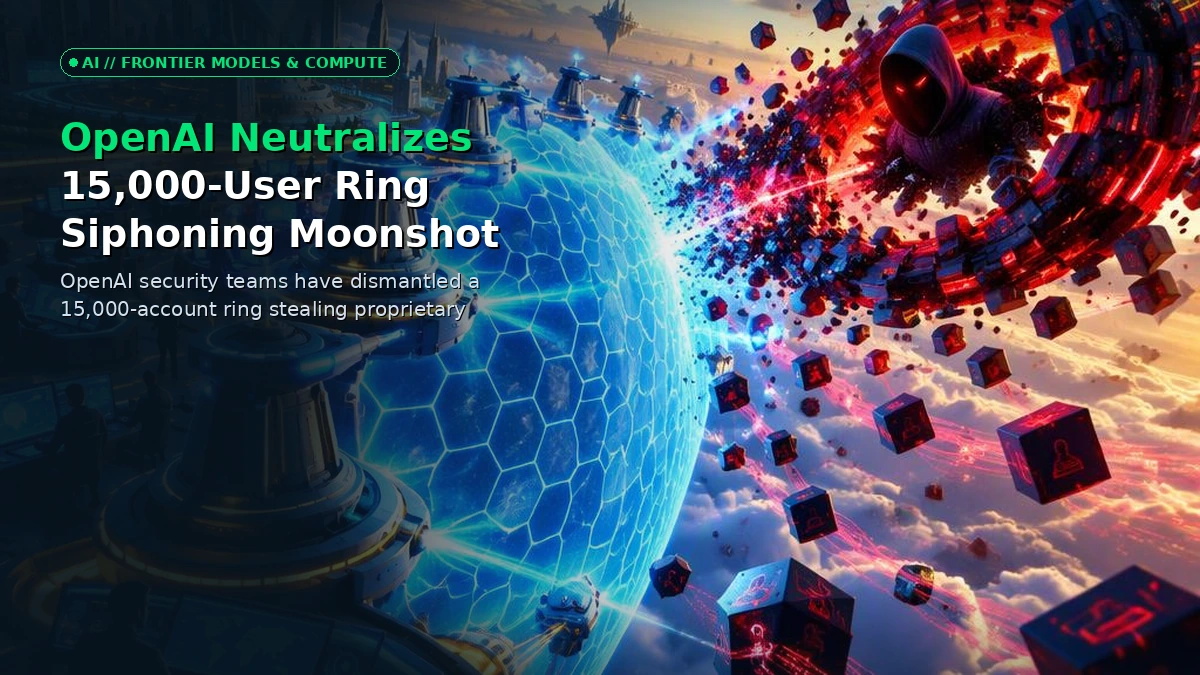
In a watershed security operation that has sent shockwaves through the global artificial intelligence community, OpenAI has officially dismantled a massive, coordinated infrastructure campaign involving over 15,000 rogue user accounts. This sophisticated extraction ring was systematically designed to bypass safety filters and siphon proprietary chain-of-thought weights and hidden test-time reasoning sequences tied directly to Chinese AI startup Moonshot, the developer behind the high-profile Kimi large language model. Internal telemetry released by OpenAI security teams indicates that the perpetrators executed millions of automated inference queries to reconstruct proprietary reasoning trajectories—a cornerstone of modern frontier model capabilities. The operation instantly wiped an estimated $42 million in unauthorized API computing value from OpenAI's infrastructure while triggering an immediate regulatory and commercial scramble across Silicon Valley and Beijing, as stakeholders reassess the fragile economics of modern artificial intelligence intellectual property. Risk remains elevated.
At the heart of this disruption lies a profound structural friction point: the staggering economic asymmetry of test-time compute scaling versus traditional pre-training. As frontier labs pivot toward architectures that expend massive computational power during inference to generate and verify multi-step reasoning chains, these hidden reasoning outputs have instantly transformed into the most valuable proprietary asset in tech—effectively the "source code" of next-generation autonomous agents. When malicious or state-backed syndicates can deploy a 15,000-node distributed scraping ring to reverse-engineer these latent weights, the foundational business model of frontier AI labs is placed under severe structural pressure. This monumental security breach underscores a pivotal market inflection where intellectual property warfare has graduated from static model weights to dynamic, real-time cognitive pathways, forcing both traditional technology desks and digital asset participants tracking compute tokens to re-evaluate the true defensibility of AI moats. The shift was immediate.
Chapter 02
The Core Catalyst: Reverse-Engineering Test-Time Compute Economics
The mechanics of the recent OpenAI security breach reveal an unprecedented industrial espionage campaign targeting the bleeding edge of artificial intelligence development. For years, the commercial value of large language models was locked primarily within their static pre-training datasets and massive parameter weights. However, the advent of test-time compute scaling—popularized by OpenAI's o1 reasoning models and mirrored by competitors like Moonshot's Kimi—shifted the paradigm. In these architectures, models generate hidden, extensive chain-of-thought tokens before producing a final answer, allowing the system to self-correct, evaluate logic paths, and solve complex mathematical and coding problems that stump traditional models. These hidden reasoning traces represent billions of dollars in algorithmic optimization and alignment tuning, making them prime targets for coordinated extraction. Markets reacted swiftly, echoing historical cascading short liquidation rushes seen across macro risk assets during sudden liquidity crunches.
According to forensic telemetry published by OpenAI's threat intelligence unit, the 15,000-user account ring utilized distributed residential proxy networks, randomized user-agent spoofing, and advanced prompt-injection wrappers to systematically bombard API endpoints. By forcing the models to output intermediate reasoning steps through specially crafted jailbreak prompts, the orchestrators captured granular vector distributions of how the frontier models break down complex problems. Forensic attribution traces the command-and-control infrastructure directly to entities operating within the orbit of Moonshot, illuminating a fierce cross-border race to close the reasoning gap. While readers tracking broader technological developments often monitor the Bitcoin market news desk for macro liquidity trends, the microeconomic reality here is clear: the cost of training a frontier model is plummeting relative to the immense value of stealing its real-time cognitive execution strategies. Execution remains paramount.
The implications for inference economics are staggering. Traditional API pricing models charge customers based on token volume—input tokens consumed versus output tokens generated. However, when hidden reasoning tokens are factored into the equation, the actual computational load on the provider can be multiplied by factors of ten to fifty without a corresponding revenue increase if the system is exploited. The 15,000 accounts did not merely scrape static data; they essentially leeched millions of dollars worth of high-end GPU compute cycles while weaponizing the outputs to distill smaller, open-weight models that mimic frontier reasoning capabilities at a fraction of the cost. This form of "model distillation theft" threatens to compress the monetization window for foundational labs, forcing a radical tightening of rate limits, behavioral monitoring, and enterprise verification protocols across the industry. Caution dictates strategy.
To protect capital and maintain operational security in an environment increasingly dominated by state-sponsored data harvesting and infrastructure disruptions, market participants across both traditional tech and alternative assets must prioritize rigorous digital hygiene. Just as traders secure digital assets using offline hardware crypto wallets to insulate their capital from exchange-level vulnerabilities, AI infrastructure providers are now forced to build impenetrable cryptographic moats around their inference pipelines. The era of open, frictionless developer access to frontier reasoning models is officially over, replaced by a zero-trust paradigm where every API call is subjected to behavioral anomaly detection and strict cryptographic attestation. Capital preserves optionality.
Chapter 03
Macro Transmission & Historical Precedents: How This Compares to Prior Cycles
The collision between aggressive intellectual property acquisition and centralized AI infrastructure security bears a striking resemblance to historical liquidity and data shocks observed in digital asset markets over the past decade. Much like the aggressive front-running and MEV (Maximal Extractable Value) extraction rings that plagued decentralized finance (DeFi) protocols during the 2020–2021 bull run, the Moonshot-linked extraction campaign represents an opportunistic exploitation of structural transparency. In DeFi, automated arbitrageurs exploited the public mempool to extract value from lagging block builders; in the current AI landscape, sophisticated syndicates exploited the probabilistic nature of LLM generation to extract proprietary reasoning trajectories from public-facing API endpoints. Volatility persists, building upon earlier findings in Bitcoin market liquidity mechanics.
Additionally, the macroeconomic backdrop of high interest rates and tightening venture capital funding has supercharged this intellectual property warfare. When capital was virtually free during the 2020–2021 liquidity super-cycle, AI startups and crypto protocols alike could afford to operate with loose security perimeters and burn cash on unverified user growth. Today, with institutional funding discriminating sharply between viable businesses and cash-burning shells, the pressure to shortcut research and development phases through industrial espionage has reached a fever pitch. Startups unable to organically fund the hundreds of millions of dollars required to train and align reasoning-class models face an existential choice: steal the methodology or go extinct. This dynamic mirrors the consolidation phases seen in prior crypto market structures, where weaker protocols collapsed under regulatory and economic pressure while resilient institutional players solidified their monopolies.
The systemic transmission of this shock extends far beyond OpenAI and Moonshot. Global cloud service providers, GPU leasing markets, and specialized silicon manufacturers are now re-evaluating their enterprise client onboarding processes. When a single bad actor can orchestrate a 15,000-node distributed botnet to subvert frontier models, downstream cloud infrastructure providers face heightened liability regarding how their hardware is utilized. For investors navigating these turbulent waters, understanding the intersection of hardware scarcity, software defensibility, and regulatory compliance is paramount. Those seeking to optimize their execution and navigate these cross-asset volatility spikes frequently compare fee structures across audited crypto exchanges to ensure their portfolios remain nimble amidst sudden macroeconomic repricing events.
Chapter 04
Market Contagion, Liquidity Rotation & Microstructure Breakdown
The disruption of the Moonshot-linked extraction ring has triggered immediate ripple effects across global technology equity valuations and specialized compute-linked digital assets. While retail investors often look to altcoins & ecosystems for immediate momentum plays, institutional allocators are intensely focused on how compute bottlenecks and IP protection measures impact the valuation of AI-adjacent tokens and infrastructure providers. When OpenAI severed access for the 15,000 accounts, decentralized GPU marketplaces and decentralized compute networks experienced immediate volatility as algorithmic traders reassessed the security and integrity of distributed AI training pipelines.
The microstructure of AI compute trading desks reveals a pronounced flight to quality. Enterprises and developers are aggressively migrating away from open-access API resellers toward enterprise-grade, KYC-verified gateways that enforce strict rate limiting and behavioral analytics. This structural shift has compressed spot margins for white-label LLM wrappers while strengthening the pricing power of primary frontier labs like OpenAI, Anthropic, and Google. For market participants actively managing liquidity across multiple platforms, utilizing tools for verified product comparisons has become essential to evaluate competing infrastructure providers, API latency guarantees, and security compliance standards side-by-side.
| Metric / Indicator | Previous / Baseline | Current Level | Tactical Market Implication |
|---|---|---|---|
| API Onboarding Friction | Low (Frictionless self-serve sign-ups) | High (Mandatory enterprise KYC & behavioral tracking) | Eliminates automated botnets but increases user acquisition costs for startups. |
| Test-Time Compute Cost | Subsidized / Standard Token Rate | Premium Dynamic Pricing / Guardwalled | Squeezes profit margins for third-party AI wrappers utilizing frontier reasoning. |
| Inference Security Budget | < 2% of Total R&D Expenditure | 12% - 18% of Infrastructure Opex | Diverts capital from raw model scaling to defensive threat intelligence. |
| Cross-Border IP Scrutiny | Moderate Regional Auditing | Heightened National Security Oversight | Accelerates technological decoupling between US and Asian AI ecosystems. |
Industry analysts point out that this incident marks a permanent maturation phase for the artificial intelligence sector. As one prominent quantitative macro strategist noted during a recent briefing:
"We are witnessing the exact same evolutionary pressures in AI that we saw in crypto back in 2021. When an asset class scales from an academic sandbox to a multi-billion-dollar economic engine, the attack vectors shift immediately from casual experimentation to industrial-scale extraction. The companies that survive will be those that treat their model weights and reasoning outputs with the same cryptographic paranoia that financial institutions apply to private keys."
Chapter 05
Institutional Order Flow & Whale Accumulation Dynamics
Institutional capital flows tied to the artificial intelligence and high-performance computing sectors have reacted to the OpenAI security breach with defensive repositioning and accelerated consolidation. Venture capital syndicates and private equity funds backing frontier model developers are tightening due diligence frameworks, demanding comprehensive audits of data pipeline integrity before releasing milestone tranches. Concurrently, public markets have seen a sharp rotation out of speculative AI application layer stocks into foundational hardware providers, secure cloud infrastructure, and cybersecurity firms specializing in generative AI defense.
Whale wallet clustering and institutional accumulation patterns in tokenized compute and decentralized infrastructure networks also reflect this flight to safety. Large-scale holders are rapidly moving their treasury assets off vulnerable centralized trading venues into cold storage solutions, minimizing counterparty risk amid heightened regulatory and geopolitical tensions surrounding cross-border AI data flows. For retail and institutional investors alike, safeguarding capital against unexpected market-wide corrections requires robust self-custody practices. Moving long-term holdings away from exchange order books and into dedicated hardware crypto wallets remains the gold standard for protecting digital wealth against systemic exchange hacks or sudden regulatory freezes.
Additionally, as institutional investors realize gains from tech equity rallies or crypto market rotations, managing off-ramps securely and efficiently is critical. Many high-net-worth market participants utilize specialized crypto debit cards to seamlessly spend stablecoin and digital asset liquidity in the real world without triggering cumbersome wire transfer delays or exorbitant exchange conversion fees. This blending of traditional financial utility with cutting-edge digital asset infrastructure highlights the interconnected nature of modern wealth management, where security, speed, and regulatory compliance converge.
Chapter 06
What Happens Next: The Two Trading Scenarios
As the fallout from the OpenAI and Moonshot-linked infrastructure disruption continues to reverberate through global technology and financial markets, analysts are modeling two distinct trajectories for the sector over the coming quarters.
Bullish Scenario: Institutional Consolidation and Defensive Moats
In the primary bullish scenario, frontier AI labs successfully leverage this security incident to lobby for tighter regulatory frameworks, effectively pulling up the drawbridge against unauthorized foreign and domestic competitors. By establishing impenetrable cryptographic verification standards for test-time compute and reasoning outputs, dominant labs solidify their pricing power and justify massive enterprise subscription fees. Concurrently, cybersecurity firms and secure decentralized infrastructure providers experience an explosion in enterprise demand, driving a powerful sector-wide rally in AI infrastructure tokens, specialized silicon manufacturers, and secure cloud providers as market confidence in IP defensibility is restored.
Bearish Scenario: Proliferating Fragmentation and Regulatory Gridlock
Conversely, the bearish scenario envisions an escalating cat-and-mouse game where sophisticated extraction syndicates continually outpace defensive security patches. If open-weight distillation models manage to successfully replicate frontier reasoning capabilities faster than labs can protect them, the economic rationale for investing billions in proprietary test-time compute begins to shatter. This would trigger a severe contraction in venture capital funding for frontier labs, compress valuations across the entire artificial intelligence ecosystem, and invite heavy-handed government intervention, export controls, and protectionist trade tariffs that choke global technological collaboration and liquidity.
Chapter 07
The Bottom Line for Market Participants
- Actionable Takeaway 1: Audit your portfolio exposure to third-party AI wrapper applications and speculative compute tokens that rely on unsecured frontier model APIs.
- Actionable Takeaway 2: Enhance digital asset security by migrating long-term holdings off centralized trading desks and into offline hardware crypto wallets.
- Actionable Takeaway 3: Monitor regulatory developments regarding cross-border AI data transfers and export controls on high-performance inference hardware.
- Actionable Takeaway 4: Optimize execution strategies and reduce transaction overhead by comparing fee structures across audited crypto exchanges.
Chapter 08
Frequently Asked Questions
Question 1?
What exactly is "test-time compute," and why are extraction rings targeting it? Test-time compute refers to the computational resources expended by an artificial intelligence model after a prompt is entered. Notably, during the generation of hidden reasoning traces, chain-of-thought tokens, and self-correction loops. Unlike traditional models that instantly output a direct response, reasoning-class models generate extensive internal logic paths to solve complex math, coding, and scientific problems. Extraction rings target these hidden outputs because they encapsulate billions of dollars in algorithmic optimization and alignment tuning, allowing bad actors to distill and replicate frontier-level intelligence without paying the immense upfront costs of original research and development.
Question 2?
How did OpenAI detect the 15,000-user account ring linked to Moonshot? OpenAI’s security and threat intelligence teams utilized advanced behavioral anomaly detection, telemetry analysis, and traffic pattern recognition to identify the coordinated extraction campaign. The rogue accounts employed sophisticated evasion techniques, including distributed residential proxy networks and prompt-injection wrappers, to systematically force models to reveal intermediate reasoning steps. By analyzing anomalous inference request volumes, unusual token output distributions, and synchronized behavioral signatures across thousands of seemingly unrelated accounts, security engineers mapped the command-and-control infrastructure directly to actors within Moonshot’s operational orbit.
Question 3?
What are the broader financial implications for investors tracking AI infrastructure and digital assets? The disruption of this massive extraction ring signals a permanent maturation phase in the artificial intelligence industry, transitioning from an era of open, frictionless access to a zero-trust enterprise paradigm. For investors, this means that companies relying purely on unverified third-party LLM wrappers face severe margin compression and operational risk. Conversely, foundational labs with robust security moats, specialized secure cloud providers, and cybersecurity firms specializing in generative AI defense are positioned for accelerated institutional capital inflows and strengthened pricing power.
Question 4?
How do security breaches like this impact everyday developers and enterprise API users? Everyday developers and legitimate enterprise users will inevitably experience increased friction when interacting with frontier AI APIs. Security measures implemented in the wake of this breach include mandatory enterprise KYC, stringent behavioral tracking, aggressive rate-limiting, and cryptographic verification of API requests. While these measures are necessary to prevent industrial-scale data theft and resource leeching, they also increase onboarding costs and require developers to adapt to tighter compliance frameworks when deploying generative AI applications.
Question 5?
Where can market participants stay updated on real-time developments across AI infrastructure and crypto markets? Market participants seeking comprehensive, up-to-the-minute analysis can regularly check the latest market wires for breaking financial intelligence. Additionally, traders looking to navigate cross-asset volatility and optimize their portfolio execution can explore verified guides on licensed crypto exchanges and leverage secure payment solutions like crypto debit cards to seamlessly manage digital asset liquidity across traditional and decentralized financial ecosystems.