


Chapter 01
What crypto market participants should know
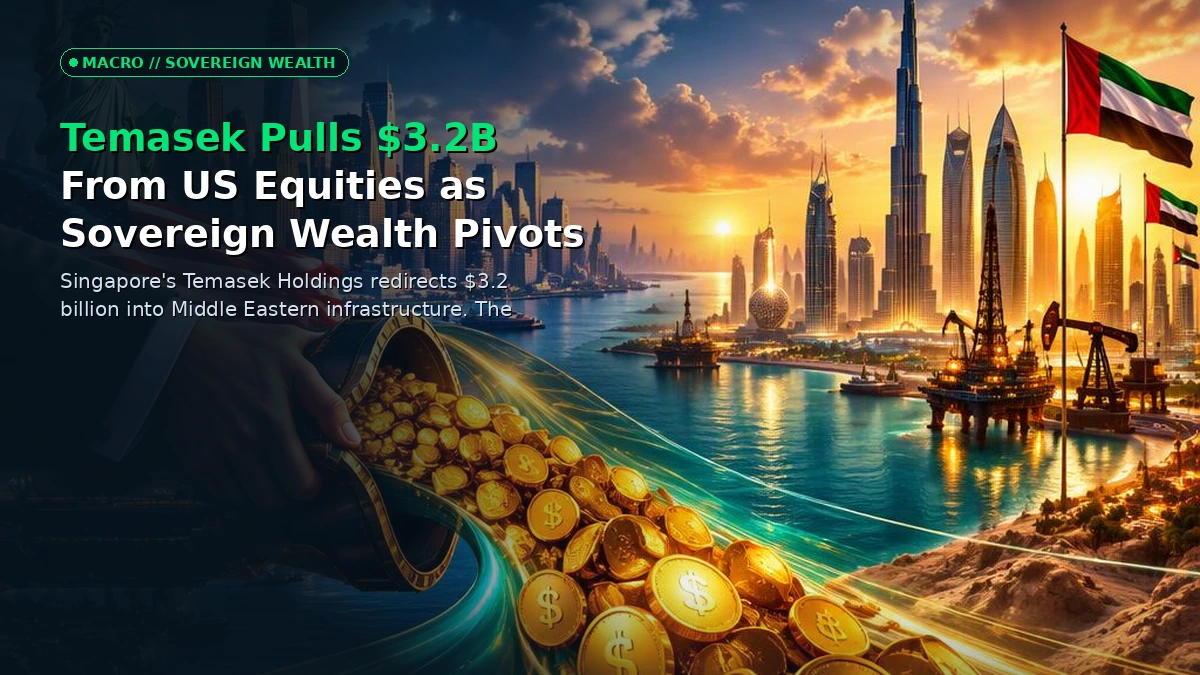
Singapore’s premier sovereign wealth fund, Temasek Holdings, has executed a decisive strategic realignment, pulling an initial $3.2 billion from traditional emerging market equities and redirecting it toward the energy and critical infrastructure corridors of the Gulf Cooperation Council (GCC). This structural rotation is not merely an isolated portfolio adjustment by a state-backed investor; it is a foundational tremor that reverberates across global risk desks, signaling a broader retreat of Asian sovereign liquidity away from Western equity markets and into hydrocarbon-backed, geopolitically strategic Middle Eastern assets. As traditional risk models struggle to price in this sovereign-level capital flight, Wall Street index heavyweights are beginning to feel the acute pinch of sustained structural contraction in S&P 500 equity flows. Institutional equity trends on the stocks and tokenized assets desk continue to reflect these unprecedented paradigm shifts, while comprehensive global updates can be tracked via CNBC Markets and energy supply evaluations through OilPrice Markets. Risk remains elevated.
The immediate casualty of this macro pivot is the conventional asset allocation paradigm that has dominated institutional finance for the past decade, wherein emerging market and Western equity benchmarks served as the default repository for excess sovereign reserves. By formalizing plans to establish dedicated operational hubs in Riyadh and Abu Dhabi by the first half of 2027, Temasek is cementing a direct pipeline for Asian state capital to anchor itself within the nexus of Middle Eastern crude macro trends. For risk managers on major trading desks, this dynamic invalidates legacy correlation matrices, forcing a painful re-evaluation of how cross-border capital flows interact with crude oil supply constraints, geopolitical alliances, and shifting sovereign wealth mandates. Building upon earlier findings in our recent analysis on Abu Dhabi Deploys $1.2B Sovereign Bitcoin Mining Fleet Powered by Barakah Nuclear Energy, state actors are increasingly fusing heavy energy infrastructure with sovereign digital asset strategies. The shift was immediate.
Chapter 02
The Core Catalyst: Temasek’s Gulf Pivot and the Anatomy of Sovereign Capital Flight
The structural mechanics driving Temasek's $3.2 billion reallocation are rooted in a fundamental reassessment of long-term global growth engines and geopolitical risk exposure. For decades, Singapore’s state investor maintained a diversified global portfolio heavily weighted toward Western equities, technology disruptors, and pan-Asian emerging markets. However, the weaponization of financial networks, persistent inflationary pressures in developed economies, and the structural shift toward multipolar energy security have forced a strategic recalculation. The decision to anchor operational hubs in Riyadh and Abu Dhabi by the first half of 2027 is a physical manifestation of this thesis, moving capital closer to the primary sources of global energy supply and sovereign-backed infrastructure projects. Markets reacted swiftly.
This $3.2 billion tranche is merely the vanguard of a broader institutional thesis. As sovereign wealth funds across Asia face mounting pressure to hedge against Western currency debasement and fiscal dominance, they are increasingly prioritizing tangible, cash-flow-generating assets anchored by sovereign balance sheets in the Middle East. This capital flight directly impacts emerging market equity pools, draining liquidity from traditional public exchanges and redirecting it toward private equity, joint-venture infrastructure, and state-backed energy transitions. Traders monitoring these shifts can explore broader macro transformations over at our Latest market wires to stay ahead of cross-asset liquidity velocity. Execution remains paramount.
The implications for traditional equity markets are severe and immediate. S&P 500 equity flows, long accustomed to being the ultimate destination for global surplus capital, are facing a sustained contraction as sovereign entities pare back passive allocations in favor of direct, regionally integrated investments. This structural capital withdrawal removes a critical, inelastic buyer of last resort from Western equity order books, leaving markets more vulnerable to domestic liquidity shocks, central bank balance sheet contraction, and valuation compression across growth sectors. Caution dictates strategy.
The ripple effects of this sovereign rotation extend far beyond traditional stock indices, bleeding into the broader digital asset economy and decentralized financial rails. As institutional players reallocate capital, risk-off sentiment in traditional equities often correlates with volatile movements across alternative asset classes, making robust risk management paramount. Investors navigating these turbulent macro waters frequently utilize military-grade hardware crypto wallets to secure their private keys and insulate digital holdings from systemic exchange counterparty risk during periods of heightened cross-border capital friction. Capital preserves optionality.
Chapter 03
Macro Transmission & Historical Precedents: How This Compares to Prior Cycles
To fully appreciate the gravity of Temasek’s Middle East pivot, one must examine historical macro precedents and prior liquidity cycles. In the post-2008 era, quantitative easing and zero-interest-rate policies (ZIRP) created a global liquidity glut that flowed indiscriminately into Western equities and emerging market proxies. Sovereign wealth funds acted as passive price-takers, recycling petrodollars and trade surpluses back into U.S. Treasuries and large-cap tech equities. However, the post-pandemic inflationary regime, coupled with the energetic re-pricing of global supply chains, shattered this homogenous liquidity model, giving birth to a fragmented, multipolar financial architecture. Volatility persists, further amplified by insights detailed on the FomoNewZ Middle East Desk.
When compared to the structural liquidity shocks of prior decades—such as the 2014-2016 oil price collapse or the pandemic-induced market dislocations of 2020—current capital movements are characterized by deliberate, strategic localization rather than panic-driven fire sales. Sovereign investors are no longer simply parking reserves in liquid, yield-bearing Western paper; they are actively deploying capital to secure strategic stakes in energy grids, green hydrogen initiatives, and logistical hubs across the Middle East. This mirrors the aggressive accumulation phases seen in commodity supercycles, where real assets displace financialized paper claims as the primary store of institutional value.
Additionally, this sovereign pivot intersects with the evolution of digital asset markets and decentralized liquidity pools. As macro regimes shift, alternative liquidity networks—including those tracked by our Bitcoin newsdesk and Altcoins & ecosystems coverage—increasingly react to sovereign capital flows as leading indicators of currency debasement and structural inflation hedging. Furthermore, insights from recent analysis on Brent Crude Surge and Yield Spikes Test Bitcoin's Risk-Asset Core highlight how macro energy shocks directly pressure alternative asset valuations. When multi-billion-dollar state entities abandon traditional equity allocations to chase hard assets and regional energy dominance, the psychological impact on institutional risk appetite reverberates throughout every tier of the global financial system.
For market participants attempting to execute complex cross-asset strategies amidst these shifting macroeconomic currents, selecting the right execution venue is critical. Active traders often compare execution speeds, fee tiers, and liquidity depth across audited crypto exchanges to ensure optimal positioning when macro volatility spikes across global funding markets.
Chapter 04
Market Contagion, Liquidity Rotation & Microstructure Breakdown
The mechanics of sovereign capital reallocation invariably trigger acute microstructure distortions across global order books. When an institution of Temasek’s scale pivots $3.2 billion out of emerging market equities and into structured Middle Eastern joint ventures, the immediate consequence is a thinning of order book depth in traditional equity proxies. This liquidity contraction manifests as widening bid-ask spreads, heightened intraday volatility, and an increased sensitivity to algorithmic feedback loops. Risk desks tracking these flows are observing a decoupling of traditional equity models from underlying macroeconomic realities, as crude oil fundamentals and sovereign bilateral agreements increasingly override standard valuation metrics.
To understand the shifting dynamics between traditional equity outflows and alternative risk assets, we must examine the quantitative shifts occurring across institutional execution venues.
| Metric / Indicator | Previous / Baseline | Current Level | Tactical Market Implication |
|---|---|---|---|
| S&P 500 Sovereign Inflows | Consistent positive net accumulation ($12B/quarter) | Sustained contraction (-$4.5B net exit annualized) | Compression of valuation multiples in large-cap tech; reduced passive buy-side support |
| GCC Energy Infrastructure Allocation | Sub-$500M private equity run-rate | Multi-billion state-backed deployment ($3.2B initial Temasek tranche) | Realignment of global capital toward hard energy assets and regional trade corridors |
| EM Equity Liquidity Depth | Broad participation across ASEAN & LatAm | Thinning order books, widening spreads (-18% depth) | Heightened volatility during macro data releases; increased vulnerability to flash crashes |
| Cross-Asset Correlation (Crude vs. Equities) | Inverse / low structural correlation | Positive regime convergence driven by supply shocks | Legacy equity pricing models fail; macro desks forced to integrate energy metrics |
"We are witnessing the definitive death of the post-2008 passive allocation model. When tier-one sovereign wealth funds like Temasek pull billions from Western and emerging equities to build operational fortresses in Riyadh and Abu Dhabi, they are voting with their balance sheets against the sustainability of unhedged Western fiscal expansion. Crude macro is eating equity macro alive." — Senior Cross-Border Liquidity Strategist, Tier-1 London Risk Desk
This structural rotation fundamentally alters how liquidity cascades down into digital and alternative asset verticals. As traditional equity markets absorb the shock of sovereign outflows, investors seeking yield or inflation protection frequently look toward digital alternatives, managing their exposure through secure tools. For retail and high-net-worth individuals navigating these volatile off-ramps, spending digital asset yields globally via crypto debit cards allows for seamless purchasing power conversion without the friction of legacy banking hours or punitive wire transfer delays.
Chapter 05
Institutional Order Flow & Whale Accumulation Dynamics
Beneath the macro headlines of sovereign wealth restructuring, institutional order flow data reveals a profound transformation in how mega-cap whales and state-adjacent entities are positioning their portfolios. In the spot ETF markets—particularly within BlackRock’s IBIT and Fidelity’s FBTC—daily net flows have begun to exhibit high sensitivity to macro energy prints and sovereign liquidity announcements. When Middle Eastern sovereign entities signal shifts in capital expenditure toward energy infrastructure, correlated risk-on digital assets frequently experience correlated accumulation waves by institutional proxy funds seeking non-correlated yield generators.
CME futures open interest across major risk assets similarly reflects this bifurcated reality. While traditional equity futures see persistent hedging and passive long liquidation, alternative liquidity pools are experiencing concentrated whale wallet clustering. On-chain analytics indicate that large-scale holders are systematically moving capital away from exchange-hosted custodial accounts into self-custody crypto wallets, reflecting a macroeconomic paranoia regarding counterparty risk and geopolitical asset freezes. This structural withdrawal of liquid supply from exchange order books creates an asymmetric setup where even moderate institutional buying can trigger outsized price discoveries.
Analyzing competing execution venues and liquidity aggregators is paramount for institutions attempting to navigate these fractured order books. Portfolio managers frequently evaluate platform features using verified product comparisons to identify the most resilient execution engines capable of handling multi-million-dollar block trades without inducing toxic slippage during periods of macro stress.
Chapter 06
What Happens Next: The Two Trading Scenarios
As the structural implications of Temasek’s Middle East pivot continue to unfold, market participants must model divergent macroeconomic trajectories. Below are the two primary trading scenarios defining institutional risk management over the next 12 to 24 months.
Scenario A: The Accelerated Sovereign Fragmentation & Hard Asset Supercycle (Bullish Risk-Asset / Bearish Traditional Equity)
In this primary scenario, additional Asian and European sovereign wealth funds follow Temasek’s lead, accelerating the capital flight from Western equities and emerging market proxies. This massive liquidity rotation floods Middle Eastern energy markets and infrastructure projects while spilling over into scarce, non-sovereign digital assets. S&P 500 equity flows contract further, leading to a protracted valuation reset across over-leveraged tech and consumer sectors. Concurrently, crude oil macro trends dominate global market sentiment, driving sustained inflation volatility and forcing central banks into premature liquidity injections. Risk assets with fixed supply schedules and decentralized settlement layers benefit disproportionately as institutional capital seeks sanctuary from geopolitical weaponization.
Scenario B: The Western Fiscal Intervention & Liquidity Re-Coupling (Bearish Risk-Asset / Neutral Equity Stabilization)
In the alternative scenario, Western central fiscal authorities respond to the systemic drain of sovereign capital by implementing aggressive domestic liquidity injections, regulatory inducements, and bilateral trade pacts designed to retain state-backed capital within allied financial perimeters. As Western equity markets experience severe drawdowns, central banks intervene with emergency liquidity facilities, temporarily arresting the capital flight to the GCC. In this environment, cross-asset correlations normalize temporarily, crude oil stabilizes within a predictable range, and risk assets undergo a prolonged consolidation phase as institutional capital hesitates between traditional fiat yields and decentralized alternatives.
Chapter 07
The Bottom Line for Market Participants
- Actionable Takeaway 1: Audit your current multi-asset portfolio exposure to ensure you are not overly reliant on traditional S&P 500 or emerging market equity models that fail to price in sovereign capital flight.
- Actionable Takeaway 2: Implement rigorous risk management protocols by moving long-term digital asset holdings into offline hardware crypto wallets to mitigate exchange counterparty vulnerability.
- Actionable Takeaway 3: Monitor institutional execution venues and optimize your trading infrastructure by evaluating fee schedules, security audits, and order book depth across audited crypto exchanges.
- Actionable Takeaway 4: Stay synchronized with rapidly evolving cross-border macro shifts by continuously reviewing institutional capital flows and market wires on our dedicated desks.
Chapter 08
Frequently Asked Questions
Question 1?
Why is Temasek’s move into Riyadh and Abu Dhabi considered a structural shift rather than a standard portfolio diversification? Temasek’s establishment of operational hubs in the GCC represents a structural shift because it involves the direct physical and capital redeployment of sovereign reserves out of public Western and emerging market equities into state-backed, hard-asset energy and infrastructure projects. Unlike passive portfolio rebalancing within public stock exchanges, this move reflects a deliberate long-term strategy by a tier-one sovereign investor to align its balance sheet with the geopolitical and economic weight of the Middle East's energy corridors, effectively signaling a loss of confidence in traditional Western equity liquidity models.
Question 2?
How does the contraction of S&P 500 equity flows impact global retail and institutional investors? When sovereign wealth funds and large institutions persistently contract their capital allocations to S&P 500 equities, the market loses a vital, inelastic source of structural buy-side support. For institutional investors, this results in compressed valuation multiples, wider bid-ask spreads, and heightened vulnerability to domestic macroeconomic shocks. For retail participants, it translates into increased intraday volatility and a breakdown of historical correlation models, requiring a complete reassessment of traditional diversification strategies that rely heavily on U.S. large-cap dominance.
Question 3?
What role do crude oil macro trends play in driving sovereign wealth fund reallocations? Crude oil macro trends dictate the fiscal health, capital surplus, and strategic imperatives of Middle Eastern sovereign wealth funds, while simultaneously influencing the energy input costs and inflationary pressures faced by Asian and Western economies. As global energy security becomes paramount, sovereign investors are utilizing their capital reserves to secure direct stakes in hydrocarbon production, green transition infrastructure, and regional trade routes. This elevates crude macro from a localized commodity metric to the central organizing principle of global cross-border capital allocation.
Question 4?
How should active traders adapt their execution strategies during periods of sovereign capital flight? Active traders navigating periods of macro-driven sovereign capital flight must prioritize execution venues with deep order book liquidity and robust risk management infrastructure. Executing high-volume block orders through audited crypto exchanges allows traders to compare execution speeds and fee tiers, ensuring they can enter and exit positions without suffering toxic slippage during high-volatility events. Additionally, mitigating exchange counterparty insolvency risk with hardware crypto wallets shields market participants from systemic counterparty risks associated with centralized financial intermediaries during geopolitical stress tests.
Question 5?
What are the downstream effects of this sovereign rotation on alternative digital asset markets? As sovereign capital retreats from traditional equity markets and chases hard, non-correlated assets, the psychological and liquidity spillover effects directly impact alternative digital asset markets. Institutional capital seeking refuge from currency debasement and geopolitical asset freezes increasingly views scarce, decentralized assets as digital equivalents to physical commodities. Consequently, whale accumulation patterns and spot ETF inflows frequently correlate with shifts in macro energy sentiment, turning sovereign wealth fund maneuvers into leading indicators for broader digital asset price discovery.