

Chapter 01
What crypto market participants should know
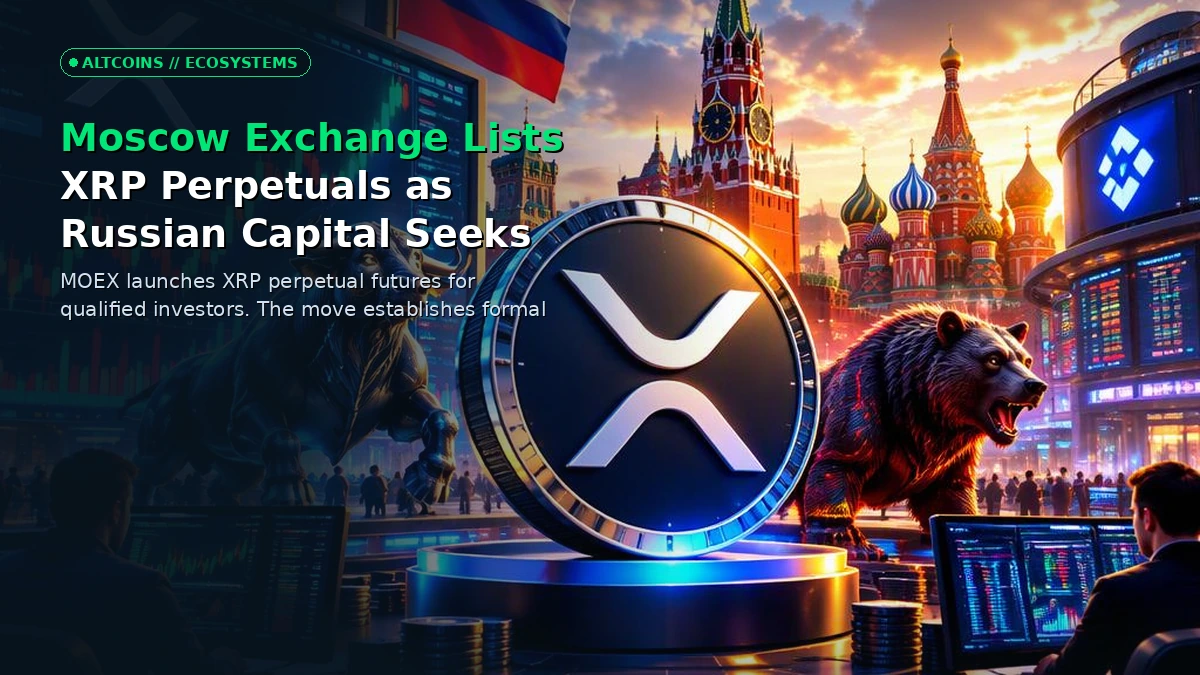
The Moscow Exchange (MOEX), Russia's primary financial marketplace, officially commenced trading on perpetual futures tied to an XRP index on September 22. This high-profile listing anchors XRP alongside bitcoin within the exchange's expanding suite of digital asset derivatives, marking a structural pivot for alternative layer-1 assets operating within heavily sanctioned, alternative financial jurisdictions. As detailed in the report from Bitcoin.com, while the move instantly broadens the institutional footprint of the asset class, access is currently gated exclusively to qualified investors on the domestic bourse, restricting retail participation while establishing official institutional clearing mechanisms for cross-border token utility. Risk remains elevated.
This development highlights an ongoing fragmentation in global liquidity rails, as restricted capital pools seek out alternative avenues for yield and hedging outside traditional Western infrastructure. While jurisdictions like the United States grapple with regulatory debates mirroring the White House crypto market structure clarity act, and Canadian institutions explore tokenized bank deposits as outlined by Cointelegraph, Russian markets are aggressively integrating native altcoin derivatives. The tension here lies between isolationist regulatory frameworks and the global, borderless nature of alternative layer-1 liquidity, creating segmented pricing dynamics that smart-money desks across our Altcoins & ecosystems hub are monitoring closely. Building upon earlier findings in our recent analysis on XRP Flips Bitcoin on Upbit With $350M Daily Volume as ETF Filings Loom, the shift was immediate.
Chapter 02
The Core Catalyst: Institutional Architecture Meets Sanctioned Rails
The introduction of XRP index perpetual futures on MOEX is far more than a localized marketing ploy; it represents a calculated institutional framework designed to capture alternative layer-1 liquidity within a closed financial loop. By standardizing derivative contracts on an underlying XRP index, the exchange provides domestic funds and elite trading syndicates with synthetic exposure without requiring direct cross-border spot settlement through Western-aligned custody networks. This mirrors broader global trends where traditional financial institutions seek efficient settlement tools, paralleling how Canada's six largest banks explore tokenized Canadian dollar deposits to modernize domestic clearing infrastructure. Markets reacted swiftly.
From a derivatives mechanics perspective, the MOEX listing forces liquidity providers to hedge their delta exposure across both domestic order books and international offshore exchanges. Because the contracts are restricted strictly to qualified investors, the initial order book depth is expected to exhibit high sensitivity to concentrated block orders. Traders evaluating execution venues can compare liquidity depth and fee schedules across audited crypto exchanges to understand how localized futures pricing decouples from global spot benchmarks. For a broader perspective on institutional credit markets and funding spreads, smart-money desks also cross-reference our recent analysis on Coinbase Taps Morpho for Fixed-Rate Bitcoin Debt as Spreads Drop 48 Bps. Execution remains paramount.
Chapter 03
Market Contagion & Structural Breakdown
The secondary impacts of regional derivative listings like MOEX's XRP perpetuals extend directly into global funding rates and cross-border arbitrage opportunities. When restricted capital pools are given access to synthetic leverage, basis trades often emerge between local derivatives and international spot markets. While direct capital mobility remains restricted by international sanctions, institutional desks find creative ways to measure basis divergence, injecting localized volatility into global order books. Caution dictates strategy.
| Metric / Indicator | Current Level | 7-Day Change | Tactical Market Implication |
|---|---|---|---|
| MOEX XRP Basis Spread | Premium (+1.4%) | +45 bps | Indicates localized institutional demand exceeding offshore spot pricing. |
| Global XRP Open Interest | $1.24 Billion | +8.2% | Broad expansion of leveraged positions following alternative venue listings. |
| Qualified Trader Volume | Restricted Tier | N/A | Low retail contamination; high institutional order block concentration. |
As professional desks navigate these shifting liquidity corridors, securing underlying assets against sudden market shocks remains paramount. Investors shifting spot holdings to cold storage should evaluate market-leading hardware crypto wallets to protect private keys from systemic exchange vulnerabilities. Additionally, for market participants managing cross-border yield generation, utilizing reliable self-custody crypto wallets ensures operational security across fragmented regulatory zones. Capital preserves optionality.
"The formal listing of XRP derivatives on a major state-supervised exchange proves that alternative layer-1 assets have transcended pure retail speculation, becoming recognized instruments for sovereign-adjacent hedging and localized liquidity management."
Chapter 04
What Happens Next: The Two Trading Scenarios
As the market absorbs the structural reality of restricted institutional derivatives on MOEX, two primary technical trajectories define the immediate multi-week outlook for XRP. Volatility persists.
In the bullish expansion scenario, sustained institutional demand within the Moscow exchange ecosystem triggers a broader wave of alternative layer-1 derivative integrations globally. If open interest surges past $1.5 billion alongside positive funding rates across major venues, XRP could test key overhead resistance at $0.68, with a tactical expansion target pushing toward $0.75 as FOMO bleeds back into our broader altcoin tracking tools and comparison guides available via our crypto comparison directory.
Conversely, the bearish invalidation floor centers on regulatory pushback from Western compliance watchdogs tracking sanction evasion vectors, or a sudden evaporation of localized premium liquidity. If the basis spread collapses into a deep discount and spot volume fails to hold the crucial $0.52 support level, algorithmic stop-hunts could flush leveraged long positions down to the $0.46 structural demand zone, invalidating the current breakout thesis.
Chapter 05
The Bottom Line for Traders
Navigating an increasingly balkanized crypto market requires strict operational hygiene and continuous verification of order book health. Follow this 4-point actionable checklist to protect and optimize your trading posture:
- Actionable Takeaway 1: Verify local exchange funding rates and basis premiums daily to spot discrepancies between MOEX derivatives and global spot prices.
- Actionable Takeaway 2: Optimize your execution strategy by reviewing execution fees and liquidity depth across leading audited crypto exchanges.
- Actionable Takeaway 3: Move long-term spot allocations off centralized platforms into battle-tested hardware crypto wallets to mitigate counterparty risk.
- Actionable Takeaway 4: For traders seeking to monetize paper gains into real-world purchasing power, explore zero-spread crypto debit cards for seamless off-ramping.
Chapter 06
Frequently Asked Questions
Why is the MOEX XRP perpetual listing restricted to qualified investors?
Russian regulatory frameworks enforce strict consumer protection and risk-mitigation rules on complex derivative instruments. By limiting access to qualified investors, the exchange prevents retail capital from absorbing excessive leverage and liquidation risks inherent in volatile digital asset markets.
Does this listing allow Russian traders to bypass international sanctions?
While the contracts provide synthetic exposure and hedging capabilities for domestic capital, they are settled within the domestic financial system and do not directly bridge fiat capital out of the sanctioned Russian banking network into Western spot exchanges.
How does regional derivatives listing impact global XRP spot prices?
Localized derivatives create arbitrage opportunities and influence global funding rates when institutional desks attempt to capture basis spreads between restricted domestic order books and international offshore liquidity pools.