

Chapter 01
What crypto market participants should know
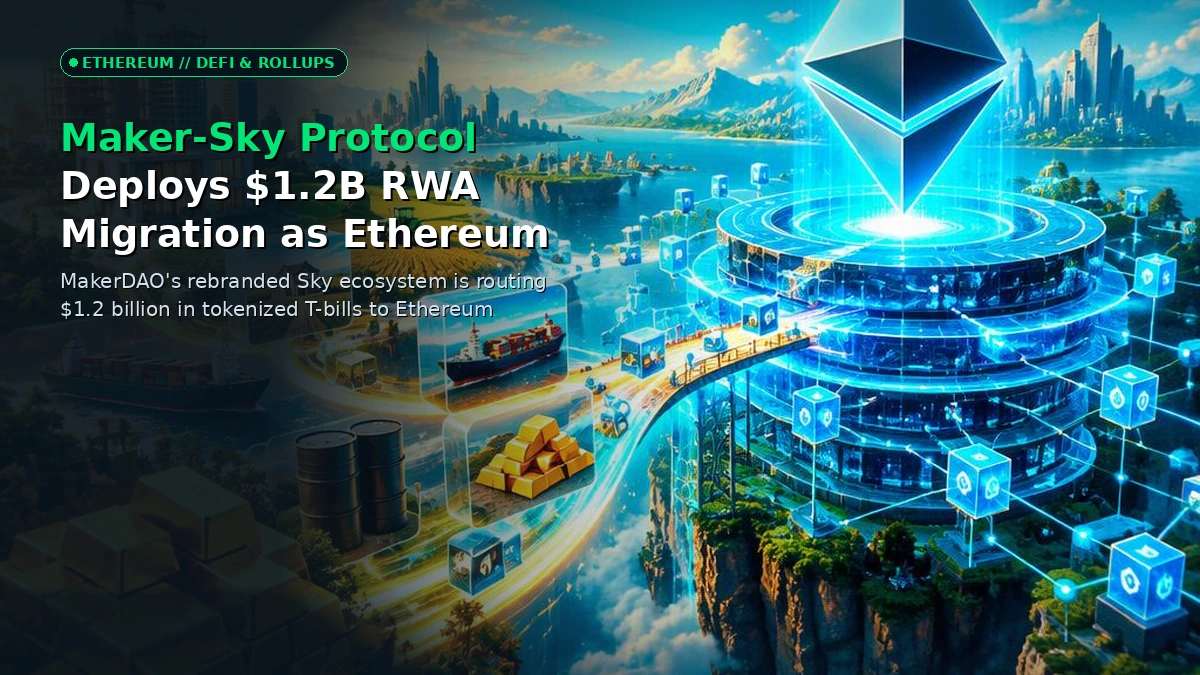
The landscape of decentralized finance is undergoing a structural seismic shift as MakerDAO—now operating under its expanded Sky ecosystem branding—successfully secures governance approval for a massive $1.2 billion real-world asset (RWA) migration. This multi-tranche collateral realignment moves monumental blocks of tokenized United States Treasury bills and traditional fixed-income securities directly onto high-throughput Ethereum Layer-2 execution layers. The immediate on-chain reaction has triggered a flurry of smart contract deployment activity, with protocol governance tokens responding to the efficiency gains of bypassing base-layer gas friction. By relocating massive pools of institutional-grade collateral away from congested mainnet blocks, the protocol is setting a new operational standard for how high-yield decentralized applications handle multi-billion-dollar liquidity pipelines. Risk remains elevated.
Yet, this architectural migration exposes a severe underlying friction point across the broader Ethereum ecosystem—deeply analyzed in our dedicated Ethereum newsroom desk and tracked via live metrics on the live ETH price hub—revealing a widening structural divide between base-layer and roll-up borrowing rates that is currently squeezing traditional yield farmers while rewarding institutional giants. As borrowing rates for stablecoins diverge between Layer-1 and Layer-2 environments to hit a six-month high, retail participants find themselves priced out of prime yield opportunities. Meanwhile, institutional liquidity providers capitalize on sub-second settlement optimizations designed to slash protocol operational friction by upwards of 40%. This transition is no longer just a technical upgrade; it is a profound market inflection point that redraws the boundaries of who gets to access sustainable, real-world-backed yield within the decentralized economy. The shift was immediate.
Chapter 02
The Core Catalyst: Architectural Migration of $1.2 Billion in Tokenized Treasury Collateral
The decision by Maker/Sky governance to route $1.2 billion in tokenized real-world assets across Ethereum execution layers addresses a fundamental bottleneck that has plagued decentralized finance for years: mainnet gas congestion and block-space latency. Historically, managing multi-million-dollar real-world asset vaults required executing complex collateral rebalancing, interest rate adjustments, and oracle updates directly on the Ethereum Layer-1 base layer. During periods of heightened market volatility, spiking gas fees could siphon away a significant percentage of annual yield returns simply through routine smart contract administration and collateral maintenance. Markets reacted swiftly.
By migrating these massive Treasury-backed portfolios to high-performance Layer-2 architectures, Sky is engineering a frictionless pipeline for institutional liquidity. This technical overhaul targets a 40% reduction in protocol operational friction, enabling near-instantaneous collateral rebalancing and automated yield distribution. The shift leverages advanced cryptographic proof systems and decentralized bridging mechanisms to maintain uncompromising security standards while unlocking unprecedented execution speeds. For an in-depth look at how other protocols are adapting their multi-chain strategies, readers can review our latest updates on Altcoins & ecosystems. Execution remains paramount, aligning with broader findings on tokenization investment portfolios and recent analysis on Aave Token Burn Proposal Sparks 11% Surge as DeFi Yields Defy Bond Shock.
Additionally, the mechanics of this migration fundamentally alter how institutional capital interacts with decentralized debt markets. When tokenized U.S. Treasuries yield a stable 4% to 5% baseline return, every basis point saved on operational overhead and gas friction directly enhances the net yield delivered to decentralized stablecoin holders and vault participants. As these assets settle with sub-second finality on L2 networks, market makers and institutional desks can dynamically adjust their borrowing positions without fearing sudden mainnet fee spikes. Traders looking to capture these evolving yield spreads across various platforms can compare execution efficiency metrics using comprehensive product comparisons. Caution dictates strategy.
Chapter 03
Macro Transmission & Historical Precedents: How This Compares to Prior Cycles
To truly grasp the significance of the Maker/Sky $1.2 billion migration, one must contextualize it within the broader evolution of crypto market cycles and macroeconomic monetary policy. In the 2020 DeFi Summer, decentralized finance was fueled almost entirely by reflexive, crypto-native yields—such as algorithmic stablecoin farming, hyper-inflationary governance token incentives, and speculative leverage loops. Those mechanisms proved fragile when macroeconomic tightening occurred, leading to cascading liquidations and catastrophic structural collapses. Today's RWA-driven DeFi ecosystem stands in stark contrast, anchoring decentralized yields to sovereign debt markets and traditional macroeconomic interest rate regimes, as highlighted in DeFi yields and Layer-2 expansion reports. Capital preserves optionality.
The current macro backdrop—characterized by elevated central bank interest rates and quantitative tightening—has made real-world yield a prized commodity across all digital asset verticals. Unlike the zero-interest-rate policy (ZIRP) era of 2020 or the speculative fervor surrounding the 2024 spot ETF approvals, today's institutional participants demand predictable, bankruptcy-remote cash flows backed by tangible legal frameworks. The Maker/Sky protocol is effectively bridging the gap between TradFi and DeFi by institutionalizing tokenized debt on high-speed execution layers. This structural maturation mirrors the transition of traditional equity markets from physical trading floors to electronic high-frequency networks, permanently altering the risk-reward profile of digital asset lending. Volatility persists.
Analyzing this transition requires looking at how liquidity flows from traditional financial systems into decentralized protocols during distinct monetary cycles, a trend mirrored by record Ethereum validator staking lockups. During the 2024 ETF-driven accumulation phase, capital primarily flooded into passive spot vehicles, creating isolated pools of liquidity that remained largely detached from active DeFi yield generation. Now, through protocols like Sky, institutional capital is actively seeking programmable yield environments that offer both regulatory compliance and superior execution efficiency. As these liquidity bridges mature, the boundary between traditional fixed income and decentralized lending continues to dissolve, paving the way for multi-tranche debt markets that operate 24/7 without traditional banking hours or settlement delays.
Chapter 04
Market Contagion, Liquidity Rotation & Microstructure Breakdown
The collateral effects of the Maker/Sky migration are rapidly rippling through secondary markets, exerting direct pressure on perpetual funding rates, spot lending spreads, and cross-chain liquidity depth. As liquidity concentrates on Layer-2 execution environments to capture optimized borrowing rates, Ethereum Layer-1 stablecoin liquidity is experiencing a noticeable contraction. This divergence has pushed the gap between L1 and L2 stablecoin borrowing rates to a six-month high, creating lucrative arbitrage opportunities for sophisticated market makers while simultaneously increasing the cost of capital for leveraged mainnet traders.
| Metric / Indicator | Previous / Baseline | Current Level | Tactical Market Implication |
|---|---|---|---|
| Layer-1 vs. L2 Stablecoin Borrowing Rate Spread | 25 bps delta | 185 bps delta | Incentivizes rapid migration of active debt positions to L2 networks. |
| Protocol Operational Friction (Gas Overhead) | ~3.8% of yield | ~2.2% of yield | 40% reduction directly boosts net annual percentage yield (APY). |
| Tokenized RWA Collateral Volume on L2 | $150M pilot phase | $1.2B migrated | Validates institutional scalability of decentralized rollups. |
| Perpetual Funding Rates (Major Exchanges) | Neutral (0.01%) | Mildly Positive (0.03%) | Signals cautious spot accumulation despite borrowing rate divergence. |
The compression of execution spreads and the optimization of settlement times are fundamentally changing how trading desks manage risk. Market participants can no longer rely on sluggish mainnet transactions to rebalance collateral during high-volatility events.
"We are witnessing the definitive decoupling of crypto-native credit markets from base-layer gas constraints. When a protocol can shift over a billion dollars of institutional-grade Treasury collateral across execution layers with sub-second finality, it signals to every major traditional finance player that DeFi infrastructure is finally enterprise-ready."
For active traders navigating these rapid microstructural changes, maintaining optimal execution speed across multiple decentralized venues is paramount. Traders aiming to optimize order routing and minimize slippage can compare fee schedules and liquidity depth across audited crypto exchanges. Additionally, as capital flows dynamically between L1 and L2 rails, securing digital assets against unexpected network congestion or bridging vulnerabilities makes utilizing offline hardware crypto wallets an absolute necessity for risk-conscious market participants.
Chapter 05
Institutional Order Flow & Whale Accumulation Dynamics
Beneath the surface of on-chain borrowing rates and protocol governance votes, institutional order flow data reveals a calculated, methodical accumulation pattern by macro funds and crypto-native whales. Following the initial announcement of the $1.2 billion RWA migration, spot exchange net flows for major ecosystem tokens exhibited a sharp deceleration in exchange deposits, indicating a strong preference for self-custody and long-term vault locking. Institutional investors are increasingly viewing governance tokens associated with yield-generating real-world asset protocols as cash-flow-producing digital equities rather than purely speculative governance assets.
Simultaneously, derivatives data from institutional-grade clearinghouses shows a steady climb in CME futures open interest, coupled with a notable shift in delta-neutral yield strategies. Sophisticated desks are deploying capital into tokenized debt vaults while hedging their directional exposure in the derivatives market, effectively locking in net yields that significantly outperform traditional fixed-income instruments. This institutional participation is heavily concentrated among entities that require strict compliance, predictable cash flows, and robust smart contract security audits before deploying eight-figure capital allocations into decentralized finance applications.
Whale wallet clustering analysis further corroborates this structural shift, echoing corporate treasury Ethereum allocation thresholds. On-chain telemetry identifies several newly minted multi-sig addresses—linked to prominent asset management entities—systematically accumulating protocol governance tokens and positioning themselves within newly formed L2 liquidity pools. This accumulation phase is occurring quietly, largely insulated from retail radar, as large players absorb available spot liquidity without triggering explosive price volatility. For those looking to track broader market sentiment and institutional inflows in real-time, our latest market wires provide continuous, data-driven reporting on shifting liquidity trends across the digital asset economy.
Chapter 06
What Happens Next: The Two Trading Scenarios
As the Maker/Sky ecosystem completes its $1.2 billion RWA migration and the divergence between Layer-1 and Layer-2 borrowing rates reaches cyclical extremes, market participants must prepare for two distinct macro trading scenarios over the upcoming quarters.
Bullish Scenario: The Institutional Liquidity Super-Cycle
In the primary bullish scenario, the seamless execution of the $1.2 billion migration serves as a watershed moment that attracts a new wave of institutional capital into Ethereum Layer-2 DeFi. As operational friction drops by 40% and net yields outperform traditional fixed-income alternatives, total value locked (TVL) across Sky-integrated L2s surges past previous all-time highs. Stablecoin borrowing rates normalize as liquidity bridges mature, and governance tokens reprice aggressively upward to reflect the protocol's growing fee-generation capacity. Key technical resistance bands for ecosystem tokens break cleanly on high volume, paving the way for a sustained multi-month upward trend driven by fundamental yield demand rather than speculative retail mania.
Bearish Scenario: Bridge Contagion & Rate Dislocation
Conversely, the bearish scenario hinges on systemic risks related to cross-chain bridge vulnerabilities, regulatory friction surrounding tokenized real-world assets, or persistent rate dislocation. If the widening gap between L1 and L2 borrowing rates creates severe liquidity crunches for leveraged vault operators, a wave of forced liquidations could ripple through interconnected DeFi protocols. Additionally, any unforeseen technical exploit within the multi-tranche L2 bridging architecture would severely damage institutional confidence, triggering a massive flight of capital out of decentralized debt markets and back into traditional, off-chain financial instruments, invalidating bullish continuation models.
Chapter 07
The Bottom Line for Market Participants
assessing the market of real-world asset migration, Layer-2 yield divergence, and institutional capital flows requires a disciplined, risk-managed approach. Market participants must adapt their operational strategies to match the evolving technical realities of the Ethereum ecosystem.
- Actionable Takeaway 1: Audit your current stablecoin exposure and evaluate whether your active borrowing positions are optimized for Layer-2 execution efficiency to avoid excessive Layer-1 gas drag.
- Actionable Takeaway 2: Compare fee schedules and liquidity depth across audited crypto exchanges to ensure optimal execution when rebalancing portfolios during periods of high market volatility.
- Actionable Takeaway 3: Safeguard long-term holdings and multi-sig vault keys by migrating idle assets into secure offline hardware crypto wallets away from centralized exchange custody.
- Actionable Takeaway 4: Monitor daily macro inflows, stablecoin borrowing rate spreads, and RWA collateral expansion metrics via our Bitcoin newsdesk and ecosystem wires to stay ahead of structural liquidity shifts.
Chapter 08
Frequently Asked Questions
Question 1?
What are the primary technical drivers behind Maker/Sky's decision to migrate $1.2 billion in RWA collateral to Layer-2 networks? The primary driver is the elimination of base-layer gas friction and block-space congestion that previously ate into protocol yields during periods of high network activity. By shifting tokenized U.S. Treasuries and fixed-income assets to Ethereum Layer-2 execution layers, Sky achieves sub-second settlement optimizations and a targeted 40% reduction in operational overhead. This architectural shift allows institutional capital to move frictionlessly, ensuring that the net yield delivered to decentralized debt markets remains competitive with traditional financial instruments while scaling efficiently without paying exorbitant mainnet transaction fees.
Question 2?
Why is the divergence between Layer-1 and Layer-2 stablecoin borrowing rates currently hitting a six-month high? This divergence is primarily driven by the mass migration of institutional liquidity and high-yield tokenized assets onto Layer-2 rollups, where operational efficiency and faster settlement times attract active borrowers. As capital concentrates on L2 execution environments, supply and demand dynamics for stablecoin liquidity become decoupled from the mainnet. While Layer-1 borrowing rates remain bogged down by historical liquidity fragmentation and higher gas overhead, L2 borrowing markets experience compressed spreads and tighter liquidity loops, creating the widest rate delta seen in six months.
Question 3?
How do tokenized real-world assets (RWAs) change the risk profile of decentralized finance compared to past cycles? In prior crypto cycles like 2020, DeFi yields were almost entirely crypto-native, relying on reflexive token emissions, algorithmic stability models, and speculative leverage loops that collapsed during macroeconomic downturns. In contrast, RWA-backed protocols anchor decentralized yields to sovereign debt markets, such as U.S. Treasuries, providing a predictable, bankruptcy-remote cash flow backed by legal frameworks. While this introduces traditional financial counterparty and regulatory risks, it fundamentally stabilizes the underlying revenue generation of the protocol, shifting DeFi from a speculative casino into a mature, yield-bearing financial infrastructure.
Question 4?
What are the practical implications of this migration for everyday retail DeFi users? For retail participants, the institutionalization of Layer-2 RWA migration presents both opportunities and challenges. On the positive side, the overall robustness, security standards, and institutional adoption of decentralized infrastructure increase significantly, laying the groundwork for a more stable financial ecosystem. However, retail users may find themselves competing with multi-billion-dollar institutional vaults for prime yield opportunities, while navigating a fragmented multi-chain environment where understanding Layer-1 versus Layer-2 gas and borrowing rate dynamics becomes essential to avoid getting priced out of profitable positions.
Question 5?
How can market participants effectively hedge against cross-chain bridging risks when interacting with Layer-2 RWA protocols? Mitigating cross-chain bridging risks requires adhering to rigorous self-custody and risk management protocols. Participants should prioritize interacting exclusively with decentralized applications that utilize audited, trust-minimized bridge architectures with proven cryptographic security guarantees. Additionally, investors should avoid over-concentrating capital in a single bridge or L2 network, diversify their exposure across verified execution venues, and store long-term governance or yield-bearing tokens in cold storage using hardware crypto wallets to protect against smart contract exploits or unforeseen bridge vulnerabilities.