

Chapter 01
What crypto market participants should know
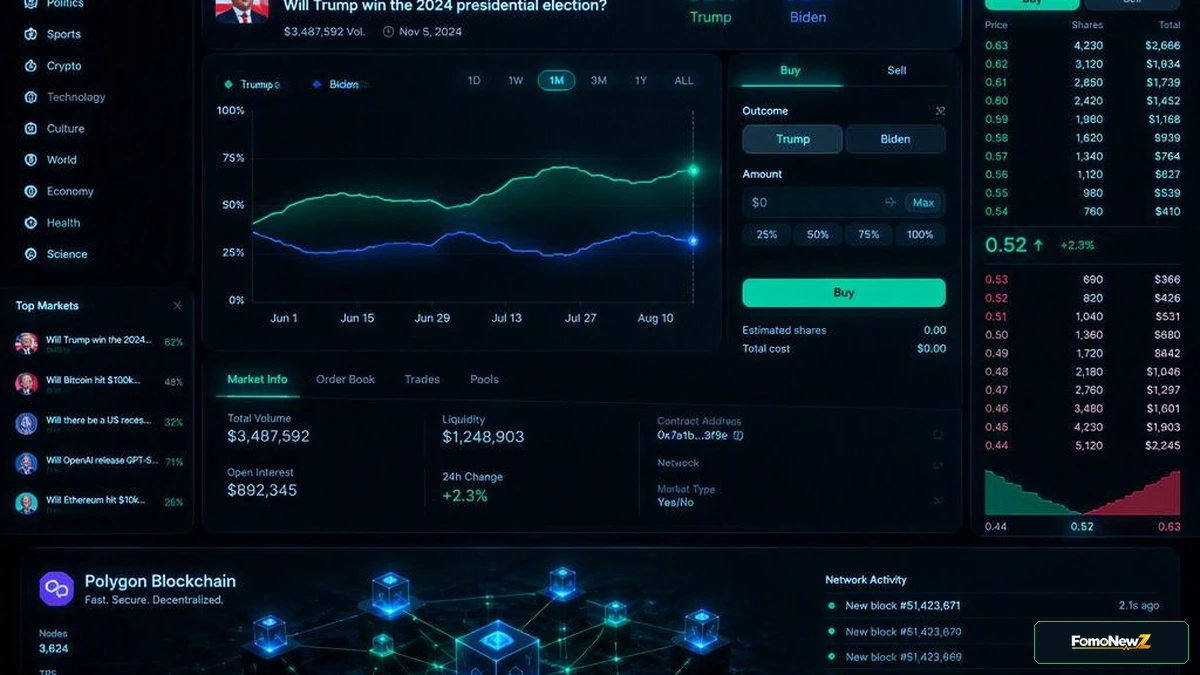
Decentralized prediction markets are recording unprecedented trading velocity in 2026, fundamentally altering the economics of online wagering. Leading the charge is Polymarket, the Polygon-based prediction protocol whose monthly open interest and volume prints have surged into billions of dollars. What began as a niche experiment in political forecasting has evolved into a full-scale alternative to centralized crypto sportsbooks, challenging the core financial model that has governed sports betting for decades.
For bettors and capital allocators exploring decentralized gaming architecture, consult our Crypto Gambling & Betting Hub and track ecosystem rotations on the Altcoins & ecosystems desk.
Chapter 02
The Core Catalyst: Zero House Edge Meets Peer-to-Peer Order Books
The architectural superiority of decentralized prediction markets over legacy bookmakers boils down to a single mathematical metric: vigorish (the bookmaker's margin). Traditional fiat sportsbooks and conventional offshore crypto books construct betting lines with a built-in mathematical advantage ranging from 4.5% to upwards of 10%. To make an even-money bet on an NFL or Premier League spread, bettors routinely risk $110 to win $100 (-110 odds), guaranteeing bookmaker profitability regardless of the outcome.
In contrast, prediction markets operate on a Central Limit Order Book (CLOB). Participants trade binary outcome shares priced between $0.00 and $1.00, representing the market's collective consensus probability. If a football club has a 65% market-implied probability of victory, shares trade at $0.65. If the outcome resolves true, the smart contract settles each share at $1.00; if false, it resolves to zero.
Because participants trade directly against other participants rather than against a casino balance sheet, the effective house edge on Polymarket is 0%. Market makers provide liquidity within tight bid-ask spreads, and capital allocators capture pure probability arbitrage without surrendering an upfront mathematical edge to an operator.
Chapter 03
Technical Architecture: Oracles and On-Chain Settlement
A fundamental distinction between centralized sportsbooks and decentralized prediction protocols lies in how outcomes are resolved and custody is maintained. When betting on centralized venues, players must trust operator data feeds and surrender custody of their digital assets. If a game is interrupted or disputed, centralized operators reserve unilateral rights to cancel bets or stall payouts.
Polymarket eliminates counterparty settlement risk through a dual-layer decentralized mechanism:
1. Central Limit Order Book (CLOB) Off-Chain Matching: Orders are matched off-chain with sub-millisecond latency to provide instantaneous execution, while settlement executes atomically on the Polygon proof-of-stake blockchain. 2. UMA Optimistic Oracle Resolution: Contract settlement is dictated by UMA's Optimistic Oracle. Proposers submit the verifiable factual outcome along with a financial bond. If no dispute is raised within a challenge window, the proposal is finalized. If challenged, UMA token holders vote on-chain, creating a decentralized court system immune to unilateral operator tampering.
| Architecture Dimension | Centralized Crypto Sportsbooks | Decentralized Prediction Markets (Polymarket) |
|---|---|---|
| House Edge / Vig | 4.5% – 10.0% (Bookmaker margin) | 0% (Pure peer-to-peer order book) |
| Custody Model | Custodial (Funds held on casino hot wallet) | Non-Custodial (Funds remain in user Web3 wallet) |
| Resolution Authority | Internal operator decision (Centralized) | UMA Optimistic Oracle (Decentralized on-chain vote) |
| Wagering Markets | Fixed lines, parlays, prop bets | Binary event shares ($0.00 – $1.00 probability pricing) |
| Settlement Asset | BTC, ETH, USDT, Multi-crypto | USDC stablecoin on Polygon POS |
Traders participating in on-chain prediction markets must safeguard their private keys against malicious contract approvals. Utilizing battle-tested hardware crypto wallets ensures private keys remain completely isolated during Web3 dApp interactions.
Chapter 04
Market Contagion: How Bookmakers Are Responding
The explosive growth of Polymarket has triggered a swift competitive response from established crypto gaming giants like Stake, Rollbit, and BC.Game. Centralized operators are countering by launching proprietary in-house prediction verticals, integrating esports live streams, and introducing 0% margin promotional boosts on major sporting events.
Furthermore, hybrid venues like Rollbit are blending sports betting with 1000x crypto perpetual leverage and token buy-and-burn revenue share, catering to high-frequency traders who desire continuous action. For traders navigating liquidity depth and execution across both centralized and decentralized order books, comparing spot spreads on audited crypto exchanges remains critical for maintaining capital efficiency.
When realizing profits from prediction market trades, converting on-chain USDC directly into everyday purchasing power can be streamlined using zero-conversion crypto debit cards, bypassing legacy banking withdrawal friction.
Chapter 05
Key Takeaways for Web3 Bettors
- Evaluate True Pricing: Always calculate the implied probability on Polymarket against sportsbook decimal or American odds to identify mispriced lines.
- Understand Oracle Timelines: Prediction market contracts may take 2 to 24 hours to finalize through optimistic oracle challenge periods, whereas centralized books settle immediately upon match whistle.
- Manage Polygon Gas Reserves: Maintain a small balance of POL tokens in your self-custody wallet to ensure seamless order cancellation and redemption transactions.
- Review Regulatory Jurisdiction: U.S. residents remain restricted from Polymarket under CFTC regulatory enforcement, whereas international participants enjoy global access.
Chapter 06
Frequently Asked Questions
Does Polymarket charge trading fees on prediction markets?
Polymarket features 0% trading fees on most standard event contracts, with market makers compensated through the bid-ask spread and liquidity incentive programs.
What happens if an event is postponed or ambiguous on Polymarket?
The market resolution rules specify exact criteria. If an event is postponed beyond the contract expiration date, UMA's Optimistic Oracle evaluates the resolution criteria; if unresolved, the market typically refunds participants at $0.50 per share.
Can I withdraw prediction market winnings instantly?
Yes. Because Polymarket settles directly into your non-custodial Polygon wallet in USDC, winnings are immediately available for decentralized swapping or off-ramping without operator withdrawal approvals.