

Chapter 01
What crypto market participants should know
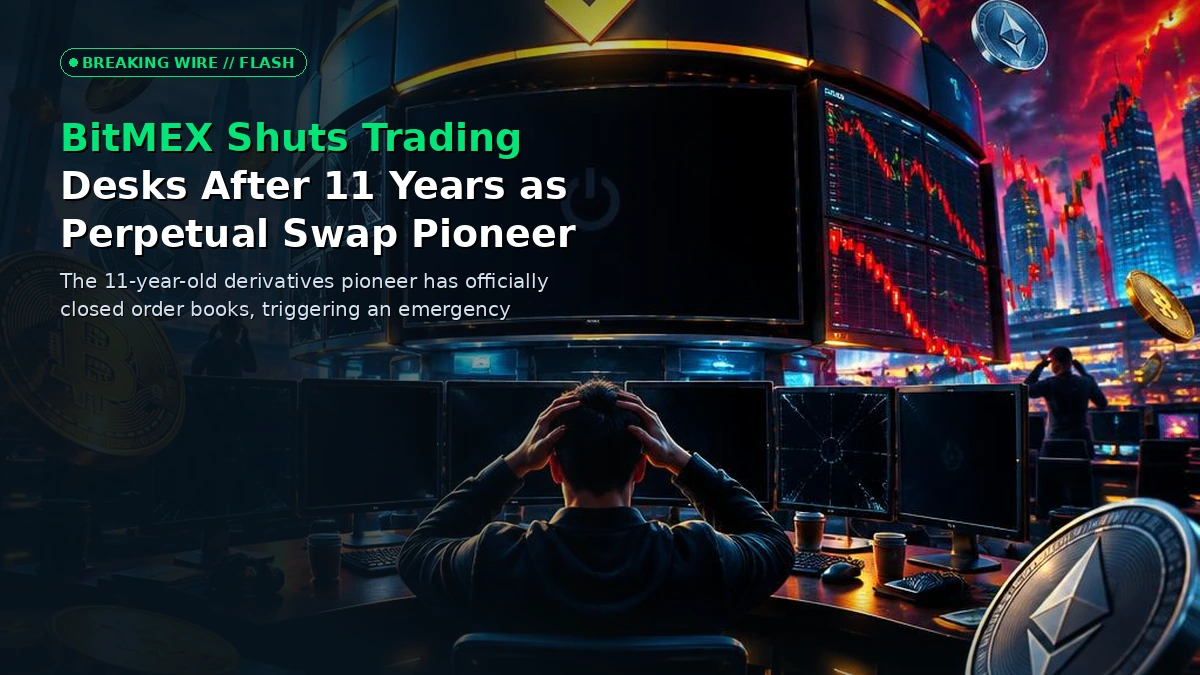
The digital asset derivatives market reached a historic inflection point today as BitMEX, the 11-year-old pioneer that originally invented the perpetual swap, officially shut down its trading desks and deposit facilities. Following a concluding operational run, active order books went dark, prompting a frantic rush of final user withdrawals as long-standing accounts scrambled to pull remaining collateral off the platform. While the platform has assured users that login portals remain temporarily functional exclusively for processing outgoing transfers, the sudden wind-down marks the definitive end of an era that fundamentally shaped modern crypto leverage. Risk remains elevated.
The friction point driving this emergency exodus centers on the swift evaporation of legacy institutional trust and the tightening noose of global regulatory compliance, leaving legacy margin platforms exposed to terminal capital flight. This is not routine market noise or a standard platform maintenance update; it represents the structural obsolescence of a founding titan that failed to successfully navigate the post-compliance era of digital asset trading. Traders seeking sustainable execution venues are increasingly migrating their volume toward modern, audited crypto exchanges equipped with transparent reserve proofs, while safeguarding capital off-platform using secure hardware crypto wallets to mitigate counterparty risk. The shift was immediate.
Chapter 02
The Core Catalyst: The Twilight of the Perpetual Swap Pioneer
To understand the magnitude of BitMEX’s closure, one must look back at its foundational architecture. Launched over a decade ago, the exchange introduced the perpetual swap—a derivative instrument with no expiry date that mimics a spot market via periodic funding payments. This single innovation unlocked the hyper-leveraged trading environment that underpins modern crypto liquidity across our comprehensive Bitcoin network analysis coverage, drawing parallels to historical cascading short liquidation rushes. Markets reacted swiftly.
However, years of mounting regulatory enforcement actions, compliance pressures, and shifting institutional preferences eroded its once-dominant market share. As liquidity fractured and migrated to multi-jurisdictional compliant giants, BitMEX’s operational runway quietly expired. On-chain metrics tracked a noticeable uptick in outbound ERC-20 and native asset transactions in the final 48 hours before trading halted, confirming that even long-term algorithmic market makers and legacy retail participants were voting with their feet to avoid solvency ambiguity. Execution remains paramount.
Chapter 03
Market Contagion & Structural Breakdown
The immediate aftermath of a legacy venue shuttering involves the forced reallocation of residual open interest and residual collateral pools. While BitMEX's remaining open interest had dwindled to a fraction of its 2017–2020 heyday, the sudden liquidation and withdrawal rush created minor localized spot deviations across peripheral order books. Traders looking to review alternative execution environments can evaluate competing platforms using comprehensive product comparisons before deploying capital elsewhere. Caution dictates strategy.
| Metric / Indicator | Current Level | 7-Day Change | Tactical Market Implication |
|---|---|---|---|
| BitMEX Trading Volume | $0 (Halted) | -100% | Complete cessation of legacy order book execution. |
| Outbound Exchange Flows | Elevated | +340% | Aggressive migration of funds to self-custody and rival desks. |
| Perpetual Funding Rates | Neutral | 0.00% | Minimal cross-market contagion; arbitrageurs absorbed shifts. |
"The closure of BitMEX is a poignant reminder that first-mover advantage cannot indefinitely outrun regulatory evolution. The liquidity has already found new homes, but the nostalgic weight of the platform that built modern crypto leverage cannot be overstated."
Chapter 04
What Happens Next: The Two Trading Scenarios
As the dust settles on this historic wind-down, the broader derivatives market faces two distinct structural trajectories over the coming sessions. Capital preserves optionality.
In the bullish expansion scenario, displaced capital from BitMEX rapidly recycles into dominant tier-1 derivatives venues and decentralized perpetual protocols. If open interest surges past current local resistance zones alongside expanding spot ETF inflows, Bitcoin could challenge its upper psychological barriers, invalidating lingering fears of systemic contagion across altcoin ecosystems tracked in our Altcoins & ecosystems desk. Volatility persists, supported further by understanding Bitcoin market liquidity mechanics across global order books.
Conversely, in the bearish invalidation floor scenario, if the forced unwinding of legacy accounts coincides with broader macroeconomic tightening, secondary margin cascades could break key structural supports. Traders should monitor funding rates closely and ensure profits are safely locked away by off-ramping liquidity or spending gains seamlessly via crypto debit cards without incurring punitive exchange fees.
Chapter 05
The Bottom Line for Traders
- Actionable Takeaway 1: Immediately log into the BitMEX portal to verify that all remaining asset balances have been successfully initiated for withdrawal.
- Actionable Takeaway 2: Transfer withdrawn funds directly into cold storage using reliable hardware crypto wallets to eliminate exchange counterparty risk entirely.
- Actionable Takeaway 3: Research and migrate active trading strategies to fully compliant, audited crypto exchanges with robust proof-of-reserves frameworks.
- Actionable Takeaway 4: Stay updated on real-time macro shifts and market wires by checking our Latest market wires for ongoing regulatory developments.
Chapter 06
Frequently Asked Questions
Can I still place new trades or open positions on BitMEX?
No. All trading operations, margin mechanisms, and deposit portals have been permanently disabled. Login access is strictly limited to facilitating historical data access and final asset withdrawals.
What should I do if I missed the withdrawal window or encounter technical errors?
Users should immediately reach out through official BitMEX support channels or monitor their official communication handles for guidance on legacy asset recovery protocols, though processing times may vary significantly.
Where is the displaced liquidity from BitMEX migrating?
The majority of institutional and retail volume is rotating into tier-1 centralized derivatives exchanges with robust regulatory frameworks, as well as decentralized perpetual DEXs operating on high-throughput layer-1 and layer-2 networks.