


Chapter 01
What crypto market participants should know
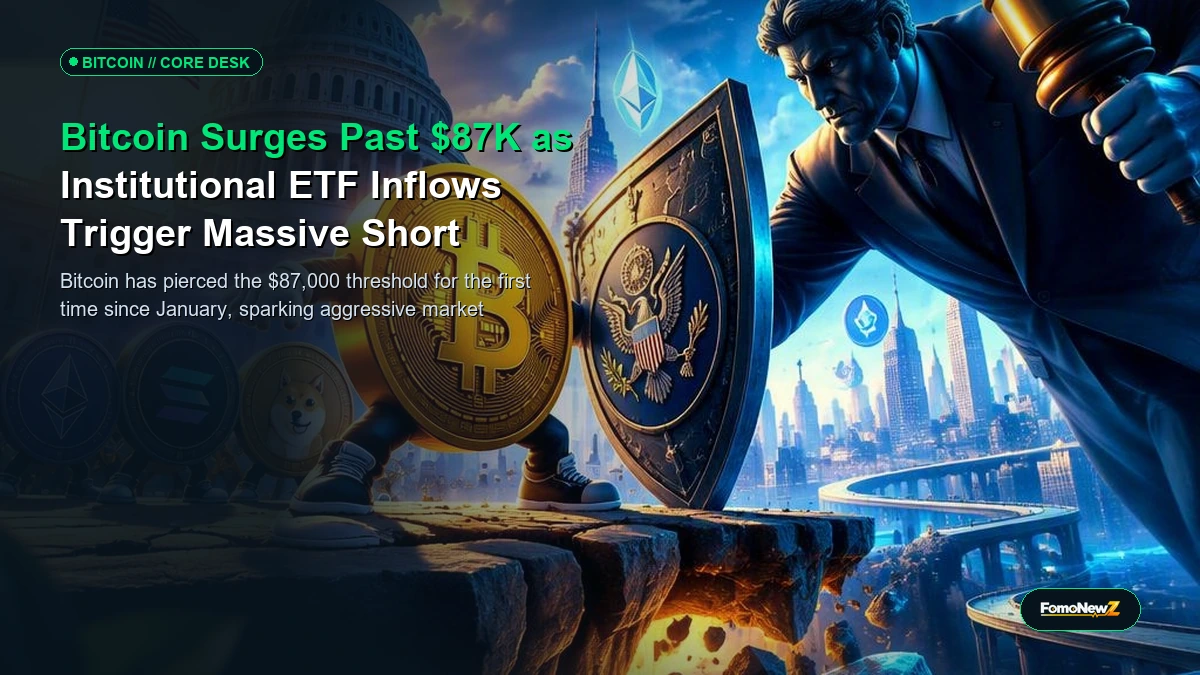
Bitcoin has officially pierced the $87,000 threshold for the first time since late January, triggering an aggressive wave of market liquidations that caught leveraged bears completely off guard. As spot prices vaulted past resistance, trading desks across global financial hubs reported surging order book volume, pushing total market capitalization higher and breathing new life into a digital asset sector that had spent weeks consolidating within a tight, directionless range.
Behind this sudden price acceleration lies a structural collision between renewed institutional accumulation and a heavily overcrowded short position. As institutional capital re-entered spot markets via exchange-traded funds, leveraged shorts betting on a deeper correction were forced into automated buybacks, creating a classic cascade effect reminiscent of historical cascading short liquidation rushes. For a deeper look at real-time price action across the ecosystem, visit the Bitcoin market news desk alongside our Latest market wires, or check live valuations on the Bitcoin live price tracker.
Chapter 02
The Core Catalyst: Institutional Inflows Meet Over-Leveraged Shorts
The mechanical driver behind Bitcoin's push past $87,000 is a potent combination of surging spot exchange-traded fund inflows and aggressive short liquidations. Corporate treasuries and institutional allocators have stepped up accumulation after weeks of passive sidelined behavior. Nigel Green, CEO of deVere Group, recently noted in analysis covering institutional Bitcoin demand that this latest upward leg has serious institutional money behind it, contrasting sharply with historical retail-driven manias. This institutional demand creates a sticky baseline of passive buying that absorbs marginal sell pressure, leaving the order books vulnerable to an upside squeeze whenever macro conditions turn favorable.
Derivatives data reveals that persistent bears had built up heavy short exposure below the $85,000 level, anticipating a rejection that never materialized. When spot bids overwhelmed regional sell walls, cascading margin calls forced these positions to liquidate, driving an accelerated upward trajectory—a phenomenon deeply intertwined with understanding Bitcoin market liquidity mechanics. Traders looking to execute strategies across volatile conditions must ensure their capital is deployed across robust infrastructure; comparing execution quality on audited crypto exchanges remains a primary defense against slippage during rapid squeezes.
Chapter 03
Market Contagion & Structural Breakdown
The shockwaves from Bitcoin's breakout did not remain confined to BTC alone. Capital quickly rotated across the broader digital asset landscape, sparking widespread momentum. Binance Coin (BNB) managed to cross the $800 threshold, while major altcoins such as Dogecoin (DOGE) and XRP logged double-digit percentage gains over a 24-hour window, as detailed in reports on cross-token market rallies, proving that risk appetite has returned in force to the broader ecosystem. For a comprehensive overview of how layer-1 tokens and alternative assets are reacting to this liquidity injection, consult our Altcoins & ecosystems coverage.
Soaring derivatives leverage introduces acute fragilities. Open interest across major perpetual swap venues has spiked dramatically, raising concerns that the market is becoming over-leveraged and vulnerable to sharp, flush-out corrections.
| Metric / Indicator | Current Level | 7-Day Change | Tactical Market Implication |
|---|---|---|---|
| Bitcoin Spot Price | $87,450 | +8.4% | Breaking multi-week resistance; targets psychological $90K handle. |
| Spot ETF Net Inflows | +$1.22B | +145% | Institutional accumulation underpinning the supply squeeze. |
| Aggregate Open Interest | $34.2B | +12.1% | Elevated leverage increases risk of sudden liquidation wicks. |
| Perpetual Funding Rates | 0.038% | Neutral-High | Longs paying modest premiums; market leaning bullish but orderly. |
"While the influx of spot ETF capital provides a formidable structural floor, the rapid accumulation of derivative leverage means traders should brace for heightened intraday volatility as the market tests the psychological $90,000 barrier." — CoinDesk Market Intelligence Report
Chapter 04
What Happens Next: The Two Trading Scenarios
As Bitcoin pushes into uncharted quarterly territory, two distinct technical pathways face the market. The bullish expansion scenario assumes that institutional ETF inflows continue unabated, absorbing available exchange liquidity and forcing remaining bears to capitulate. Under this trajectory, momentum could easily propel BTC toward a test of the psychological $90,000 level and beyond, dragging high-beta altcoins along for the ride.
Conversely, the bearish invalidation floor centers around the risk of an aggressive leverage flush. If macroeconomic headwinds flare up or ETF inflows stall, a failure to hold support above $83,500 could trigger a long squeeze, wiping out over-leveraged accounts and dragging prices back toward the mid-$70,000 consolidation zone. To safeguard accumulated capital against sudden exchange volatility, savvy investors frequently utilize secure hardware crypto wallets for long-term cold storage. Turning tactical paper gains into everyday utility without navigating complex withdrawal loops is achieved efficiently through zero-fee crypto debit cards, which offer a seamless off-ramp.
Chapter 05
The Bottom Line for Traders
- Actionable Takeaway 1: Monitor daily spot ETF net inflow reports to verify that institutional accumulation is keeping pace with retail profit-taking.
- Actionable Takeaway 2: Track aggregate derivatives open interest across major trading venues to gauge whether leverage is becoming dangerously overextended.
- Actionable Takeaway 3: Safeguard long-term holdings by transferring assets off trading platforms and into self-custody cold storage using verified hardware crypto wallets.
- Actionable Takeaway 4: Evaluate alternative trading venues and fee tiers side-by-side using comprehensive product comparisons before executing large orders.
Chapter 06
Frequently Asked Questions
Is the current $87K breakout primarily driven by retail FOMO or institutional buying?
Current on-chain metrics and ETF flow data confirm that institutional capital is the primary engine behind this move, with corporate treasuries and spot ETF products absorbing supply far more aggressively than during typical retail-led surges.
What are the main risks of trading during a short squeeze?
Rapid upward liquidations often create extreme order book volatility and wide spreads, increasing the risk of slippage. High funding rates can quickly punish long positions if the momentum stalls unexpectedly.
How can traders best protect themselves against sudden exchange liquidations?
Maintaining conservative leverage ratios, utilizing strict stop-loss parameters, and keeping the bulk of capital in secure self-custody environments rather than active margin accounts are essential risk management practices.