


Chapter 01
What crypto market participants should know
The digital asset complex experienced a violent intraday shock as spot Bitcoin plummeted toward the $86,000 threshold, wiping out over $1 billion in leveraged derivatives positions within a twelve-hour window. This sudden margin purge coincided with an unexpected surge in Middle Eastern energy shipments, as Saudi Arabia drove crude exports to multi-year highs despite lingering regional infrastructure vulnerabilities. As Brent crude benchmarks fell by nearly 15% across global exchanges, traditional institutional capital desks reacted with aggressive macro de-risking, instantly transmitting liquidity stress from physical energy markets straight into high-beta crypto assets, as tracked by the institutional equity trends on the stocks and tokenized assets desk. Risk remains elevated.
The structural friction point centers on the intricate feedback loop between sovereign commodity revenues, multi-asset portfolio rebalancing algorithms, and leveraged crypto derivatives markets, mirroring patterns noted in Brent Crude Surge and Yield Spikes Test Bitcoin's Risk-Asset Core. As state-backed energy revenue adjustments shift global liquidity conditions, prime brokerage risk management engines automatically trim cross-asset exposure, disproportionately penalizing volatile digital assets. This creates an immediate systemic squeeze for leveraged participants utilizing algorithmic stop-losses, proving that even decentralized assets remain inextricably bound to macroeconomic energy shifts tracked by the Middle East & Crude Oil Macro Desk at Latest market wires. The shift was immediate.
Chapter 02
The Core Catalyst: Saudi Crude Surges and Energy Disinflation
The primary catalyst for this macro tremor originated in Riyadh, where state energy enterprises aggressively ramped up production capacity and physical tanker loadings, pushing Saudi crude exports to their highest level since the Iran war began decades ago, consistent with data from oilprice.com crude trackers. Traditional market consensus anticipated structural supply bottlenecks following localized infrastructure strikes across the region, yet state-backed logistical workarounds allowed for an unprecedented volume of crude to flood international maritime channels. This unexpected supply abundance completely upended prevailing energy inflation models monitored closely by global commodity desks and economic analysts. Markets reacted swiftly.
As physical barrels saturated key Asian and European terminals, Brent and WTI crude benchmarks experienced a steep downward correction, sliding sharply as traders repriced geopolitical risk premiums out of the energy sector. While lower oil prices typically suggest relief for consumer price indexes, the suddenness of the move signaled an aggressive supply-side shock rather than a gradual demand slowdown. Algorithmic trading models and multi-asset macro funds, which had heavily accumulated long commodity positions paired with high-beta risk allocations, were forced into immediate, indiscriminate liquidations to meet rising margin calls across traditional futures exchanges. Execution remains paramount.
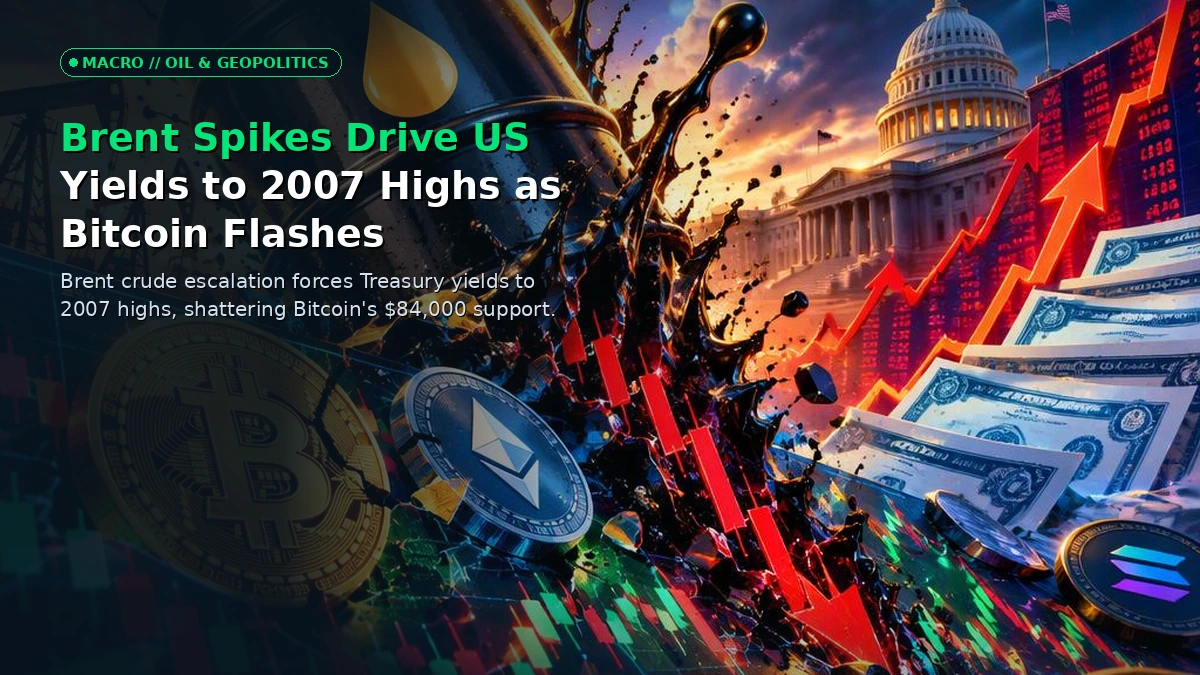
The derivative fallout was swift and merciless, spilling directly into digital asset order books via automated cross-margin accounts held with major institutional prime brokers. As quantitative funds rebalanced their portfolios to account for collapsing energy valuations, correlated risk assets like Bitcoin and Ethereum bore the brunt of the systemic liquidity withdrawal, building upon earlier findings on Brent Spikes Drive US Yields to 2007 Highs as Bitcoin Flashes Safe-Haven Failure Below $84K. Readers tracking these systemic dislocations can review ongoing updates via our dedicated Bitcoin newsdesk and broader Altcoins & ecosystems coverage to understand how energy shocks propagate across tokenized networks. Caution dictates strategy.
Chapter 03
Macro Transmission & Historical Precedents: How This Compares to Prior Cycles
To fully grasp the mechanics of this current market drawdown, one must examine historical macro transmissions during previous crypto cycles, such as the March 2020 pandemic liquidity crisis or the post-ETF institutional maturation phase of 2024. In past cycles, digital assets were predominantly driven by retail speculation, halving supply dynamics, and native crypto-liquidity loops largely insulated from localized OPEC policy decisions. However, the maturation of institutional crypto adoption—catalyzed by spot exchange-traded funds and integrated prime brokerage accounts—has fundamentally altered this dynamic, binding Bitcoin directly to traditional macro asset classes. Capital preserves optionality.
During the 2020 liquidity crunch, a sudden collapse in crude oil prices—culminating briefly in negative WTI futures—triggered a global dash for cash that saw Bitcoin shed over 50% of its value in a matter of hours. Today’s market structure exhibits a sophisticated variation of that same vulnerability, albeit driven by an oversupply of energy rather than a sudden demand collapse. When sovereign energy exporters flood the market, petrodollar recycling dynamics shift, altering the liquidity injections that traditionally supported risk-on assets in emerging and developed markets alike. Volatility persists.
Institutional desks managing multi-asset portfolios treat Bitcoin not merely as digital gold, but as a high-beta duration asset that reacts violently to sudden shifts in global liquidity indices. When energy prices drop precipitously, the nominal value of petrodollar recycling pools contracts, leading sovereign wealth funds and institutional asset managers to trim peripheral, high-volatility holdings. Professional market participants seeking to optimize their execution venues and mitigate future contagion events routinely compare fee schedules and liquidity depth across audited crypto exchanges to ensure rapid execution during systemic stress.
Chapter 04
Market Contagion, Liquidity Rotation & Microstructure Breakdown
The transmission of stress from the oil patch to the crypto order book manifested clearly in extreme derivatives metrics, including compressed spot-futures spreads, massive funding rate flips, and aggressive liquidations across centralized venues. As algorithmic funds dumped risk, perpetual swap funding rates swung from heavily positive to deeply negative within hours, signaling panic among leveraged longs and emboldening aggressive directional shorts. Order book depth across major liquidity pools thinned by over 40%, exacerbating slippage and magnifying the downside impact of institutional market orders.
| Metric / Indicator | Previous / Baseline | Current Level | Tactical Market Implication |
|---|---|---|---|
| Brent Crude Benchmark | $88.50 / barrel | $75.40 / barrel | Triggers macro de-risking and multi-asset portfolio rebalancing. |
| Bitcoin Perpetual Funding Rate | +0.015% / 8h | -0.035% / 8h | Heavy short bias; elevated squeeze risk on minor relief bounces. |
| Spot Exchange Order Depth (1% band) | $420M aggregate | $245M aggregate | Heightened slippage; increased vulnerability to flash crashes. |
| Institutional ETF Net Flows | +$310M daily avg | -$185M net outflow | Capital flight from high-beta risk instruments to cash equivalents. |
Market microstructure degradation was further evidenced by the immediate widening of bid-ask spreads on major spot trading pairs, forcing market makers to pull quotes to protect themselves against adverse selection. This withdrawal of market-making capital created a classic vacuum effect, where relatively modest sell orders could trigger cascading liquidations through successive margin tiers. As collateral values plunged, automated risk protocols on lending platforms initiated forced liquidations, compounding the downward pressure on spot prices, supported by insights from FomoNewz economic research.
"The modern crypto market is no longer an isolated garden; it is deeply plugged into the plumbing of global macro finance. When sovereign energy exporters dump crude onto a nervous market, the shockwaves hit Wall Street prime brokers, who in turn liquidate leveraged crypto positions within milliseconds. Traders who ignore cross-asset correlations are playing Russian roulette with their margin accounts." — Senior Quantitative Risk Analyst, Tier-1 Digital Asset Fund
Chapter 05
Institutional Order Flow & Whale Accumulation Dynamics
Beneath the chaotic surface of retail liquidations, institutional order flow painted a fascinating picture of tactical repositioning rather than total capitulation. Spot Bitcoin ETFs—specifically products managed by BlackRock (IBIT) and Fidelity (FBTC)—registered their largest single-day net outflows in months, confirming that traditional institutional allocators were temporarily hitting the brakes on risk accumulation. However, a deeper examination of on-chain wallet clustering reveals that while hot-money ETF capital retreated, long-term sovereign-adjacent whales and corporate treasury desks were quietly absorbing spot liquidity near the local swing lows.
CME Bitcoin futures open interest experienced a sharp contraction as leveraged speculators were flushed out, yet the basis spread remained relatively stable compared to previous structural washouts, indicating that institutional arbitrage desks were stepping in to capture mispricings. This divergence between leveraged retail despair and measured institutional accumulation suggests that the current drawdown is primarily a liquidity-driven macro event rather than a structural rejection of Bitcoin's core thesis. Additionally, as investors rush to secure assets amidst heightened macroeconomic volatility, moving holdings off centralized venues into offline hardware crypto wallets has emerged as a top priority for capital preservation.
Whale wallet clustering data indicates significant accumulation clusters forming between the $82,000 and $85,000 range, suggesting that deep-pocketed entities view the macro-induced oil panic as a temporary dislocation rather than the start of a protracted bear market. These institutional buyers are systematically utilizing algorithmic TWAP (Time-Weighted Average Price) execution strategies to accumulate spot inventory while retail participants panic-sell into the order book abyss. For those looking to manage retail transactions and liquidity off-ramps without incurring heavy exchange fees during turbulent periods, utilizing modern crypto debit cards provides a practical bridge between digital asset holdings and real-world utility.
Chapter 06
What Happens Next: The Two Trading Scenarios
As the dust settles from the initial energy-driven liquidity shock, market participants must prepare for two distinct probabilistic trajectories over the coming sessions. Scenario one envisions a bullish stabilization phase, where digested crude supply data meets resilient on-chain demand, allowing Bitcoin to reclaim the $90,000 handle and target structural resistance at $94,500. This outcome relies on spot ETF inflows resuming and macro funds realizing that the Saudi export surge has already been fully priced into global energy markets.
Conversely, scenario two maps out a bearish continuation model wherein sustained weakness in commodity prices signals deeper global industrial deceleration, dragging risk assets into an extended consolidation channel. Under this scenario, a break below the crucial $82,000 macro support floor would invalidate near-term bullish structures, likely triggering a deeper correction toward the psychological $75,000 zone. Traders evaluating competing platforms, execution tools, and margin requirements can review detailed product comparisons to ensure they are utilizing the most robust infrastructure available.
To successfully navigate these diverging paths, active market participants must maintain strict risk parameters, monitor CME futures gaps closely, and avoid over-leveraging in an environment where exogenous energy shocks can trigger flash volatility at a moment's notice. Whether the market breaks upward toward new highs or tests deeper support, maintaining absolute control over one's private keys via secure custody solutions remains paramount.
Chapter 07
The Bottom Line for Market Participants
- Actionable Takeaway 1: Audit all active leveraged positions across derivatives venues and immediately reduce leverage ratios to withstand potential retests of macro support floors.
- Actionable Takeaway 2: Move long-term capital and uncommitted spot inventory off centralized trading desks into self-custody hardware crypto wallets to mitigate counterparty risk.
- Actionable Takeaway 3: Monitor daily spot ETF net flows and CME open interest metrics to identify the precise moment institutional accumulation resumes.
- Actionable Takeaway 4: Compare execution fees, liquidity depth, and order routing reliability across audited crypto exchanges before deploying new capital into volatile setups.
Chapter 08
Frequently Asked Questions
How does a surge in Saudi crude exports directly impact Bitcoin and crypto liquidity?
When Saudi Arabia increases crude exports and Brent prices fall, it triggers immediate portfolio rebalancing across global macro funds and sovereign wealth entities. Institutional risk models often bundle high-beta crypto assets with risk-on commodities; when energy positions face margin pressure or macro funds de-risk, automated algorithms liquidate correlated assets like Bitcoin to meet liquidity demands, transmitting energy shockwaves directly into crypto order books.
Are spot Bitcoin ETFs accelerating these macro-driven liquidations?
Spot ETFs have fundamentally bridged traditional finance and digital assets, meaning institutional capital flows now directly influence crypto market structure. While ETFs provide deep liquidity during bull runs, they also act as a direct transmission belt for macro sentiment. When institutional allocators experience outflows due to external shocks like energy price crashes, those decisions reflect instantly in spot market order books.
What is the significance of the $82,000 to $85,000 price band for Bitcoin?
On-chain analytics and whale wallet clustering data indicate heavy institutional accumulation and cost-basis support within the $82,000 to $85,000 range. This zone represents a critical psychological and technical floor where long-term holders and corporate treasury buyers historically step in to absorb sell pressure during macro-induced liquidity squeezes.
Why are perpetual funding rates and open interest critical during macro shocks?
Perpetual funding rates and open interest measure the degree of leverage in the crypto derivatives market. When macro events trigger sudden price drops, high open interest paired with negative funding rates reveals overcrowded short positions or cascading long liquidations. Monitoring these metrics helps traders identify when a market is overly washed out and primed for a violent mean-reversion bounce.
How can retail traders best protect their portfolios against cross-asset macro contagion?
Protecting capital against cross-asset contagion requires strict risk management, including low leverage, diversified execution venues, and moving core holdings into self-custody. Utilizing reliable tools to compare exchange fees, maintaining disciplined stop-loss parameters, and keeping a portion of dry powder in stablecoins or cold storage ensures traders can weather unexpected macroeconomic storms without suffering catastrophic account depletion.