

Chapter 01
What crypto market participants should know
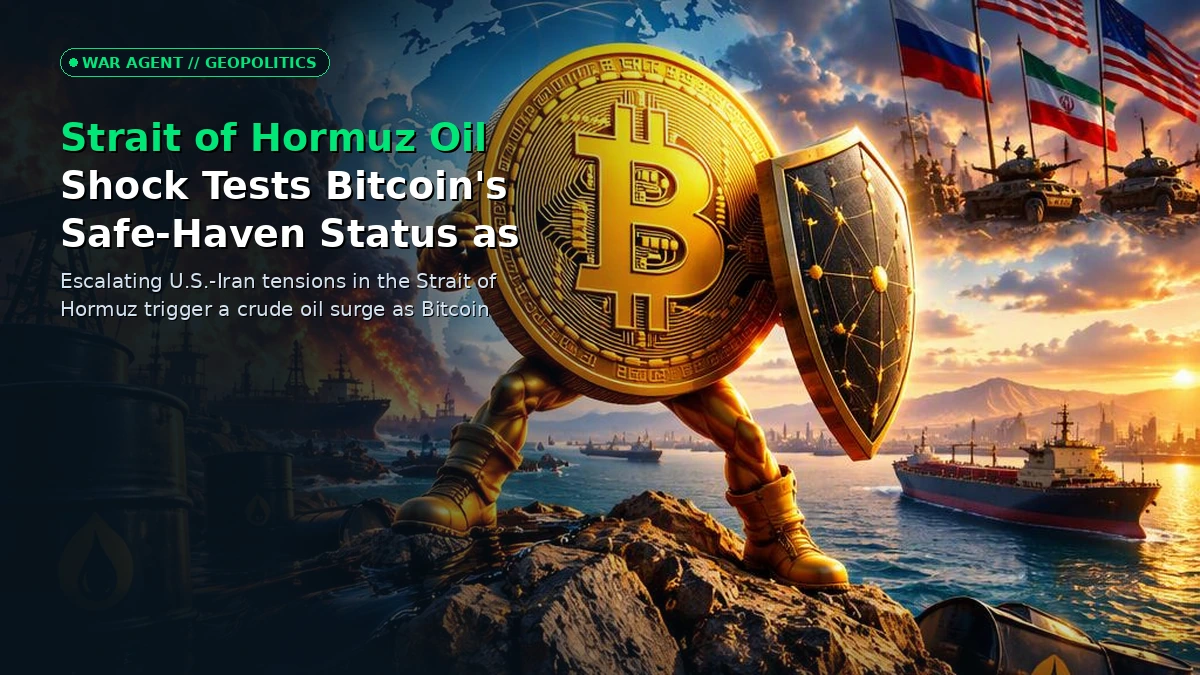
The global financial markets are facing an unprecedented stress test as escalating U.S.-Iran geopolitical friction converges on the Strait of Hormuz, threatening a catastrophic choke point for nearly a fifth of the world’s petroleum supply. Amid surging Brent crude volatility and violent spikes in the DXY dollar index, Bitcoin has firmly stabilized above the critical $86,000 psychological threshold, commanding an imposing $1.73 trillion market capitalization. While traditional equity benchmarks and sovereign bonds react with standard risk-off contractions, the premier digital asset is exhibiting a resilient floor, forcing institutional allocators to re-evaluate whether decentralized assets are finally decoupling into genuine safe-havens or simply consolidating ahead of a broader macro liquidation event. Risk remains elevated.
The primary friction point lies in the violent cross-currents between traditional energy risk premiums and digital asset liquidity plumbing. Institutional desks, tracking real-time updates via our Bitcoin newsdesk and latest market wires, are caught in a structural tug-of-war, with public market integration tracked by the crypto stocks desk. On one side, skyrocketing oil prices threaten global inflation resurgences, forcing central banks to rethink monetary easing paths and driving a flight to fiat safety. On the other side, corporate treasuries and macro hedge funds are increasingly viewing decentralized scarcity as an essential hedge against sovereign currency devaluation and geopolitical asset seizures, a dynamic further highlighted in recent analysis on Coinbase Balance Sheet Exposes How USDC Yields Drive COIN Equity Valuations. This tension is not routine market noise; it is a high-stakes referendum on Bitcoin's long-term macro correlation profile during an active energy shock. The shift was immediate.
Chapter 02
The Core Catalyst: Choke Point Economics and On-Chain Liquidity Depth
The macroeconomic mechanics driving the current environment are rooted in the physical vulnerability of maritime energy corridors. As geopolitical rhetoric intensifies around the Strait of Hormuz, energy traders are pricing in immediate supply shocks, driving Brent crude futures into violent backwardation. This energy shock directly impacts global liquidity, tightening financial conditions across traditional equity and debt markets. Yet, despite macroeconomic headwinds that historically crush risk-on assets, Bitcoin's order book depth across major audited crypto exchanges has absorbed multi-million-dollar sell walls without cascading into structural liquidations. Markets reacted swiftly.
On-chain metrics reveal a fascinating dichotomy beneath the surface price action. While exchange inflows have ticked up slightly as jittery retail investors seek short-term liquidity, long-term holder (LTH) supply remains remarkably sticky, a trend reinforced by recent analysis on Why Bitcoin Whales Are Silently Accumulating Supply While BTC Stalls at $85K. Dormant coins aged over one year continue to show net accumulation, signaling that institutional and high-net-worth market participants are utilizing price stabilization above $86,000 to quietly lock away inventory. For advanced traders seeking to execute complex hedging strategies across spot and derivatives desks, evaluating platform infrastructure via side-by-side product comparisons has become paramount as systemic counterparty risk comes back into focus. Execution remains paramount.
Chapter 03
Market Contagion & Structural Breakdown
The secondary shockwaves of the Middle East energy crisis are rapidly rippling through broader digital asset sectors, as tracked closely by our Altcoins & ecosystems coverage and reported by CoinDesk. High-beta Layer-1 tokens and decentralized finance (DeFi) yield protocols are experiencing elevated liquidation cascades as leveraged long positions get wiped out by sudden macroeconomic flash crashes. Funding rates across perpetual swap markets have compressed significantly, indicating that speculative excess has been thoroughly flushed out of the system, leaving behind a cleaner, spot-driven market structure anchored by institutional balance sheets. Caution dictates strategy.
| Metric / Indicator | Current Level | 7-Day Change | Tactical Market Implication |
|---|---|---|---|
| Bitcoin Price / Market Cap | $86,450 / $1.73T | +2.4% | Demonstrating structural resilience above key macro support. |
| Brent Crude Volatility Index | Elevated (34.2) | +14.8% | High geopolitical risk premium driving safe-haven demand. |
| Perpetual Swap Funding Rates | Neutral (0.01%) | -0.03% | Speculative leverage purged; lower risk of cascading longs. |
| Exchange Reserve Balances | 2.12M BTC | -0.8% | Continued steady outflow toward long-term cold storage. |
Market veterans note that the current regime shift mirrors historical geopolitical crises, albeit with a vastly superior institutional safety net. As macro strategist Julian Vance noted in a recent briefing with institutional clients, referencing data mirrored on Cointelegraph: Capital preserves optionality.
"We are witnessing the ultimate stress test for digital collateral. When energy corridors freeze and fiat currencies wobble, capital doesn't just vanish—it seeks the hardest mathematical container available. Bitcoin holding $86K in the face of a crude oil spike proves that institutional portfolios now view sovereign risk and digital scarcity through the exact same risk lens."
Chapter 04
What Happens Next: The Two Trading Scenarios
As the geopolitical standoff in the Middle East evolves, market participants must prepare for two distinct probabilistic pathways over the coming sessions. The bullish expansion scenario assumes that diplomatic channels manage to prevent a physical blockade of the Strait of Hormuz while persistent inflation fears drive capital further into hard assets, a dynamic also noted by Bitcoin.com. In this environment, Bitcoin is positioned to break out past immediate overhead resistance at $90,000, triggering a fresh wave of corporate treasury announcements and driving altcoin liquidity reclamation. Volatility persists.
Conversely, the bearish invalidation floor centers on an unexpected military escalation that triggers a wholesale liquidity crunch across all global risk markets. If Brent crude surges past critical psychological ceilings and forces central banks into emergency monetary tightening, Bitcoin could experience a sharp sweep of the $82,000 support level, testing the resolve of leveraged institutional holders. Protecting capital against such sudden volatility mandates that investors move speculative trading profits into offline hardware crypto wallets to ensure absolute private key sovereignty away from custodial exchange risks.
Chapter 05
The Bottom Line for Traders
Navigating this geopolitical macro storm requires a disciplined, checklist-driven approach to risk management and execution architecture.
- Actionable Takeaway 1: Verify your exchange execution venues and confirm optimal margin requirements by checking liquidity depth across tier-one audited crypto exchanges.
- Actionable Takeaway 2: Secure all core capital and long-term stack allocations offline using multi-sig or single-owner hardware crypto wallets to mitigate counterparty risk.
- Actionable Takeaway 3: Monitor real-time energy markets, specifically Brent crude spot movements and DXY fluctuations, as primary leading indicators for short-term BTC volatility.
- Actionable Takeaway 4: For investors looking to monetize paper gains into real-world purchasing power during macro turbulence, spending digital asset and stablecoin yields globally via crypto debit cards offers seamless liquidity.
Chapter 06
Frequently Asked Questions
Question 1?
How does a potential energy crisis in the Strait of Hormuz directly impact Bitcoin's price action? An energy crisis drives up global inflation expectations and rattles traditional equities, which initially triggers broad-based macro liquidations. However. the realization of fiat currency devaluation sets in, Bitcoin increasingly attracts flight-to-safety capital looking for a non-sovereign hedge against geopolitical chaos.
Question 2?
Why is the $86,000 threshold considered critical for institutional market structure? Holding $86,000 keeps Bitcoin's market capitalization comfortably above the $1.73 trillion mark, validating key institutional accumulation zones established during previous quarters. A breakdown below this level would invalidate short-term bullish market structures and trigger cascading liquidations across leveraged derivatives desks.
Question 3?
Should retail investors alter their custody strategy during heightened geopolitical tensions? Yes, periods of acute geopolitical stress invariably increase the operational and regulatory risks facing centralized financial platforms. Moving core holdings into self-custodial storage solutions ensures complete sovereignty over digital assets regardless of macroeconomic or platform-specific disruptions.