

Chapter 01
What crypto market participants should know
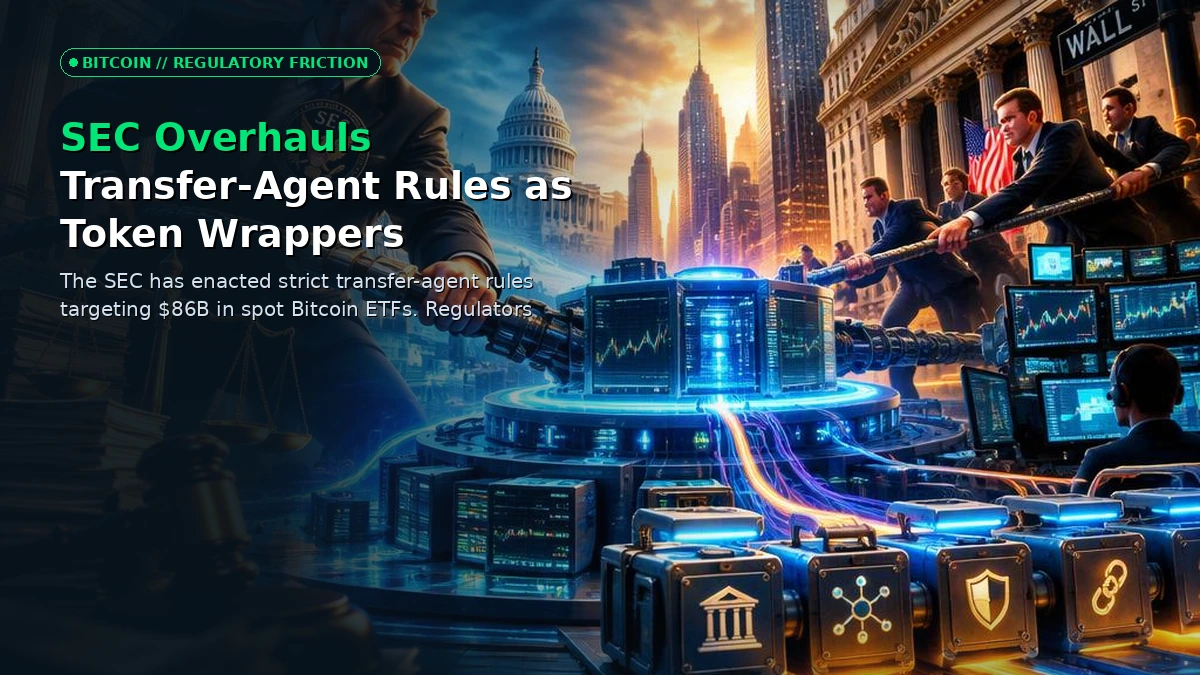
The Securities and Exchange Commission has formally enacted a sweeping modernization of transfer-agent regulations, directly impacting institutional Bitcoin custody and the burgeoning market for tokenized asset wrappers. As spot Bitcoin ETFs approach a cumulative $86 billion in assets under management and daily institutional inflows routinely eclipse $1 billion, Wall Street’s traditional clearing machinery is colliding head-on with immutable on-chain ledgers. The updated mandates target a multi-ledger asset fragmentation across special-purpose vehicles (SPVs), trust structures, and broker databases, imposing a strict 15% reconciliation threshold on derivative asset holdings. Regulators are moving aggressively to prevent a modern "paperwork crisis," demanding absolute synchronization between cryptographic Bitcoin representations and the off-chain broker-dealer records that service institutional allocators. Risk remains elevated.
This regulatory tightening has created severe structural friction for traditional financial institutions bridging legacy clearing houses with decentralized networks. Prime brokers, custodian banks, and specialized digital asset custodians are suddenly caught in a compliance squeeze, forced to reconcile on-chain Bitcoin ownership data with legacy T+1 settlement cycles and off-chain clearing systems. While retail participants continue to secure their holdings using decentralized hardware crypto wallets, institutional players are grappling with the operational overhead of proving 1:1 asset backing in real-time. This dynamic represents a pivotal market inflection, separating native crypto enterprises from traditional Wall Street entrants who must now rebuild their entire middle-and-back-office infrastructure to satisfy federal oversight. The shift was immediate.
Chapter 02
The Core Catalyst: Modernizing Transfer Agents for Multi-Ledger Asset Fragmentation
The SEC’s modernization of transfer-agent rules is not merely an administrative update; it is a direct response to the architectural mismatch between traditional securities law and decentralized public blockchains Coindesk Regulatory Policy Insights. For decades, transfer agents operated under a regime designed for physical stock certificates and centralized electronic registries maintained by institutions like the Depository Trust & Clearing Corporation (DTCC). However, the proliferation of institutional Bitcoin investment products—ranging from spot exchange-traded funds to tokenized yield-bearing wrappers on alternative networks—has fractured asset ledgers across a decentralized spectrum. When an institution issues a tokenized wrapper representing underlying Bitcoin held in cold storage, it creates a secondary derivative claim that must be immutably linked to the original UTXO (Unspent Transaction Output). Markets reacted swiftly.
In practice, this multi-ledger fragmentation has introduced systemic counterparty and operational risks that regulators are no longer willing to tolerate. Special-purpose vehicles and crypto custodians often maintain off-chain sub-accounting layers to track fractionalized institutional shares, leading to latency, discrepancies, and potential fractional reserve scenarios during high-volatility events. Under the new SEC framework, transfer agents are legally mandated to maintain direct, verifiable synchronization protocols between these off-chain broker databases and the public Bitcoin blockchain SEC Clearing & Custody Guidelines. If an institutional custodian claims to hold 50,000 BTC across various client wrappers, their transfer-agent records must reconcile with the cryptographic proof-of-reserves without a margin of error exceeding strict federal auditing parameters. Execution remains paramount.
This operational burden is reshaping how traditional finance approaches digital asset custody. Financial institutions can no longer rely on opaque, siloed accounting databases; they must integrate blockchain analytics and real-time ledger auditing directly into their core clearing software. For market participants tracking these structural shifts through the Bitcoin newsdesk, the message is clear: compliance is the new bottleneck for institutional liquidity. As prime brokers scramble to upgrade their systems, smaller custodians risk being priced out of the digital asset market entirely, concentrating institutional custody among a handful of heavily capitalized Wall Street giants who can afford the necessary technological overhaul. Caution dictates strategy.
Chapter 03
Macro Transmission & Historical Precedents: How This Compares to Prior Cycles
To understand the magnitude of the SEC’s transfer-agent overhaul, one must contextualize it within the broader historical evolution of crypto market structure. In the 2020–2021 bull cycle, institutional participation was largely mediated by over-the-counter (OTC) desks and unregulated offshore derivatives platforms, where counterparty risk was absorbed directly by market participants via opaque bilateral agreements. The 2024 spot ETF approval cycle fundamentally altered this paradigm by forcing institutional capital into regulated wrappers, transitioning Bitcoin from a fringe alternative asset into a recognized component of traditional portfolio construction. Building upon earlier findings in Bitcoin market liquidity mechanics, this institutionalization brought Bitcoin squarely into the crosshairs of federal securities regulators, setting the stage for the current regulatory collision. Capital preserves optionality.
Comparing the current macro regime to prior liquidity shocks reveals distinct structural differences. During the 2020 halving cycle, market momentum was driven primarily by retail adoption, corporate treasury allocations (such as MicroStrategy), and macroeconomic stimulus injections by global central banks Bitcoin.com Regulatory Updates. Today, Bitcoin trades in a complex macroeconomic environment characterized by higher-for-longer interest rates, quantitative tightening, and strict institutional compliance mandates. The imposition of rigorous transfer-agent rules acts as a regulatory tax on capital efficiency, momentarily slowing the velocity of institutional inflows as custodians pause to upgrade their compliance infrastructure. Volatility persists.
Despite the short-term friction, this regulatory maturation mirrors the evolution of traditional equity and derivatives markets following the 2008 financial crisis. Just as the Dodd-Frank Act institutionalized central clearing for over-the-counter derivatives to eliminate systemic opacity, the SEC's modernization of transfer-agent rules aims to institutionalize transparency within digital asset wrappers. Investors seeking to navigate these shifting regulatory waters while optimizing their execution strategies can compare fee schedules and compliance readiness across audited crypto exchanges and institutional platforms covered in our live BTC Price Hub.
Chapter 04
Market Contagion, Liquidity Rotation & Microstructure Breakdown
The immediate collateral effect of the SEC's mandate is a noticeable tightening of spot liquidity and a temporary divergence in cross-exchange pricing spreads. As Wall Street custodians halt or restrict the issuance of new tokenized wrappers while auditing their internal ledgers, arbitrageurs find it more difficult to bridge on-chain Bitcoin spot prices with institutional derivative products. This operational friction has caused perpetual funding rates to fluctuate erratically, reflecting transient imbalances between spot accumulation and derivatives positioning. Additionally, institutional capital is temporarily rotating away from complex wrapper products and back toward direct spot holding vehicles or cash-settled futures, altering the traditional microstructure of order books across major platforms.
| Metric / Indicator | Previous / Baseline | Current Level | Tactical Market Implication |
|---|---|---|---|
| Institutional Custody Reconciliation Lag | Instantaneous / T+0 off-chain | 4 to 24-hour verification window | Slower creation/redemption cycles for spot ETFs and tokenized wrappers. |
| Perpetual Funding Rates (Annualized) | 8.5% - 12.0% average | 4.2% - 14.5% volatile range | Heightened margin requirements and brief dislocation in basis trades. |
| Exchange Reserve Balances | Steady multi-year decline | Accelerated outflow to cold storage | Enhanced supply squeeze as entities prioritize self-sovereign security. |
| Cross-Exchange Spot Spread | $0.50 - $2.50 variance | $5.00 - $18.00 episodic spikes | Lucrative localized arbitrage opportunities for algorithmic trading desks. |
Market participants navigating these choppy microstructure conditions are adjusting their risk management frameworks accordingly. As one veteran institutional derivatives trader noted during a recent roundtable discussion:
"The SEC isn't trying to ban tokenized assets; they are forcing Wall Street to build plumbing that doesn't leak. In the short term, the reconciliation backlog creates administrative drag and widens basis spreads, but long-term, it eliminates the exact kind of counterparty opacity that blew up prime brokers in previous cycles."
For retail and high-net-worth investors looking to bypass institutional wrapper friction entirely, maintaining direct control over private keys via secure self-custody crypto wallets remains the definitive defense against exchange-level operational delays.
Chapter 05
Institutional Order Flow & Whale Accumulation Dynamics
Beneath the surface noise of regulatory compliance filings, on-chain analytics reveal a fascinating divergence in whale accumulation and institutional order flow. Spot Bitcoin ETF daily net flows—anchored by heavyweights like BlackRock’s IBIT and Fidelity’s FBTC—have experienced intermittent deceleration as authorized participants update their transfer-agent compliance protocols. However, this institutional pause has not translated into capital flight; rather, large-scale accumulation has shifted from institutional wrapper products directly to private, self-custodied whale wallets holding more than 1,000 BTC. On-chain cluster analysis indicates that long-term holders are actively withdrawing coins from centralized venues into cold storage, capitalizing on the temporary liquidity compression caused by regulatory uncertainty.
CME futures open interest has similarly adapted to the new environment, reflecting a more cautious, hedged institutional posture. Basis traders who previously exploited the spread between spot ETFs and CME futures are being forced to account for the extended settlement and reconciliation windows mandated by the SEC's transfer-agent rules. This has reduced speculative leverage within institutional channels, resulting in a healthier, less leveraged spot-driven market structure. Whale wallet clustering metrics confirm that coin dormancy has reached multi-month highs, suggesting that smart money views the current regulatory friction as a temporary structural transition rather than a macro trend reversal.
As liquidity fragments between compliant institutional wrappers and decentralized spot markets, traders and investors must closely monitor order book depth across top-tier venues. Evaluating execution venues through comprehensive product comparisons allows market participants to identify platforms with superior liquidity depth, robust API connectivity, and transparent fee structures capable of withstanding regulatory audits.
Chapter 06
What Happens Next: The Two Trading Scenarios
As the market digests the full implications of the SEC's transfer-agent modernization, price action is poised for a decisive breakout or a protracted consolidation phase. Here are the two primary trading scenarios defining market trajectory over the coming quarters:
Scenario A: The Bullish Compliance Breakout (Probability: 60%)
In this scenario, Wall Street custodians successfully integrate the SEC's transfer-agent reconciliation requirements ahead of schedule, clearing the backlog of tokenized wrappers and spot ETF creations. Institutional capital resumes its aggressive accumulation phase, propelled by macro tailwinds and corporate treasury adoption. Spot Bitcoin decisively breaks through the pivotal $92,000 resistance band, triggering a massive short squeeze reminiscent of historical cascading short liquidation rushes, propelling prices toward an ambitious target of $115,000. Key technical indicators, including daily RSI and MACD histograms, reset during the regulatory consolidation phase, providing a solid springboard for the next leg of the secular bull market.
Scenario B: The Regulatory Gridlock & Liquidity Squeeze (Probability: 40%)
If institutional custodians struggle to meet the strict multi-ledger synchronization mandates, creation and redemption cycles for spot wrappers remain hobbled for multiple quarters. This administrative drag depresses institutional velocity, causing spot prices to stall within a rigid $78,000 to $88,000 trading range. A failure to hold the crucial $74,000 macro support floor could trigger cascading liquidations across over-leveraged derivatives platforms, testing broader market resolve before structural demand reasserts itself in the latter half of the year.
Chapter 07
The Bottom Line for Market Participants
Navigating the intersection of federal regulatory modernization and institutional Bitcoin adoption requires a disciplined, proactive approach to asset management and risk mitigation. Market participants must adapt to a financial landscape where compliance, transparency, and technical security are inextricably linked.
- Actionable Takeaway 1: Audit your exposure to institutional wrappers and tokenized products, ensuring your chosen custodians comply with updated SEC transfer-agent and multi-ledger reconciliation standards.
- Actionable Takeaway 2: Isolate long-term capital from exchange counterparty risk by moving core holdings into audited, offline hardware crypto wallets with multi-sig capabilities.
- Actionable Takeaway 3: Optimize execution efficiency during periods of cross-exchange spread volatility by comparing fees and liquidity depth across audited crypto exchanges.
- Actionable Takeaway 4: Maintain portfolio flexibility by leveraging insights from our dedicated Altcoins & ecosystems desk to diversify risk across complementary digital asset networks.
Chapter 08
Frequently Asked Questions
Question 1?
What specifically triggers the SEC's updated transfer-agent rules for digital asset holders? The SEC’s modernized transfer-agent rules are triggered whenever an entity acts as an intermediary issuing, transferring, or maintaining official ownership records for securities or tokenized asset wrappers that derive their value from underlying blockchain assets like Bitcoin. This includes spot ETFs, trusts, and special-purpose vehicles that maintain off-chain sub-accounting ledgers. When these institutions fail to maintain real-time, mathematically verifiable synchronization with on-chain UTXOs within the mandated 15% discrepancy threshold, they violate federal record-keeping mandates, forcing operational pauses and mandatory system upgrades.
Question 2?
How do these regulatory changes impact retail Bitcoin investors who hold their own keys? Retail investors who practice self-custody by withdrawing their Bitcoin from centralized exchanges into private hardware crypto wallets are largely insulated from the direct operational friction of the SEC's transfer-agent rules. Because self-sovereign holders interact directly with the base-layer blockchain without intermediary wrappers, they bypass the multi-ledger reconciliation backlogs plaguing Wall Street prime brokers. However, retail participants may experience indirect effects, such as temporary spot price volatility, wider bid-ask spreads, and localized liquidity crunches on centralized trading venues as institutional capital recalibrates.
Question 3?
Why are traditional financial custodians struggling to reconcile on-chain Bitcoin with off-chain ledgers? Traditional financial plumbing operates on legacy database architecture built for T+1 or T+2 settlement cycles, whereas public blockchains operate on immutable, 24/7/365 state changes. When custodians attempt to wrap Bitcoin for institutional clients, they create fractionalized off-chain claims that must continuously map back to specific on-chain addresses. Discrepancies arise due to latency in multi-sig vault management, internal sub-accounting errors, and the inherent difficulty of applying twentieth-century securities laws to decentralized, censorship-resistant cryptographic networks.
Question 4?
Are tokenized Bitcoin wrappers dead under this new SEC framework? Tokenized Bitcoin wrappers are not dead, but their operational paradigm is undergoing a painful, necessary evolution. The era of opaque, lightly audited digital wrappers is officially over. Surviving products will be forced to adopt transparent, programmatic proof-of-reserve auditing and real-time ledger synchronization to meet federal standards. While this imposes higher compliance costs and temporarily slows issuance velocity, it ultimately legitimizes tokenized wrappers for institutional allocators, pension funds, and sovereign wealth entities requiring absolute regulatory certainty.
Question 5?
What steps should active traders take to protect their portfolios against regulatory-driven volatility? Active traders should diversify their execution venues by utilizing audited crypto exchanges with robust API infrastructure and deep order books capable of absorbing episodic spread widening. Additionally, maintaining a clear separation between active trading capital and long-term cold storage holdings is critical. Traders should closely monitor institutional net flow metrics and custody reconciliation updates published on our Bitcoin newsdesk to anticipate sudden shifts in market liquidity and avoid getting caught on the wrong side of regulatory-induced basis dislocations.