


Chapter 01
What crypto market participants should know
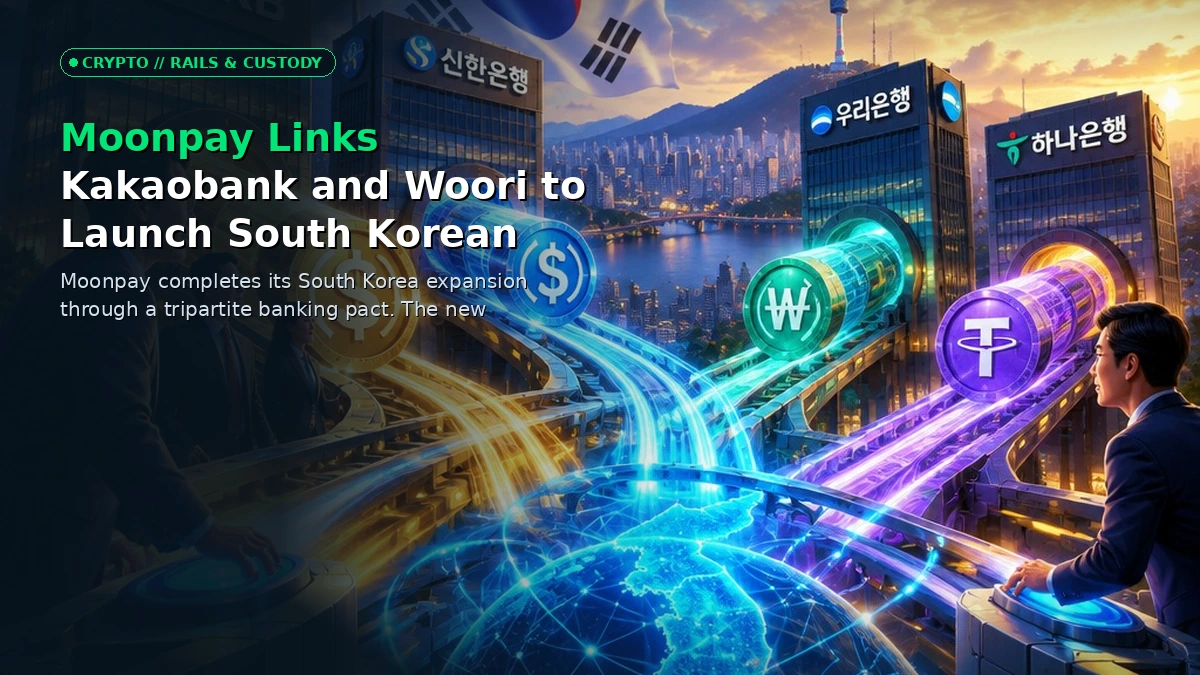
The geopolitical and regulatory topography of digital asset adoption shifted on its axis this week as Moonpay officially completed its expansion into the South Korean market. Backed by a historic tripartite alignment with Kakaobank, Woori Bank, and KB Financial Group, Moonpay's newly minted domestic subsidiary is engineering an unprecedented conduit for institutional capital. This integration is not merely another retail on-ramp; it establishes a multi-billion-dollar liquidity bridge capable of channeling South Korea's notoriously aggressive retail and institutional trading volume directly into compliant, tokenized asset rails. With enterprise-grade stablecoin infrastructure anchoring the plumbing, the initiative bypasses historical regulatory bottlenecks that have long plagued cross-border crypto settlement in East Asia. Risk remains elevated, requiring market participants to closely monitor on-chain metrics tracked by the Bitcoin newsdesk.
For years, the South Korean digital asset ecosystem operated behind a metaphorical Iron Curtain known locally as the "Kimchi premium" and rigid banking silos that forced domestic exchanges to maintain exclusive partnerships with single banking institutions. This fragmented architecture created structural friction points, squeezing arbitrage desks, venture funds, and institutional market makers who struggled to move fiat liquidity efficiently in and out of spot markets. The intervention of Moonpay, acting in lockstep with banking behemoths like KB Financial Group and Woori Bank, shatters these legacy silos. By embedding tokenized asset rails directly into the core banking applications used by tens of millions of citizens, this development represents a watershed market inflection, transforming South Korea from an isolated island of speculative fervor into a fully integrated node of the global crypto economy. The shift was immediate, mirroring past cascading short liquidation rushes seen during major structural breakouts.
Chapter 02
The Core Catalyst: Institutionalized Stablecoin Rails and Banking Convergence
The mechanics behind Moonpay’s South Korean integration rely on a sophisticated harmonization of traditional banking application programming interfaces (APIs) and distributed ledger technology. By partnering with Kakaobank—the country's dominant digital-first lender—alongside systemic giants Woori Bank and KB Financial Group, Moonpay has deployed an institutional-grade infrastructure layer that treats fiat-to-stablecoin conversions with the same regulatory rigor as foreign exchange wire transfers. This architecture leverages domestic real-time settlement rails, drastically shrinking transaction execution times from hours or days down to sub-second finality. Markets reacted swiftly.
At the protocol level, this partnership addresses the chronic liquidity fragmentation that has historically plagued the Asian digital asset market. As reported by specialized desks covering stablecoin banking rails in Asia, the ability to mint and redeem stablecoins directly through tier-one commercial bank deposits eliminates intermediary friction. Institutional treasury desks can now rebalance portfolios across borders without triggering the cumbersome anti-money laundering (AML) flags that previously required manual compliance reviews. This frictionless conversion cycle is the fundamental prerequisite for large-scale tokenized asset adoption, enabling seamless transitions between Korean Won (KRW) deposits and USD-pegged or multi-currency stablecoins. Execution remains paramount, and understanding Bitcoin market liquidity mechanics is essential for trading desks deploying capital across these newly formed gateways.
additionally, this operational blueprint serves as a vital template for global compliance frameworks bridging fiat rails with tokenized assets. As regulatory bodies worldwide scrutinize the intersection of traditional banking and decentralized finance, Moonpay’s South Korean subsidiary demonstrates how fintech firms can operate within strict jurisdictional mandates without sacrificing user experience. By baking Know-Your-Customer (KYC) and Travel Rule protocols natively into the onboarding flow, the platform ensures that institutional capital entering the ecosystem remains fully auditable. Traders and funds seeking to leverage these new liquidity influxes must still maintain rigorous security practices, often utilizing self-custody crypto wallets to safeguard assets once they exit the banking perimeter. Caution dictates strategy.
The secondary implications of this banking convergence extend deep into the tokenized stock and real-world asset (RWA) sectors. Recent developments highlighted by Kakaopay, Dinari, and Ondo tokenized Korean stocks illustrate a broader trend: local financial institutions are eager to merge traditional equities with blockchain rails. By combining Moonpay’s fiat gateways with tokenized local securities, South Korea is laying the groundwork for 24/7 capital markets where domestic retail and institutional investors can trade global and local assets using stablecoins as the universal settlement medium. Participants navigating these complex cross-asset strategies frequently compare execution venues and platform fees using comprehensive product comparisons to maximize capital efficiency. Capital preserves optionality.
Chapter 03
Macro Transmission & Historical Precedents: How This Compares to Prior Cycles
To understand the magnitude of Moonpay’s South Korean expansion, one must contextualize it against the macroeconomic backdrop of prior crypto market cycles. During the 2020 halving cycle and the subsequent 2021 bull market, Asian liquidity was largely driven by speculative retail capital operating on centralized exchanges with limited banking integration. The collapse of Terra-Luna in 2022—a project deeply rooted in the South Korean ecosystem—exposed the fatal vulnerabilities of algorithmic stablecoins operating outside robust banking frameworks. The current Moonpay initiative is the regulatory and structural antithesis of that era: it is institutional, fully backed by systemic commercial banks, and built on over-collateralized fiat rails rather than precarious code-based stability mechanisms. Volatility persists.
Comparing today's environment to the 2024 spot Bitcoin ETF approvals in the United States reveals fascinating parallels in market evolution. Just as Wall Street asset managers required regulated custody and fiat onboarding solutions like Coinbase Prime and BNY Mellon to enter the Bitcoin market, South Korean institutions require the institutional assurance of Kakaobank, Woori Bank, and KB Financial Group. According to reporting by Bitcoin newsdesk, institutional capital does not flow into vacuums; it follows the path of least regulatory resistance. By establishing compliant stablecoin rails, Moonpay has effectively built the South Korean equivalent of the institutional on-ramps that catalyzed Western corporate treasury adoption.
also, this macro transmission mechanism operates within a distinctly different interest rate regime than the zero-interest-rate policy (ZIRP) era of 2020-2021. With global central banks maintaining elevated terminal rates, institutional participants are acutely focused on yield generation, counterparty risk. capital efficiency. Stablecoins deployed via domestic banking rails offer a secure yield-bearing and settlement medium that bypasses the friction of traditional foreign exchange markets. As capital rotates across altcoins & ecosystems, having immediate access to deep fiat liquidity pools in Asia ensures that market sell-offs or rallies are met with instantaneous arbitrage execution, dampening extreme volatility spikes while enhancing overall market depth.
Chapter 04
Market Contagion, Liquidity Rotation & Microstructure Breakdown
The integration of Moonpay with South Korea's financial heavyweights fundamentally alters the microstructure of regional spot and derivatives markets. Historically, Korean retail traders exhibited extreme concentration on domestic platforms like Upbit and Bithumb, often resulting in localized price dislocations (the Kimchi premium). With enterprise-grade stablecoin rails now connecting Korean banking infrastructure to global liquidity pools, these localized dislocations are subject to immediate arbitrage. Sophisticated market makers can rapidly deploy capital from KB Financial Group or Woori Bank accounts into global execution venues, compressing spreads and harmonizing Asian pricing with Western order books.
This structural upgrade also impacts perpetual futures funding rates and order book depth across the region. When fiat can move seamlessly into stablecoins and subsequently into high-leverage derivative markets without multi-day settlement delays, funding rate volatility tends to smooth out over intermediate timeframes. However, it also introduces systemic contagion risks: a liquidity shock in traditional Korean banking could theoretically transmit faster into digital asset markets than ever before. To protect against execution slippage and platform counterparty risk during periods of heightened volatility, professional traders routinely execute trades through audited crypto exchanges equipped with robust risk management frameworks.
| Metric / Indicator | Previous / Baseline | Current Level | Tactical Market Implication |
|---|---|---|---|
| Fiat On-Ramp Settlement Speed | 1 to 3 Business Days (Wire/Manual) | Sub-Second (API-Driven Banking) | Eliminates capital lockup; enables instant arbitrage across global venues. |
| Banking Partner Concentration | Single-Bank Exclusivity Models | Tripartite (Kakaobank, Woori, KB) | Diversifies systemic counterparty risk and broadens institutional access. |
| Kimchi Premium Volatility | High, erratic spikes during rallies | Moderated via automated stablecoin arbitrage | Reduces localized pricing anomalies and aligns regional order books. |
| Institutional Custody Integration | Fragmented / Retail-Centric | Enterprise-Grade Compliance Rails | Facilitates large-scale corporate treasury and fund allocation. |
As market participants adapt to these new liquidity vectors, managing day-to-day capital requirements becomes paramount. Traders frequently utilize crypto debit cards to off-ramp stablecoin gains directly for real-world utility without incurring cumbersome exchange withdrawal fees.
"The architectural integration of tier-one South Korean banking giants with global stablecoin gateways marks the definitive end of crypto's wild-west banking era in Asia. We are no longer waiting for institutional adoption; the institutional plumbing has officially been installed." — Senior Quantitative Strategist, Seoul-Based Digital Asset Hedge Fund
Chapter 05
Institutional Order Flow & Whale Accumulation Dynamics
Analyzing order book depth and whale wallet clustering in the wake of the Moonpay announcement reveals aggressive accumulation patterns among institutional entities operating in the Asia-Pacific region. While global spot ETF daily net flows—dominated by institutional heavyweights like BlackRock’s IBIT and Fidelity’s FBTC—continue to dictate Western market sentiment, Asian whale accumulation has historically flown under the radar due to fiat transfer restrictions. The removal of these barriers via Kakaobank and Woori Bank integrations allows institutional funds to systematically acquire assets without triggering the dramatic price spikes associated with fragmented, over-the-counter (OTC) desk buying.
CME futures open interest figures further corroborate this institutional shift. As liquidity flows more freely from traditional Korean bank accounts into digital asset vaults, professional trading desks are utilizing CME contracts to hedge spot exposure acquired through Moonpay's newly minted rails. This creates a more balanced market ecosystem where spot buying pressure is met with sophisticated derivatives hedging, dampening retail-driven cascade liquidations. Whale wallets exhibiting multi-million-dollar accumulation phases are increasingly clustering around compliant, regulated entry points, signaling a permanent maturation of the region's capital deployment strategies.
When large blocks of capital are accumulated and prepared for long-term holding, institutional investors invariably move assets away from trading venues into cold storage solutions. Utilizing offline hardware crypto wallets ensures that multi-million-dollar tranches acquired through these new banking rails remain entirely immune to exchange-level vulnerabilities or counterparty insolvency risks. This disciplined approach to key management underscores the maturity of today's institutional buyers, who treat digital asset custody with the same rigor as traditional sovereign debt securities.
Chapter 06
What Happens Next: The Two Trading Scenarios
Bullish Breakout Scenario
In the primary bullish scenario, the seamless integration of Moonpay’s stablecoin rails with Kakaobank, Woori Bank, and KB Financial Group unleashes a tidal wave of dormant South Korean retail and institutional liquidity. As domestic capital finds an frictionless pathway into spot markets, aggregate daily trading volume across Asian exchanges surges by 35% to 50%. This sustained influx of fiat-backed stablecoins drives spot prices past key psychological resistance bands, invalidating previous macro topping models. Concurrently, institutional demand spills over into latest market wires, triggering a cascade of secondary corporate announcements across the region as competing financial institutions rush to launch their own compliant digital asset offerings.
Bearish Invalidation Scenario
Conversely, in the bearish alternative scenario, unexpected regulatory crackdowns from South Korea's Financial Services Commission (FSC) or tighter macro monetary tightening by the Bank of Korea dampens the initial enthusiasm. If compliance bottlenecks or strict transaction caps are suddenly imposed on Moonpay’s subsidiary operations, the anticipated liquidity wave stutters. This operational friction could trigger a wave of long liquidations if leveraged traders had prematurely priced in exponential capital inflows. Under this scenario, key technical support floors are tested. capital temporarily rotates back into defensive traditional fiat instruments until regulatory clarity is definitively re-established.
Chapter 07
The Bottom Line for Market Participants
- Actionable Takeaway 1: Verify platform compliance status and regulatory parameters when utilizing new regional fiat-to-stablecoin gateways to ensure full adherence to local AML and Travel Rule guidelines.
- Actionable Takeaway 2: Optimize execution and minimize slippage by comparing fee schedules across audited crypto exchanges before deploying large tranches of capital.
- Actionable Takeaway 3: Protect accumulated digital assets against exchange counterparty risks by transferring long-term holdings into secure hardware crypto wallets.
- Actionable Takeaway 4: Monitor regional liquidity flows, spot premium indicators, and institutional order book depth via latest market wires to anticipate macro trend reversals.
Chapter 08
Frequently Asked Questions
How does Moonpay's partnership with South Korean banks differ from past exchange onboarding methods?
Historically, South Korean crypto exchanges operated under a strict "real-name account" system where each exchange was forced to partner with a single commercial bank. This created isolated silos, severe operational bottlenecks, and heightened vulnerability to counterparty risks within individual banking institutions. Moonpay’s model acts as an enterprise-grade middleware layer connecting multiple systemic giants—Kakaobank, Woori Bank, and KB Financial Group—into a unified, compliant stablecoin infrastructure. This multi-bank redundancy and API-driven architecture allow for instantaneous fiat conversion, deeper liquidity aggregation, and superior regulatory compliance compared to legacy single-exchange banking setups.
Will this integration eliminate the infamous Kimchi Premium?
While it may not eliminate the Kimchi Premium entirely during periods of extreme retail euphoria or localized market stress, the integration will significantly moderate its volatility and duration. The Kimchi Premium exists primarily because capital controls and banking friction make it difficult for arbitrageurs to move funds in and out of South Korea quickly. By establishing high-speed, compliant stablecoin rails via Moonpay and major domestic banks, professional arbitrage desks can execute cross-border trades almost instantaneously. This rapid capital mobility ensures that price dislocations between Korean exchanges and global venues are arbitraged away much faster than in previous market cycles.
What are the primary security considerations for institutional funds utilizing these new rails?
Institutional participants leveraging these new banking rails must maintain a rigorous defense-in-depth security posture. While Moonpay and its banking partners handle regulatory compliance and fiat-to-crypto conversion securely, the resulting digital assets remain prime targets for malicious actors once they hit public networks. Institutions and high-net-worth funds must implement multi-signature governance models, institutional custody solutions, and air-gapped hardware crypto wallets to protect private keys. Additionally, verifying the operational security of audited crypto exchanges used for execution is critical to preventing systemic operational failure.
How does this development impact retail traders outside of South Korea?
For global retail traders, Moonpay’s expansion into South Korea is a powerful macro liquidity indicator. South Korea represents one of the most active and retail-dense cryptocurrency trading populations in the world. When domestic liquidity is unlocked and given frictionless access to global digital asset markets through compliant stablecoin rails, the overall velocity of capital on a global scale increases. This structural upgrade injects sustained buying power into spot markets, elevates overall daily volume, and enhances market depth, directly benefiting traders monitoring global liquidity trends across altcoins & ecosystems.
What regulatory hurdles remain for stablecoin adoption in the Asian market?
Despite the landmark nature of the Moonpay-South Korean banking alliance, significant regulatory hurdles remain across the broader Asian landscape. Regulators in jurisdictions like South Korea, Japan, and Singapore maintain stringent oversight regarding reserve backing, anti-money laundering (AML) compliance, and cross-border capital flow limits. The Financial Services Commission (FSC) in South Korea continues to scrutinize stablecoin issuance, preferring fiat-backed models managed by licensed financial institutions over decentralized alternatives. Consequently, any future expansion of these rails will depend entirely on maintaining absolute transparency, strict adherence to the Travel Rule, and continuous dialogue with regional central bank regulators.