


Chapter 01
What crypto market participants should know
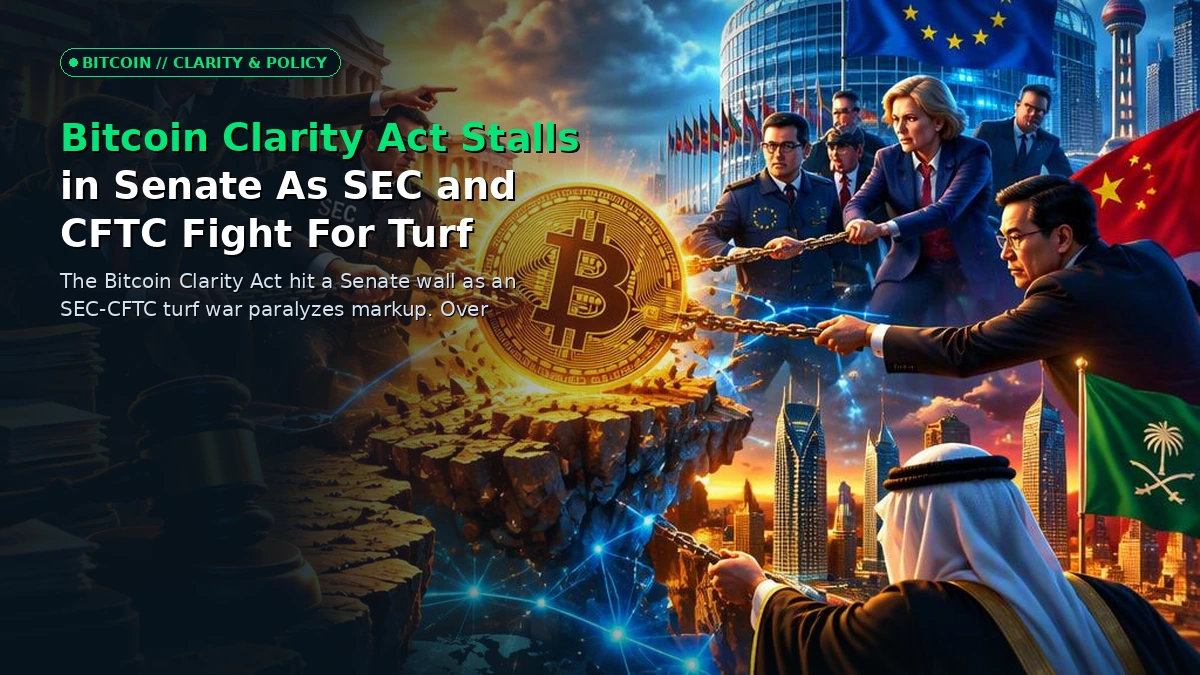
As Bitcoin hovers within a volatile channel around the $86,000 threshold, a high-stakes standoff is unfolding across Washington D.C. and Wall Street. The landmark Clarity Act—a piece of legislation designed to finally establish definitive market-structure statutory boundaries and regulatory jurisdiction between the SEC and the CFTC—has officially stalled in the Senate Banking Committee, a legislative struggle detailed in recent reporting on Crypto's Sisyphean Struggle. Facing insurmountable legislative gridlock and a rapidly ticking clock ahead of upcoming congressional turnover, the bill risks falling victim to a total end-of-session reset. For retail traders tracking digital asset policy wires on our Bitcoin newsdesk, the legislative paralysis threatens to leave the asset class in regulatory limbo just as mainstream financial adoption accelerates. Risk remains elevated.
Yet, while lawmakers drag their feet on Capitol Hill, Wall Street’s Tier-1 mega-banks, institutional lenders, and prime brokers are executing a masterclass in opportunistic capital deployment, a resilient trend highlighted by The Clarity Act Stalled, Bankers Aren't Hitting the Brakes Yet on Crypto Dealmaking. Rather than hitting the brakes, traditional financial giants are aggressively accelerating Bitcoin rail deals, securing bespoke OCC trust charters, and executing record-shattering M&A plays. This race to build out compliant infrastructure before statutory rules are finalized has triggered a fierce turf war, highlighted by the Independent Community Bankers of America (ICBA) launching a federal legal challenge against Office of the Comptroller of the Currency (OCC) trust charter expansions for digital asset custodians—a contentious battle analyzed in depth by Bank Group Sues US Regulator Over Granting Crypto Trust Charters. As institutional capital crashes against legacy banking resistance, market participants must examine how this high-level regulatory chess match will reshape spot liquidity, execution venues, and long-term asset custody. The shift was immediate.
Chapter 02
The Core Catalyst: Senate Legislative Gridlock Meets Wall Street Infrastructure M&A
The primary catalyst behind the current market-structure paradox is the stark disconnect between sluggish legislative timelines and the relentless acceleration of institutional balance sheet allocation. The Clarity Act was intended to provide the definitive statutory clarity that institutional risk committees have demanded for years, clearly delineating whether digital assets fall under the securities umbrella or commodity oversight. However, deep partisan divisions, complex jurisdictional turf wars between congressional committees, and intense lobbying pressure from traditional banking associations have effectively frozen the bill inside the Senate Banking Committee. With a looming congressional turnover threatening to wipe the slate clean, market observers tracking the latest market wires note that the probability of a comprehensive statutory framework passing before the current session expires is plummeting toward zero. Markets reacted swiftly.
Paradoxically, this legislative inertia has not suppressed institutional dealmaking; it has supercharged it. Realizing that waiting for Washington could mean missing the structural shift of a generation, Wall Street financial institutions are aggressively pushing forward under existing, albeit contested, regulatory frameworks. Data compiled across Q3 reveals a record surge in digital asset M&A activity and bilateral infrastructure joint ventures. Mega-banks and prime brokers are rushing to acquire boutique crypto-native custodians, technology providers, and compliance firms, embedding digital asset rails directly into legacy financial plumbing. This aggressive consolidation allows traditional financial institutions to capture prime positioning in the digital asset economy, ensuring they control the institutional pipeline regardless of how the regulatory pendulum eventually swings. Execution remains paramount.
At the epicenter of this institutional rush is the race for regulated custody infrastructure, with several national banks seeking bespoke trust charters directly from the OCC. These specialized charters allow traditional institutions to custody digital assets with the same legal protections and operational frameworks applied to traditional securities and fiat deposits. However, this aggressive expansion has ignited fierce resistance from legacy banking coalitions. The Independent Community Bankers of America (ICBA) has formally filed federal actions challenging the OCC’s authority to grant these digital asset trust charters, arguing that such moves expose the traditional banking system to undue systemic risk without adequate congressional authorization. This legal battle sets up a high-stakes constitutional showdown over regulatory overreach, forcing institutions to navigate a maze of shifting legal terrain while managing massive capital allocations. Caution dictates strategy.
Institutional investors seeking to capitalize on these institutional on-ramps while safeguarding their assets must evaluate their execution venues and storage strategies. Choosing audited crypto exchanges ensures that high-volume institutional flows are met with deep liquidity and transparent proof-of-reserves. Simultaneously, mitigating counterparty risk during regulatory transitions makes utilizing secure hardware crypto wallets an absolute necessity for cold-storage asset protection. Capital preserves optionality.
Chapter 03
Macro Transmission & Historical Precedents: How This Compares to Prior Cycles
To truly grasp the significance of banks bypassing stalled legislation, one must examine the historical context of prior institutional adoption cycles. During the 2020 halving cycle, institutional adoption was defined by corporate treasury experiments—most notably MicroStrategy’s initial balance sheet transformations—and the nascent development of primitive crypto-native investment vehicles like the Grayscale Bitcoin Trust (GBTC). Back then, traditional financial institutions viewed Bitcoin through a lens of skepticism and regulatory peril, often restricting clients from touching the asset class due to strict fiduciary compliance mandates. The regulatory environment was characterized by hostile enforcement actions, frequent SEC rejections of spot exchange-traded products, and a general lack of institutional-grade custody solutions. Volatility persists.
The 2024 spot ETF launch marked the second major historical pivot, successfully bridging traditional brokerage accounts with spot Bitcoin liquidity via giants like BlackRock and Fidelity. However, those ETF products operated largely as closed-loop investment vehicles, keeping Bitcoin locked within centralized custodial silos managed by traditional financial custodians like BNY Mellon and Coinbase Custody. The current post-ETF phase represents a structural evolution, building upon earlier findings in Bitcoin market liquidity mechanics: traditional financial institutions are no longer content with merely acting as passive fund custodians or brokers. Instead, Wall Street is attempting to vertically integrate the entire Bitcoin stack—from proprietary prime brokerage and lending desks to OCC-chartered trust infrastructure and tokenized settlement rails—effectively bypassing the need for explicit congressional statutory permission.
This macro transmission mechanism reflects a broader historical reality: financial innovation and capital accumulation frequently outpace legislative frameworks. When regulatory bodies like the SEC and OCC engage in prolonged turf wars or legislative bodies stall on bills like the Clarity Act, capital does not sit idly; it seeks the path of least resistance through regulatory arbitrage and aggressive corporate maneuvers. By establishing proprietary trust charters and locking down M&A targets, Wall Street banks are essentially creating a de facto regulatory reality on the ground. If traditional institutions control the primary custody rails and settlement networks before Congress manages to pass comprehensive market structure bills, any future legislation will inevitably have to accommodate the institutional infrastructure already built.
As capital rotates through these expanding traditional financial channels, participants frequently look to product comparisons to evaluate competing institutional custodians, prime brokerage suites, and execution platforms side-by-side. Additionally, investors executing cross-border strategies or liquidating portions of their digital asset gains for everyday utility often leverage crypto debit cards to seamlessly off-ramp liquidity without navigating cumbersome wire transfers or high exchange withdrawal fees.
Chapter 04
Market Contagion, Liquidity Rotation & Microstructure Breakdown
The interplay between legislative inertia in the Senate and aggressive Wall Street M&A has profound implications for spot market microstructure, perpetual funding rates, and exchange liquidity depth. When regulatory clarity is delayed, speculative capital often experiences bouts of heightened volatility, oscillating between macro-driven liquidations and structural accumulation phases. However, the steady absorption of spot Bitcoin by institutional trusts and corporate treasuries creates a persistent supply drain that cushions downside price action, even when macro headwinds or political stalemates threaten sentiment across altcoins & ecosystems.
Analyzing the order book dynamics reveals a fascinating divergence between leveraged derivatives markets and spot accumulation vectors. While retail-heavy perpetual swap platforms experience aggressive swings in open interest and funding rates, institutional OTC desks and trust applicants are quietly absorbing block-size liquidity, reducing available exchange float. This structural supply squeeze ensures that any sudden catalyst—whether an unexpected court ruling on the ICBA lawsuit or a sudden revival of the Clarity Act markup—can trigger rapid upward price discovery.
| Metric / Indicator | Previous / Baseline | Current Level | Tactical Market Implication |
|---|---|---|---|
| Institutional Custody M&A Volume | Moderate (Early-stage venture investments) | Record quarterly highs (Mega-bank acquisitions) | Accelerates traditional financial integration, bypassing statutory delays. |
| OCC Trust Charter Applications | Fragmented & hesitant post-guidance | Aggressive Tier-1 bank expansion | Escalates legal friction with community banking groups like ICBA. |
| Spot Exchange Liquid Float | Elevated reserves across centralized venues | Declining trend due to institutional cold storage | Amplifies sensitivity to sudden supply shocks and squeeze dynamics. |
| Derivatives Open Interest & Funding | Neutral-to-positive baseline leverage | Fluctuation around key psychological resistance | Indicates cautious positioning ahead of potential legislative votes. |
"The market is operating under a fascinating dichotomy: Washington is trapped in legislative gridlock over the Clarity Act, but Wall Street's boardrooms have already voted with their capital. Banks aren't waiting for permission slips from Congress; they are buying the plumbing so they can own the flow when the floodgates finally open." — Senior Derivatives Trader at a Tier-1 Digital Asset Prime Brokerage
Chapter 05
Institutional Order Flow & Whale Accumulation Dynamics
Beneath the macro headline noise, on-chain analytics and order flow metrics provide a clear window into how institutional whales and spot ETF issuers are positioning themselves. Daily net flows into spot Bitcoin exchange-traded funds, led by heavyweights such as BlackRock's IBIT and Fidelity's FBTC, continue to demonstrate resilient demand. Even during periods where macroeconomic data or congressional delays spark temporary market dips, institutional accumulation vectors remain remarkably sticky. These inflows are not speculative hot money; they represent long-duration fiduciary capital seeking structural yield and balance sheet diversification.
Concurrently, CME Bitcoin futures open interest remains elevated, signaling that institutional macro funds and quantitative trading desks are utilizing regulated derivatives to hedge spot exposure or execute basis trades. The convergence of spot accumulation via ETFs and sophisticated hedging via CME creates a resilient market floor. Whale wallet clustering data further confirms that entities holding between 1,000 and 10,000 BTC are continuing to accumulate during consolidation ranges, systematically removing liquid supply from centralized trading venues.
This persistent whale accumulation directly counters the bearish narrative surrounding the stalled Clarity Act. While retail traders often panic over legislative delays, sophisticated institutional players understand that regulatory clarity is an inevitability rather than an uncertainty. By aggressively expanding their footprint through M&A and trust charter applications while prices consolidate, these mega-institutions are positioning themselves to capture the entirety of the next major liquidity expansion phase without waiting for congressional approval.
Chapter 06
What Happens Next: The Two Trading Scenarios
As the Senate navigates its end-of-session calendar and legal battles between national banks and community banking associations intensify, market participants must prepare for two distinct trading scenarios over the coming quarters.
Scenario A: The Bullish Institutional Breakout (Probability: 60%)
In this scenario, the Senate surprises markets by carving out a bipartisan compromise to fast-track a streamlined digital asset framework, or alternatively, the aggressive rollout of OCC-chartered bank custody solutions neutralizes regulatory uncertainty. Institutional inflows surge as traditional wealth management platforms officially onboard spot Bitcoin products en masse. Spot prices break out decisively above key psychological resistance bands ($92,000 - $95,000), triggering aggressive short liquidations and driving Bitcoin toward new all-time highs above $100,000. Exchange float drops to multi-year lows as supply is locked into institutional vaults.
Scenario B: The Legislative Reset & Legal Stalemate (Probability: 40%)
In this alternative scenario, the Clarity Act officially stalls out as the congressional session expires, forcing a complete legislative reset in the next term. Simultaneously, the ICBA’s federal lawsuit against the OCC gains traction, creating temporary legal uncertainty for bank-backed digital asset custodians. Spot prices experience a sharp corrective pullback toward major structural support floors ($78,000 - $82,000) as leveraged longs are flushed out. However, the downside remains fundamentally cushioned by continuous structural demand from spot ETFs and corporate treasury accumulation, setting up a prolonged multi-month consolidation channel before the next macro catalyst emerges.
Chapter 07
The Bottom Line for Market Participants
Navigating the intersection of stalled legislation and aggressive Wall Street dealmaking requires a disciplined, risk-managed approach. Market participants must look past daily political noise and focus on the structural accumulation of institutional infrastructure.
- Actionable Takeaway 1: Monitor federal court dockets regarding the ICBA’s legal challenge against OCC trust charter expansions to gauge regulatory friction for traditional bank custodians.
- Actionable Takeaway 2: Track daily net flows across spot Bitcoin ETFs (IBIT, FBTC) to measure institutional demand persistence during legislative consolidation phases.
- Actionable Takeaway 3: Audit your execution and custody setup by moving long-term holdings off centralized venues into offline hardware crypto wallets to mitigate counterparty risk.
- Actionable Takeaway 4: Evaluate and compare execution venue fee structures and liquidity depth using verified audited crypto exchanges to optimize trade execution during periods of heightened volatility.
Chapter 08
Frequently Asked Questions
Why is the Clarity Act stalling in the Senate Banking Committee?
The Clarity Act has hit significant legislative roadblocks due to intense partisan disagreements over regulatory jurisdiction between the SEC and the CFTC, coupled with aggressive lobbying from traditional banking and financial interest groups. Lawmakers are divided over how broadly to define decentralized finance (DeFi) oversight and how to structure consumer protection mandates without stifling domestic financial innovation. Additionally, the looming congressional turnover has compressed legislative timelines, making it exceedingly difficult to build the necessary consensus required to pass a complex market-structure bill before the current session expires.
How do OCC trust charters impact institutional Bitcoin custody?
OCC trust charters grant national banks the legal authority to provide fiduciary custody services for digital assets, placing cryptocurrency custody on the exact same regulatory footing as traditional securities, equities, and fiat deposits. This allows Tier-1 mega-banks to offer institutional-grade cold storage, settlement, and prime brokerage services directly to corporate treasuries, pension funds, and high-net-worth clients. By securing these bespoke charters, traditional financial institutions can vertically integrate Bitcoin services into their existing legacy banking architecture without relying on third-party crypto-native custodians.
What is the significance of the ICBA lawsuit against the OCC?
The Independent Community Bankers of America (ICBA) filed a federal legal challenge against the OCC to halt the expansion of digital asset trust charters granted to specialized crypto custodians and national banks. The ICBA argues that these charters introduce systemic risks into the traditional banking system, bypass proper congressional oversight, and give large mega-banks an unfair competitive advantage over smaller community banks. The outcome of this lawsuit will heavily influence whether national banks can freely operate digital asset custody divisions or if federal courts will force a regulatory rollback.
How should retail investors navigate the disconnect between policy gridlock and Wall Street adoption?
Retail investors should recognize that while Washington is caught in political gridlock, institutional capital deployment is marching forward unabated. Rather than attempting to trade every legislative headline or rumor coming out of Capitol Hill, market participants should focus on structural metrics—such as spot ETF net flows, exchange reserve balances, and whale wallet accumulation. Maintaining a disciplined risk management strategy, utilizing secure self-custody solutions, and executing trades through liquid, regulated venues are the most effective ways to navigate this transitional market environment.
Will a legislative reset on the Clarity Act derail the current bull market cycle?
A legislative reset of the Clarity Act—meaning the bill fails to pass before the end of the session and must be reintroduced in the next Congress—would not fundamentally derail the broader structural adoption cycle. While a procedural reset might cause short-term volatility and speculative disappointment, the primary drivers of the current cycle—spot ETF inflows, sovereign and corporate balance sheet allocations, and Wall Street infrastructure building—operate independently of immediate congressional action. Institutional capital has already committed to the asset class, ensuring that structural accumulation will continue regardless of legislative pacing.