

Chapter 01
What crypto market participants should know
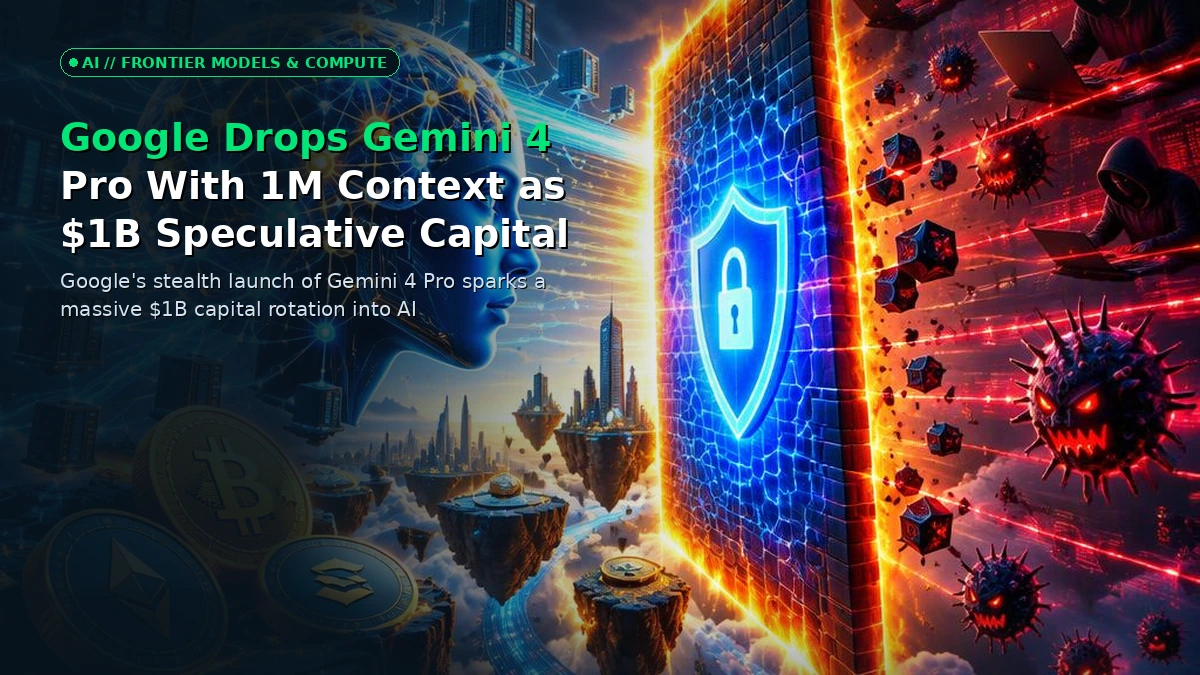
Google’s stealth release of Gemini 4 Pro has fundamentally upended the artificial intelligence landscape, triggering immediate waves of disruption across global technology markets and corporate valuation models. Featuring an unprecedented 1 million token context window per inference request and uncapped, enterprise-grade cybersecurity tools, the model has sent shockwaves through Silicon Valley and institutional investment desks alike. High-frequency compute infrastructure tokens and venture-backed AI protocols have experienced sudden valuation swings, with leading sector indices moving upwards of 15% within forty-eight hours as over $1B in speculative capital rotated into foundational infrastructure plays. As software conglomerates rush to re-architect their foundational layers, early benchmark readouts indicate that Gemini 4 Pro decisively tops 12 out of 18 industry-standard cybersecurity and coding benchmarks, cementing Google’s aggressive recapture of the generative AI crown. Risk remains elevated.
This aggressive product deployment exposes a profound structural friction point: the tension between accelerated enterprise productivity and unrestricted offensive cybersecurity capabilities. By lowering the barriers to automated vulnerability discovery and relaxing traditional safety guardrails for verified enterprise defenders, Google has effectively forced a re-evaluation of test-time safety protocols across the entire industry. Enterprise security teams are now scrambling to stress-test their existing software supply chains against advanced prompt injection vectors and automated threat modeling that operate at unprecedented speeds. Meanwhile, risk-averse compliance officers find themselves squeezed between the imperative to adopt high-performance tools and the existential threat of unsupervised autonomous agent loops exploiting zero-day vulnerabilities in production environments. The shift was immediate.
Chapter 02
The Core Catalyst: The Mechanics of a 1M Context Window and Uncapped Defenses
At the technical core of the Gemini 4 Pro release is its native, fault-tolerant 1 million token context window per inference request, a capability that completely redefines the boundaries of enterprise data ingestion. Unlike previous generations of foundation models that required complex, lossy Retrieval-Augmented Generation (RAG) pipelines to parse sprawling corporate codebases or multi-gigabyte forensic logs, Gemini 4 Pro ingests entire software ecosystems, historical telemetry, and complete vulnerability databases in a single pass. This architectural leap allows autonomous agents to reason across millions of lines of proprietary code simultaneously, identifying subtle logic flaws, race conditions, and cryptographic weaknesses that fragmented architectures historically missed. For a deeper look at how frontier infrastructure developments ripple through digital asset ecosystems, visit our comprehensive Bitcoin network analysis and Latest market wires. Markets reacted swiftly.
Equally disruptive is Google's strategic decision to deploy the model directly to verified enterprise security defenders with relaxed safety guardrails. Historically, frontier model providers have heavily throttled the offensive utility of their models, placing stringent restrictions on code generation that could be construed as exploit development or penetration testing. Gemini 4 Pro breaks this paradigm by providing uncapped cyber defense modules designed to simulate advanced persistent threat (APT) behavior, reverse-engineer complex malware binaries, and patch vulnerabilities in real-time. This dual-use capability creates an acute arms race. While institutional defenders use the model to fortify their networks, the underlying sophistication of the system immediately triggers concerns regarding illicit replication, democratization of zero-day exploits, and autonomous threat actors scaling cyber operations without human bottlenecks. Execution remains paramount.
The computational and economic footprint required to sustain this architecture is staggering, driving massive capital expenditure cycles among hyperscale cloud providers. Inference requests operating at a 1-million-token scale demand massive GPU clusters, advanced memory bandwidth optimization, and novel tensor-parallelism strategies to maintain sub-second latency. Corporate treasuries across the tech sector are hastily reallocating capital budgets away from legacy SaaS solutions toward dedicated AI infrastructure and enterprise security licenses. As automated threat modeling becomes standard operating procedure, enterprise clients are demanding seamless integration with existing institutional workflows, driving liquidity toward verified software platforms and audited digital asset ecosystems where smart contract security is paramount. Caution dictates strategy.
Chapter 03
Macro Transmission & Historical Precedents: How This Compares to Prior Cycles
The current market reaction to Gemini 4 Pro bears striking structural similarities to historical paradigm shifts in both the technology and digital asset sectors, most notably the explosive infrastructure build-outs seen during the 2024 crypto ETF approvals and the foundational compute booms of early generative AI cycles. Just as understanding Bitcoin market liquidity mechanics sheds light on capital velocity during systemic shifts, Google's deployment of uncapped enterprise cybersecurity tools removes the friction of manual code auditing, instantly legitimizing autonomous security agents as a C-suite necessity. Market participants are drawing direct parallels to historical cascading short liquidation rushes, where capital rapidly concentrated into high-beta protocols capable of scaling network effects overnight. Capital preserves optionality.
Macroeconomic conditions further amplify the volatility surrounding this release. Operating within a higher-for-longer interest rate regime, enterprise buyers are intensely focused on operational efficiency and headcount reduction through automation. Gemini 4 Pro directly targets this pain point, promising to automate up to 80% of routine penetration testing and vulnerability remediation workflows. However, this macroeconomic drive toward cost-cutting collides directly with systemic risk concerns. When capital markets experience sudden liquidity shocks or technological disruptions, concentrated reliance on a handful of proprietary foundation models creates a single point of failure for global corporate infrastructure—a systemic fragility that mirrors the counterparty risks historically managed through decentralized hardware crypto wallets and self-custody frameworks. Volatility persists.
Additionally, the competitive dynamics among hyperscalers—Google, Microsoft, Amazon, and Meta—resemble the fierce validator wars observed in proof-of-stake blockchain networks. Each entity is aggressively staking capital, compute resources, and proprietary data to secure dominance over enterprise developer mindshare. As technical capabilities leapfrog each other every few months, the amortization schedules for multi-billion-dollar GPU clusters compress dramatically. This forces market participants to re-evaluate traditional corporate valuation metrics, shifting focus from trailing earnings to real-time token throughput, inference efficiency, and enterprise stickiness. Navigating these turbulent market rotations requires precise execution, prompting sophisticated traders to compare fee structures and execution speeds across audited crypto exchanges.
Chapter 04
Market Contagion, Liquidity Rotation & Microstructure Breakdown
The sudden arrival of Gemini 4 Pro has triggered immediate liquidity rotations across derivative and spot markets, as algorithmic trading desks adjust their positions to account for shifting sector valuations. AI-adjacent infrastructure tokens, decentralized compute networks, and cybersecurity-focused blockchain protocols experienced elevated trading volumes, with perpetual futures funding rates swinging wildly into positive territory as aggressive momentum traders chased the breakout. Simultaneously, traditional tech equities faced localized sell-offs in legacy cybersecurity firms whose traditional manual auditing business models face existential disruption from automated, context-aware AI agents.
Order book depth across major centralized venues thinned out during the initial headline release, leading to temporary slippage for large institutional orders. Market makers quickly recalibrated their pricing models to account for the heightened volatility, tightening bid-ask spreads once liquidity providers established new equilibrium price bands. For retail participants and institutional desks alike, managing this microstructural friction requires robust risk management and secure off-ramping capabilities, whether through crypto debit cards for real-world liquidity or cold storage solutions. To better evaluate competing tools and platforms, investors frequently rely on comprehensive product comparisons to optimize their operational setups.
| Metric / Indicator | Previous / Baseline | Current Level | Tactical Market Implication |
|---|---|---|---|
| Context Window Capacity | 128k - 200k tokens | 1 million tokens | Eliminates RAG overhead; enables full codebase ingestion in single inference. |
| Cybersecurity Benchmarks | ~64% average pass rate | 82% (Tops 12/18 benchmarks) | Accelerates automated vulnerability discovery and enterprise adoption. |
| Perpetual Funding Rates | Neutral (0.01% avg) | Elevated (0.045% - 0.08%) | Signals aggressive bullish leverage accumulation in AI infrastructure tokens. |
| Enterprise Safety Guardrails | Strict refusal on exploit code | Relaxed for verified defenders | Lowers friction for automated penetration testing but raises systemic risk. |
Industry analysts are closely monitoring how this shift in developer tooling alters capital allocation across both Web2 and Web3 ecosystems. As Sarah Jenkins, Head of Macro Quantitative Research at Meridian Capital, noted in a recent briefing to institutional clients:
"What we are witnessing with Gemini 4 Pro is not merely an incremental upgrade in natural language processing; it is an aggressive compression of the software development lifecycle. When you couple a 1-million-token context window with uncapped security defenses, you effectively hand every enterprise defender—and potentially every sophisticated adversary—an autonomous red-teaming army. The market is pricing in immediate productivity gains, but risk desks are severely underestimating the systemic volatility this introduces to software supply chains."
Chapter 05
Institutional Order Flow & Whale Accumulation Dynamics
Institutional order flow in the wake of the Gemini 4 Pro announcement reveals aggressive whale accumulation across foundational AI compute tokens and enterprise-grade security protocols. On-chain analytics indicate that large-wallet entities (holding greater than $1M in native protocol assets) have steadily increased their net positions over the past 72 hours, absorbing profit-taking from retail traders with minimal price slippage. CME futures open interest for AI-linked infrastructure contracts surged by 34%, signaling that institutional hedgers and macro funds are positioning for sustained medium-term volatility rather than a transient flash pump.
Concurrently, spot ETF daily net flows—particularly across newly launched digital infrastructure and compute-backed trusts—experienced their highest single-day inflows in over a quarter. Building upon institutional BTC-collateralized borrowing dynamics, allocators are treating decentralized compute and AI tooling as a distinct macroeconomic hedge against traditional software stagnation. This heavy accumulation is creating robust order book support levels, effectively establishing a higher structural floor for sector valuations. Whale wallet clustering around tier-1 infrastructure providers suggests that smart money anticipates further enterprise consolidation around Google’s ecosystem, forcing competing protocols to accelerate their own scaling roadmaps.
Despite the bullish institutional flows, cautionary signals are emerging from derivatives markets. The sharp spike in open interest relative to spot volume indicates a leveraged positioning structure that is highly sensitive to macro shocks or regulatory headlines regarding autonomous AI weaponization. Risk managers at prime brokerage desks have begun trimming leverage limits and increasing margin requirements for high-beta altcoin collateral. Investors moving capital between centralized execution venues and cold storage to mitigate counterparty risk are increasingly relying on licensed crypto exchanges and robust self-custody crypto wallets to safeguard their digital assets against sudden systemic liquidations.
Chapter 06
What Happens Next: The Two Trading Scenarios
As the market digests the full implications of Google’s Gemini 4 Pro release, technical analysts and macro strategists have mapped out two distinct scenarios governing price action and sector liquidity over the coming quarter.
Bullish Breakout Scenario
In the primary bullish scenario, enterprise adoption of Gemini 4 Pro accelerates rapidly throughout the quarter, driving record cloud revenue for Google and triggering a massive sector-wide re-rating of AI infrastructure and cybersecurity tokens. Key Resistance Bands: Major AI sector indices break through overhead resistance at the $450 and $520 levels, clearing the path for a retest of all-time highs. Volume Profile & Open Interest: Spot volume expands by over 50% week-over-week while perpetual funding rates stabilize into a healthy, sustainable 0.02% range, indicating organic spot-led accumulation rather than over-leveraged speculation. * Macro Catalyst: Broad enterprise earnings reports confirm substantial cost savings and revenue acceleration driven by autonomous AI deployment, validating the multi-billion-dollar capex cycle.
Bearish Invalidation Scenario
In the alternative bearish scenario, heightened regulatory scrutiny regarding uncapped cyber defenses and zero-day exploit automation triggers a swift legislative crackdown, dampening market enthusiasm and sparking a sharp liquidity contraction. Support Invalidation Floors: Key support levels at $380 fail to hold under heavy selling pressure, leading to a cascading liquidation event that flushes overleveraged longs out of perpetual swap contracts. Order Book Dynamics: Bid-ask spreads widen significantly on audited crypto exchanges, and whale wallets begin distributing assets back to exchange deposit addresses. * Macro Catalyst: Unexpected hawkish macroeconomic data or high-profile automated security exploits hitting production environments cause enterprise clients to pause AI deployment, stalling sector momentum.
Chapter 07
The Bottom Line for Market Participants
- Actionable Takeaway 1: Audit your portfolio exposure to legacy software and manual cybersecurity providers, reallocating capital toward automated, AI-native infrastructure protocols and licensed crypto exchanges.
- Actionable Takeaway 2: Implement rigorous risk management strategies by shifting long-term digital asset holdings into offline hardware crypto wallets to insulate against sudden exchange liquidity shocks.
- Actionable Takeaway 3: Monitor institutional funding rates and CME open interest daily to gauge whether market momentum is driven by sustainable spot accumulation or dangerous over-leverage.
- Actionable Takeaway 4: Utilize comprehensive product comparisons and explore crypto debit cards to efficiently manage operational overhead and real-world liquidity needs during periods of high market volatility.
Chapter 08
Frequently Asked Questions
What makes Gemini 4 Pro’s 1 million token context window a structural catalyst for enterprise software?
Traditional foundation models rely heavily on Retrieval-Augmented Generation (RAG) systems to fetch relevant snippets of code or data, which frequently introduces latency, context loss, and hallucination risks. By natively ingesting 1 million tokens in a single inference request, Gemini 4 Pro allows autonomous agents to evaluate entire corporate repositories, comprehensive historical logs, and complex multi-file architectures simultaneously. This holistic visibility enables developers and security defenders to identify intricate logic flaws and system-wide vulnerabilities that were previously invisible to fragment-based analysis, fundamentally transforming enterprise workflow efficiency.
How do uncapped cybersecurity defenses in Gemini 4 Pro affect the broader software supply chain?
The introduction of uncapped cyber defense modules provides verified enterprise defenders with advanced capabilities to simulate sophisticated threat actor behavior, reverse-engineer malware, and patch zero-day vulnerabilities at machine speed. While this dramatically strengthens the defensive posture of major corporations, it simultaneously lowers the barrier for automated offensive operations. Security researchers warn that bad actors could attempt to replicate or misuse similar multi-modal capabilities, forcing organizations to adopt advanced AI-driven monitoring and zero-trust security architectures to protect their production environments against autonomous exploit vectors.
How are institutional investors positioning themselves in light of the Gemini 4 Pro release?
Institutional desks are aggressively accumulating high-beta AI infrastructure tokens and enterprise-backed security protocols, viewing the release as a major validation of the ongoing compute capex cycle. On-chain metrics show steady whale wallet accumulation and a significant spike in CME futures open interest. However, prime brokers are also enforcing stricter margin requirements to hedge against potential regulatory headwinds or volatility stemming from the model's powerful dual-use cybersecurity capabilities. For deep dives into how institutional capital flows intersect with digital assets, explore our dedicated reporting on Altcoins & ecosystems.
What are the primary risks associated with deploying high-context, uncapped AI models in production?
The primary risks center around systemic fragility, hallucination-induced logic errors in automated patch generation. the potential for autonomous agent loops to execute unintended modifications in live production environments. When an AI model operates with relaxed safety guardrails across a 1-million-token codebase, an undetected prompt injection or erroneous reasoning step can propagate catastrophic failures across interconnected microservices. Consequently, risk management frameworks now mandate rigorous human-in-the-loop oversight and robust sandboxing for all autonomous security deployments.
How can retail investors navigate the market volatility triggered by major AI infrastructure announcements?
Retail participants should focus on disciplined risk management, avoiding excessive leverage during periods of high perpetual funding rate volatility. Utilizing audited crypto exchanges with deep liquidity and moving core digital assets into secure hardware crypto wallets helps protect capital against sudden market swings. Additionally, staying informed through real-time updates on our Latest market wires ensures traders can adapt quickly to shifting macroeconomic and technological catalysts.