


Chapter 01
What crypto market participants should know
The transformation of online gambling through cryptocurrency represents one of the most commercially consequential developments in digital assets. Where legacy fiat casinos rely on proprietary black-box Random Number Generator (RNG) servers audited periodically by private third-party testing labs, cryptocurrency casinos employ cryptographic hashing algorithms that empower players to independently audit the mathematical integrity of every single roll, spin, or deal in real time.
Yet, despite these architectural breakthroughs, the commercial sector remains rife with predatory bonus rollover requirements, deceptive marketing terms, and shifting licensing jurisdictions. Evaluating modern crypto casinos requires moving beyond promotional banners to analyze underlying cryptographic seed mechanics, operator liquidity reserves, game weighting rules, and dispute resolution mechanisms.
To cross-reference real-time platform benchmarks, supported coins, and verified withdrawal speeds, visit the Crypto Gambling & Betting Hub and track cross-asset liquidity flows on our stablecoin intelligence desk.
Chapter 02
The Evolution of Crypto Casinos: From Early Faucets to Tier-1 Giants
Cryptocurrency gambling traces its lineage to 2012 with the launch of SatoshiDice, an elementary on-chain game created by Erik Voorhees that broadcast every wager directly onto the Bitcoin blockchain. While groundbreaking, SatoshiDice rapidly congested the Bitcoin network with microtransactions, exposing the fundamental scalability bottlenecks of base-layer proof-of-work settlement.
Over the subsequent decade, the sector bifurcated into two distinct models: 1. Hybrid Web3 Off-Chain Casinos: Operators that execute wagers instantly off-chain within high-throughput game engines while settling deposits and withdrawals across native blockchains (Bitcoin, Ethereum, Solana, TRON, Polygon). These venues provide the low latency required for live dealers and complex video slots while preserving instant crypto liquidity. 2. Decentralized On-Chain Gaming Protocols: Non-custodial smart contracts operating on Layer-2 rollups or high-speed Layer-1 networks (Solana, Arbitrum, TON) where player wagers execute directly through smart contracts without intermediary custodial balances.
Legacy Fiat Casinos vs. Modern Crypto Wagering Platforms
To understand why cryptocurrency casinos have captured double-digit global market share from traditional operators, consider their core architectural distinctions:
| Operational Dimension | Legacy Fiat Online Casino | Cryptocurrency Wagering Platform |
|---|---|---|
| Withdrawal Latency | 2 to 5 business banking days | 1 to 15 minutes via direct blockchain confirmation |
| Game Fairness Audit | Periodic private testing lab certificates (eCOGRA, GLI) | Real-time cryptographic Provably Fair verification (HMAC-SHA256) |
| Deposit Boundaries | Credit card processing limits, currency conversion fees | Borderless multi-chain deposits with zero fiat conversion fees |
| Account Creation Friction | Mandatory identity verification before first spin | Lightweight email or Web3 wallet connection; tiered verification |
| Treasury Transparency | Opaque corporate bank accounts | Auditable on-chain hot and cold storage wallet reserves |
Chapter 03
Provably Fair Cryptography: Mathematical Foundations
The central technical innovation of crypto casinos is the Provably Fair protocol. Designed to eliminate the possibility of house manipulation, Provably Fair relies on symmetric cryptographic hashing—specifically HMAC-SHA256—to establish an unalterable commitment between player and operator prior to wager placement.
The Three Seed Verification System
A provably fair round is governed by three separate inputs: - Server Seed: A high-entropy random cryptographic 64-character hexadecimal string generated by the casino server. Before a wagering round begins, the operator computes the SHA-256 hash of this string and transmits the hash to the player's client. Because cryptographic hash functions are one-way and collision-resistant, the operator cannot alter the underlying server seed once the hash commitment has been published. - Client Seed: A random alphanumeric string supplied directly by the player's browser or hardware device. Players have complete autonomy to manually edit this string at any moment before placing a wager. - Nonce: An integer counter starting at 0 that increments by 1 with every consecutive bet placed under the active pair of seeds.
The mathematical outcome of the wager is computed as follows:
Game Outcome = HMAC_SHA256(Server_Seed, Client_Seed + ":" + Nonce)

Converting Cryptographic Hashes to Game Outcomes
To convert the 64-character hexadecimal output of HMAC-SHA256 into a tangible game result (such as a dice roll between 0.00 and 99.99), the algorithm parses the digest in 4-byte (8-character) segments:
1. The first 8 hexadecimal characters are extracted from the digest (e.g., "7a8b9c1d"). 2. This string is converted into its 32-bit unsigned integer equivalent: 2,055,971,869. 3. The integer is normalized against the outcome range: (Integer % 10000) / 100. 4. The resulting floating-point figure (e.g., 71.86) dictates whether the player won or lost based on their chosen roll boundary.
Because the player possesses the client seed, the nonce, and the unhashed server seed (revealed upon session termination), they can re-run this exact computation locally in any browser developer console or Python script to prove that the casino could not have manipulated the roll.
Chapter 04
In-Depth Operator Audits: Evaluating the 2026 Market Leaders
To provide objective E-E-A-T benchmarks, our editorial research team conducted hands-on technical audits across the top verified cryptocurrency gambling platforms operating in 2026.
1. Stake.com: The Global Sportsbook & Liquidity Leader
Established in 2017, Stake has grown into the world's highest-volume cryptocurrency casino and sportsbook, processing tens of millions of wagers daily.
Operator Snapshot: Stake.com (Rating: 9.8/10 · Global Category Leader)
Primary Jurisdiction: Curaçao Gaming Control Board (GCB) | Payout Speed: Instant (< 3 minutes via BTC, ETH, SOL, USDT)
Game Catalog: 3,500+ titles including Pragmatic Play, Evolution Gaming, Hacksaw, and Stake Originals.
VIP Architecture: Progressive multi-tier VIP club (Bronze through Obsidian) with daily reload bonuses, weekly boosts, monthly coupons, and dedicated VIP host concierge.
Editorial Verdict: Unrivaled sportsbook liquidity and immediate withdrawal execution make Stake the undisputed global market benchmark for serious cryptocurrency wagering.
Stake's core competitive moat is its proprietary Stake Originals suite (Dice, Plinko, Mines, Crash, Limbo, Hilo), which feature a transparent 1.0% house edge—significantly lower than the 3.5% to 5.0% margins typical of third-party video slots. Furthermore, its sponsorship portfolio (official partner of UFC, Sauber Formula 1 Team, Everton FC) ensures that the operator maintains multi-billion-dollar balance sheet liquidity.
2. BC.GAME: The Altcoin & Multi-Tier Bonus Specialist
BC.Game distinguishes itself through unmatched token support, accepting over 100 native cryptocurrencies ranging from Bitcoin and Ethereum to micro-cap decentralized finance tokens and meme coins.
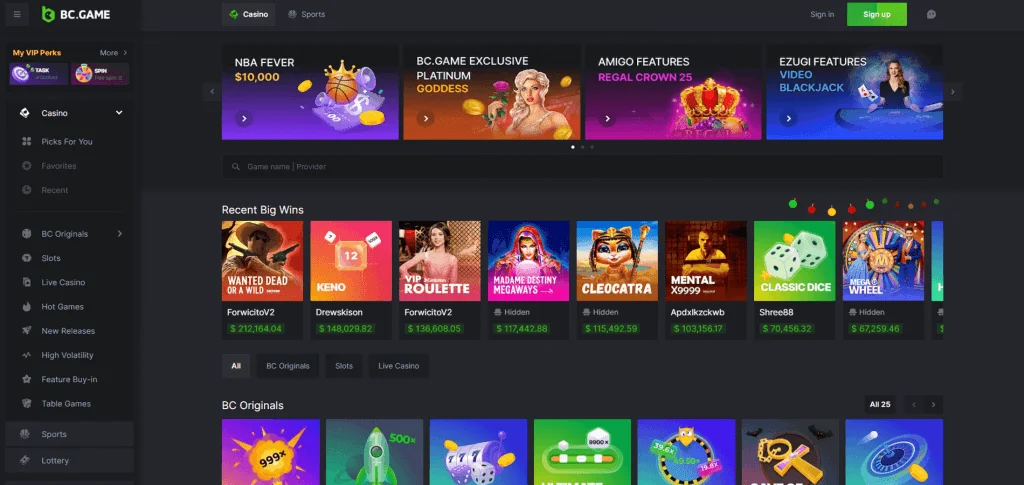
Operator Snapshot: BC.GAME (Rating: 9.6/10 · Altcoin Diversity & Multi-Tier Bonus)
Primary Jurisdiction: Anjouan Offshore Finance Authority & Curaçao LOK | Payout Speed: 5 to 10 minutes (100+ native blockchains)
Game Catalog: 10,000+ slots, live casino tables, exclusive lottery, and custom provably fair crash/plinko titles.
Promotional Structure: Up to 470% deposit match package unlocked progressively in BCD/BCG rakeback to preserve player equity.
Editorial Verdict: The premier destination for altcoin holders wishing to wager directly in niche tokens without incurring centralized exchange swapping fees.
Unlike operators that force token conversions into synthetic dollar balances, BC.Game allows players to maintain separate on-chain balances across dozens of blockchains, significantly reducing slippage and gas transfer costs.
3. Cloudbet: The High-Roller Sportsbook Pioneer
Operating continuously since November 2011, Cloudbet is the oldest active cryptocurrency sportsbook in existence, catering primarily to high-net-worth crypto holders and professional sports handicappers.
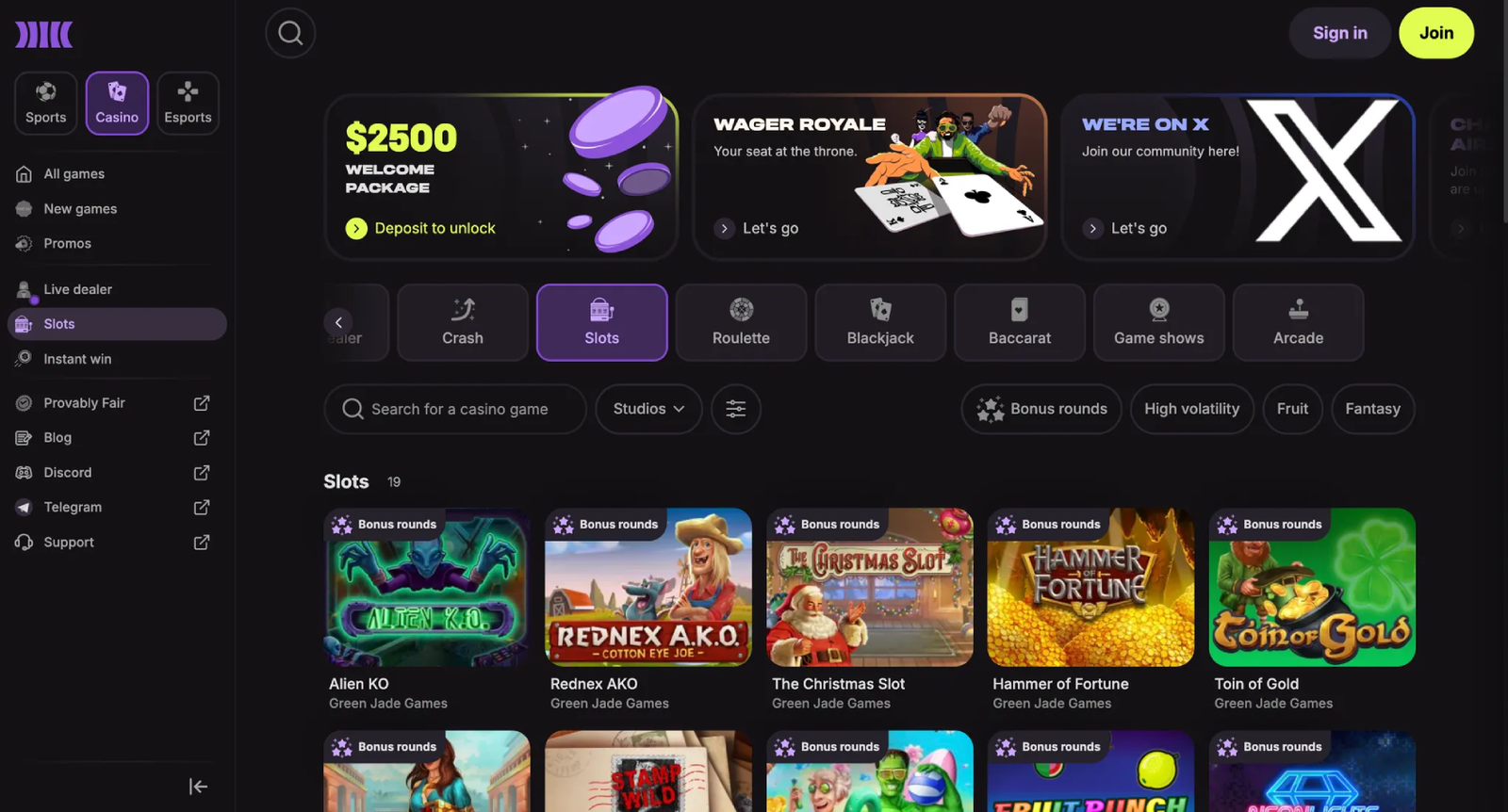
Operator Snapshot: Cloudbet (Rating: 9.4/10 · High-Roller Limits & Sportsbook Pioneer)
Primary Jurisdiction: Curaçao eGaming / Costa Rica Registry | Payout Speed: Under 15 minutes (Direct blockchain confirmation)
Operating History: Established in November 2011 (the longest-standing cryptocurrency sportsbook in active operation).
VIP & Loyalty: Cloudbet Marketplace allows players to exchange loyalty points for zero-rollover cash, free bets, and luxury experiences.
Editorial Verdict: The gold standard for high-limit sports bettors requiring five-figure and six-figure Bitcoin wagering capacity with zero bet slippage.
Cloudbet's standout feature is its lack of betting limits on Tier-1 sporting events (UEFA Champions League, NFL, NBA, English Premier League), accompanied by a dedicated Marketplace where earned reward points carry zero wagering requirements.
4. BetFury: Web3 Staking Pools & Daily Revenue Share
BetFury bridges the gap between decentralized finance tokenomics and online gambling by incorporating a daily staking pool funded by platform gross gaming revenue.
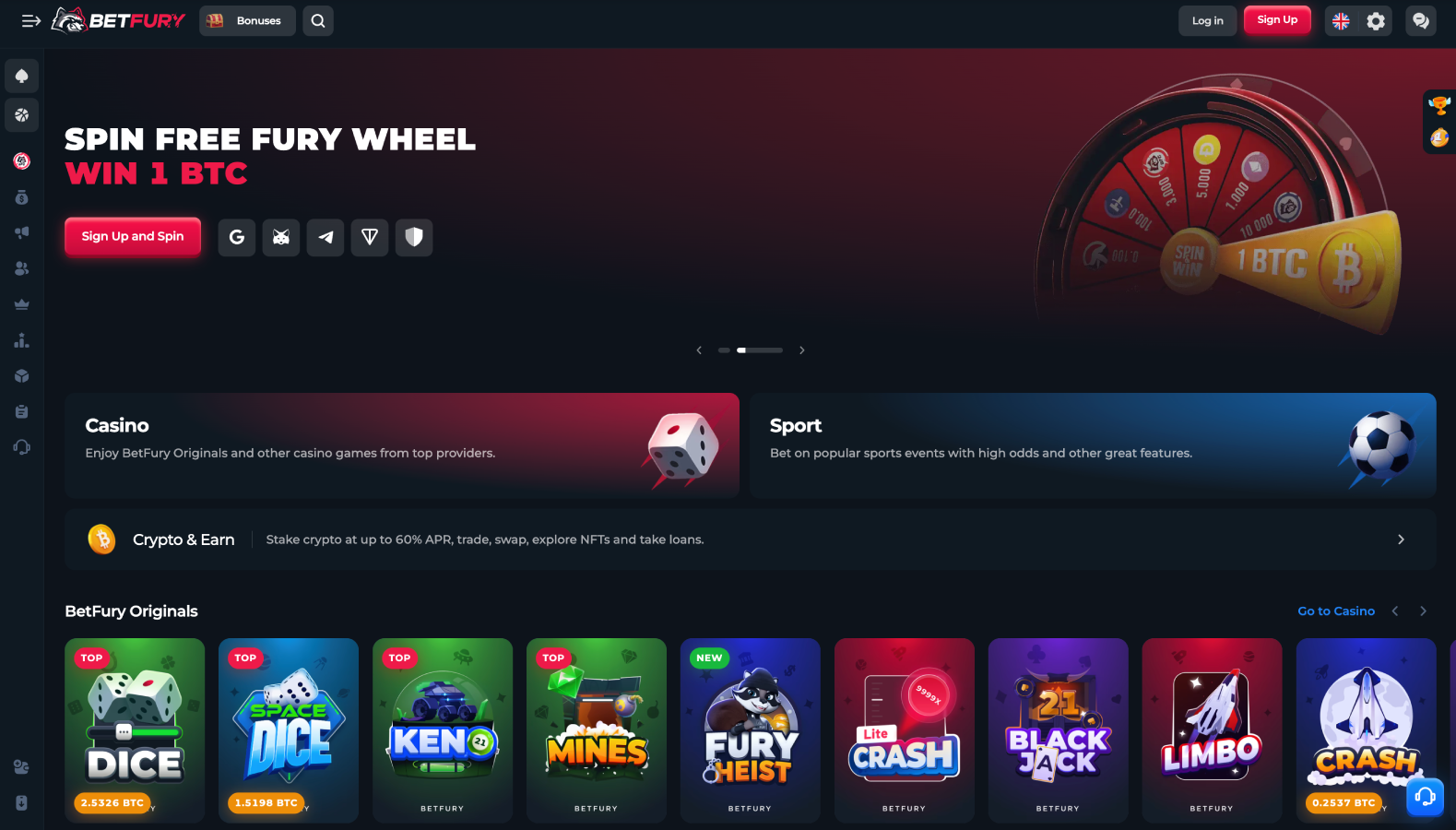
Operator Snapshot: BetFury (Rating: 9.2/10 · Staking Dividends & Web3 Tokenomics)
Primary Jurisdiction: Curaçao eGaming | Payout Speed: Instant via BSC, TRON, Ethereum, and Polygon
Web3 Tokenomics: Native BFG utility token enables holders to share directly in platform daily gross gaming revenue distributed in BTC, ETH, and USDT.
Editorial Verdict: An exceptional hybrid between decentralized finance yield mechanics and casino entertainment, ideal for players seeking passive staking yields.
Players earn native BFG tokens on every wager, which can then be staked in liquidity pools to receive daily multi-currency payouts in Bitcoin, Tether, and Binance Coin.
5. Emerging Web3 Operators: Thrill.com and Instant Settlement
The latest wave of crypto casinos leverages Solana and Telegram mini-app ecosystems to eliminate account creation entirely.
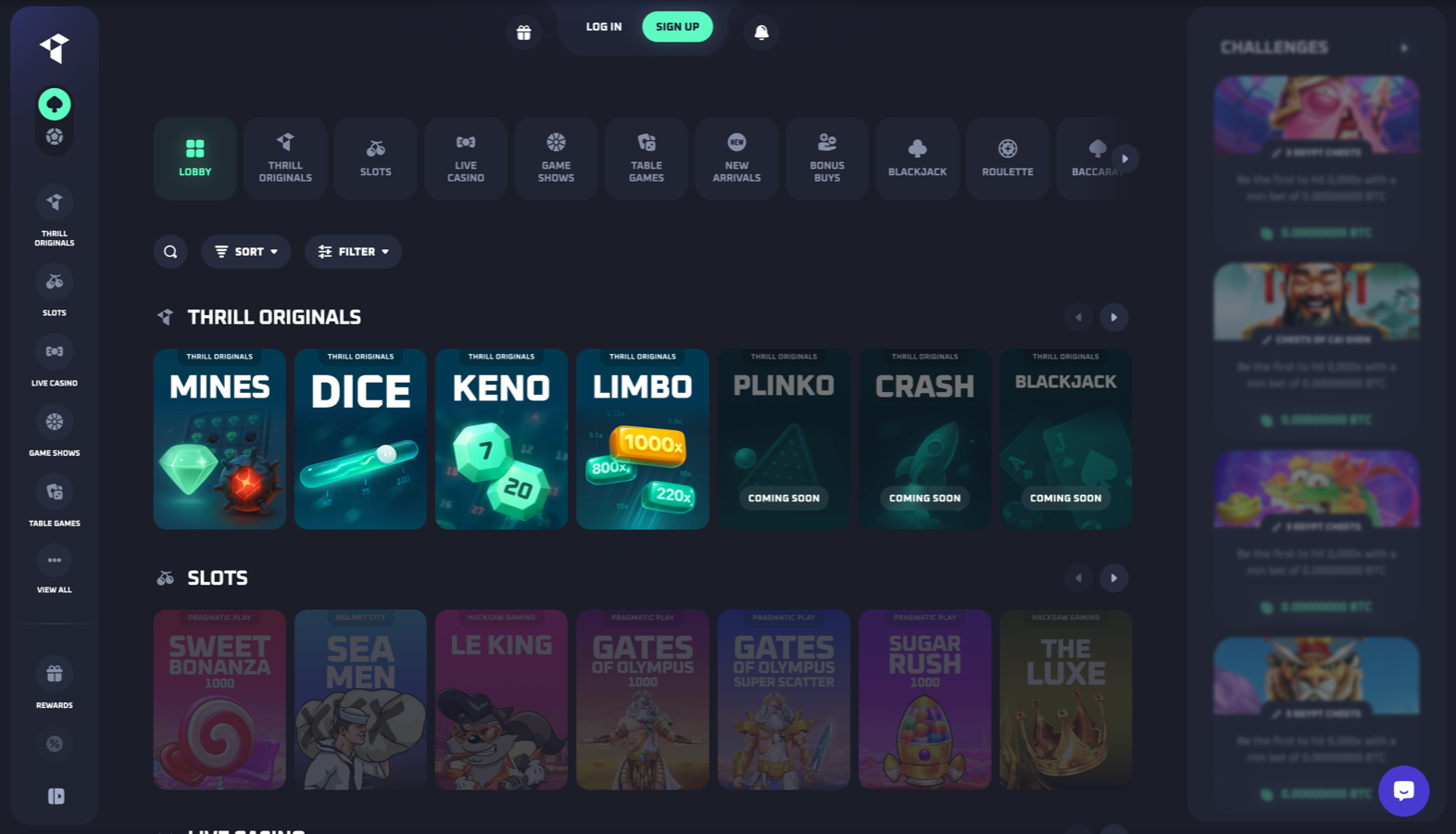
Platforms like Thrill and Rollbit utilize non-custodial wallet connections (such as Phantom or MetaMask), executing wagers with sub-second finality while integrating novel financial products like token buy-and-burn mechanisms and 1000x crypto futures trading.
Chapter 05
Comprehensive Operator Comparison Matrix
To synthesize our audit findings, the following matrix compares regulatory standing, game diversity, payout velocity, and house edges across top verified platforms:
| Platform | Licensing Authority | Payout Velocity | House Edge (Originals) | Supported Coins | Key Differentiating Moat |
|---|---|---|---|---|---|
| Stake.com | Curaçao Gaming Control Board (GCB) | Instant (< 3m) | 1.00% | 25+ major chains | Premier sportsbook liquidity & VIP perks |
| BC.GAME | Anjouan (AOFA) / Curaçao LOK | 5 - 10m | 1.00% | 100+ native assets | Multi-tier 470% bonus & altcoin diversity |
| Cloudbet | Curaçao eGaming / Costa Rica | Under 15m | 1.50% - 2.50% | BTC, ETH, SOL, USDT | High-limit wagering & zero-rollover store |
| BetFury | Curaçao eGaming | Instant (< 5m) | 1.00% - 2.00% | BSC, ETH, TRON, SOL | Daily BFG staking dividend distributions |
| FortuneJack | Curaçao Licensing Authority | Instant (< 5m) | 0.70% - 1.00% | BTC, LTC, DOGE, DASH | Decade-long operating track record (2014) |
| Rollbit | Curaçao eGaming | Instant (< 2m) | 1.00% | BTC, ETH, SOL, LTC | 1000x crypto futures & NFT collateral |
| Duelbits | Curaçao eGaming | Instant (< 3m) | 1.00% | SOL, BTC, ETH, CS2 | Web3 wallet connect & Ace rewards |
When managing capital across any of these venues, players should maintain strict custody separation by storing primary balances in dedicated hardware crypto wallets rather than leaving treasury balances in casino hot wallets.
Chapter 06
The Bonus Turnover Trap: Mathematical Expected Value (-EV)
The single most misunderstood aspect of crypto casino promotions is the bonus turnover (or rollover) requirement. Operators frequently advertise eye-popping welcome packages (e.g., "300% Bonus up to $20,000"), enticing players who fail to calculate the mathematical Expected Value (-EV) required to convert bonus credits into withdrawable cash.
The Mechanics of 40x Wagering Requirements
Consider a standard promotional offer: - Deposit Amount: $1,000 - Match Bonus: 100% ($1,000 bonus credits awarded) - Wagering Requirement: 40x (Deposit + Bonus)
Under these terms, the player must place a cumulative betting turnover of:
Turnover Required = ($1,000 Deposit + $1,000 Bonus) * 40 = $80,000
If the player clears this wagering requirement by playing standard online slots featuring a 96% Return to Player (RTP)—representing a 4.0% House Edge—the expected mathematical loss incurred during the clearing process equals:
Expected Loss = $80,000 Turnover * 0.04 House Edge = $3,200
Because the expected mathematical loss ($3,200) exceeds the combined value of the initial deposit and bonus ($2,000), the statistical probability of the player maintaining any remaining balance upon completing the 40x rollover is under 8%.
Game Weighting and Predatory Clause Identification
To further protect operator margins, terms of service enforce strict game weighting rules: - Online Slots: 100% turnover contribution. - Table Games (Roulette, Baccarat): 5% to 10% contribution (requiring up to $800,000 in turnover to clear a $1,000 bonus). - Blackjack & Live Dealers: 0% contribution (bets do not count toward rollover). - Maximum Bet Rule: Placing a single bet exceeding $5 while a bonus is active often triggers immediate forfeiture of all accumulated winnings.
When accepting promotional packages, smart players prioritize No-Wager Free Spins, Straight Rakeback, or platforms like Cloudbet and Stake that offer cash drops with zero playthrough obligations.
Chapter 07
The 2026 Regulatory Landscape: Curaçao LOK Reform vs. Anjouan
Historically, over 80% of cryptocurrency casinos operated under four historic Master Licenses issued by the Dutch Caribbean territory of Curaçao: 1. Cyberluck Curaçao N.V. (1668/JAZ) 2. Curaçao eGaming / Cyberluck (5536/JAZ) 3. Gaming Curaçao (365/JAZ) 4. Antillephone N.V. (8048/JAZ)
Under this master license structure, master license holders sub-licensed operational certificates to third-party casino brands with minimal regulatory friction. However, this decentralized system faced international scrutiny regarding anti-money laundering enforcement.
The National Ordinance on Games of Chance (LOK)
Enacted by the Parliament of Curaçao, the Landsverordening op de Kansspelen (LOK) has dismantled the master license model. The reform centralizes all supervisory oversight directly under the government's Curaçao Gaming Control Board (GCB) and the upcoming Curaçao Gaming Authority (CGA).
Key LOK compliance requirements include: - Mandatory disclosure of Ultimate Beneficial Owners (UBO) with criminal background checks. - Enforced segregation of player deposits from operational treasury accounts. - Compulsory implementation of certified Responsible Gaming tools (deposit caps, loss thresholds, global self-exclusion registries). - Formal AML/CFT transaction monitoring matching Financial Action Task Force (FATF) standards.
The Rise of Anjouan (Union of the Comoros)
As Curaçao tightened licensing standards, the Anjouan Offshore Finance Authority (AOFA), located in the autonomous island of Anjouan within the Union of the Comoros, emerged as the fastest-growing licensing hub for Web3-native gaming brands.
Anjouan offers operators a modernized regulatory framework specifically crafted for blockchain gaming, including support for smart-contract settlement, tokenized wagering, and multi-signature cold storage compliance. Reputable brands like BC.Game operate under valid Anjouan interactive gaming authorizations.
Chapter 08
Security Architecture, AML/CFT, and KYC Triggers
A common misconception among newcomers is that crypto casinos are completely anonymous black holes. While cryptocurrency facilitates pseudonymous registration, all licensed operators must maintain compliance with international Anti-Money Laundering (AML) and Counter-Terrorist Financing (CFT) statutes.
Blockchain Analytics and Sanctions Screening
Top-tier operators integrate enterprise blockchain forensic software (such as Chainalysis, TRM Labs, and Elliptic) into their automated deposit gateways. Every incoming transaction is screened for exposure to: - Sanctioned entities (OFAC lists). - Darknet marketplaces and ransomware clusters. - Privacy protocols and mixers (Tornado Cash, Wasabi Wallet).
Depositing funds directly from a coin mixer or high-risk peer-to-peer exchange address will trigger an immediate AML compliance freeze, requiring the player to submit full identity documentation (KYC) before funds can be released.
Practical Security Protocol for Casino Players
To protect your personal sovereignty and digital asset security while gaming online: 1. Never Deposit from an Exchange Account: Always route funds through an intermediary self-custody wallet (e.g., MetaMask, Phantom, or Exodus). Depositing directly from a centralized exchange (Coinbase, Kraken, Binance) violates terms of service and risks account closure. 2. Utilize Hardware Key 2FA: Protect your casino account with physical security keys (YubiKey) or hardware-backed authenticator apps. Never rely on SMS two-factor authentication, which is vulnerable to SIM-swap interception. 3. Segregate Your Bankroll: Establish a dedicated gaming wallet completely separate from long-term crypto investments or cold storage treasuries. 4. Enforce Instant Withdrawals: Never leave excess winnings deposited on a casino hot wallet. Withdraw profits immediately to personal self-custody.
Explore our crypto debit card reviews and top cryptocurrency exchanges for compliant off-ramping infrastructure once you cash out winnings.
Chapter 09
Responsible Gambling & 18+ Harm Reduction Checklist
Cryptocurrency betting involves substantial financial risk. The frictionless nature of digital asset microtransactions—combined with rapid game cycles in games like Crash and Plinko—can exacerbate compulsive wagering behavior.
Harm-reduction protocols must be treated with absolute seriousness:
- Define an Entertainment Budget: Allocate only discretionary capital that you can afford to lose completely without impacting your living standards.
- Configure Hard Loss Limits: Navigate to account settings immediately upon registration and configure daily, weekly, and monthly loss caps.
- Avoid the Gambler's Fallacy: Understand that every provably fair round is an independent random event. A losing streak on red in roulette or high in dice does not increase the probability of a subsequent win.
- Never Chase Losses: Increasing wager sizing after losses to break even is the primary catalyst for catastrophic bankroll depletion.
- Utilize Voluntary Self-Exclusion: If you feel your gaming activity is becoming unmanageable, activate an account timeout or indefinite self-exclusion lock.
If online gambling ceases to be fun or causes emotional or financial distress, contact professional confidential support resources immediately: - BeGambleAware: https://www.begambleaware.org/ (Confidential 24/7 helpline) - Gambling Therapy: https://www.gamblingtherapy.org/ (Multilingual global online support) - National Council on Problem Gambling: https://www.ncpgambling.org/ (US support resource)
Chapter 10
Frequently Asked Questions (FAQ)
Are cryptocurrency casinos legal?
The legality of online crypto gambling depends entirely on your local national and regional jurisdiction. While blockchain networks operate globally, national gambling regulations apply based on player physical location. Operators typically geo-block jurisdictions where online gambling is restricted or requires local state licensing.
What is the difference between provably fair and traditional online casino games?
Traditional online casinos rely on closed-source RNG servers audited periodically behind closed doors by testing labs. Provably fair games allow players to mathematically verify the integrity of every individual round using symmetric HMAC-SHA256 hashing and client/server seeds.
How fast are crypto casino withdrawals compared to fiat casinos?
While fiat bank wires take 3 to 5 business days to clear, cryptocurrency withdrawals from verified operators typically process within 1 to 15 minutes, depending on blockchain network traffic and confirmation requirements.
Do I have to pay taxes on crypto casino winnings?
In most jurisdictions (including the United States, United Kingdom, Canada, and European Union member states), cryptocurrency is classified as property or capital assets. Realizing profits from gambling or disposing of appreciated crypto assets triggers capital gains or miscellaneous income tax reporting obligations. Consult a certified local tax professional.
Can a crypto casino freeze my funds?
Yes. If an operator's automated blockchain analytics flags incoming deposits as having direct exposure to sanctioned addresses, darknet markets, or coin mixers, compliance departments will freeze withdrawals pending Level-2 KYC verification.
Which cryptocurrency is most cost-effective for casino wagering?
While Bitcoin and Ethereum are the most widely accepted, high gas fees make them inefficient for small wagers. High-throughput networks like Solana (SOL), TRON (USDT-TRC20), Polygon (POL), and Litecoin (LTC) offer sub-cent network transaction fees and near-instant confirmations.
How do I verify a provably fair game outcome independently?
Obtain the unhashed Server Seed (revealed after rotating seeds), your Client Seed, and the round Nonce. Input these values into a standard HMAC-SHA256 generator. The resulting hash digest can be converted into the exact numerical game result produced during the wager.
Can I gamble at crypto casinos without submitting KYC documents?
Many crypto casinos permit basic registration and withdrawals under modest volume thresholds (e.g., under $2,000 equivalent) without upfront identity verification. However, all licensed operators reserve the legal right to request KYC documents in the event of irregular betting patterns, velocity spikes, or AML risk flags.