Chapter 01
What crypto market participants should know
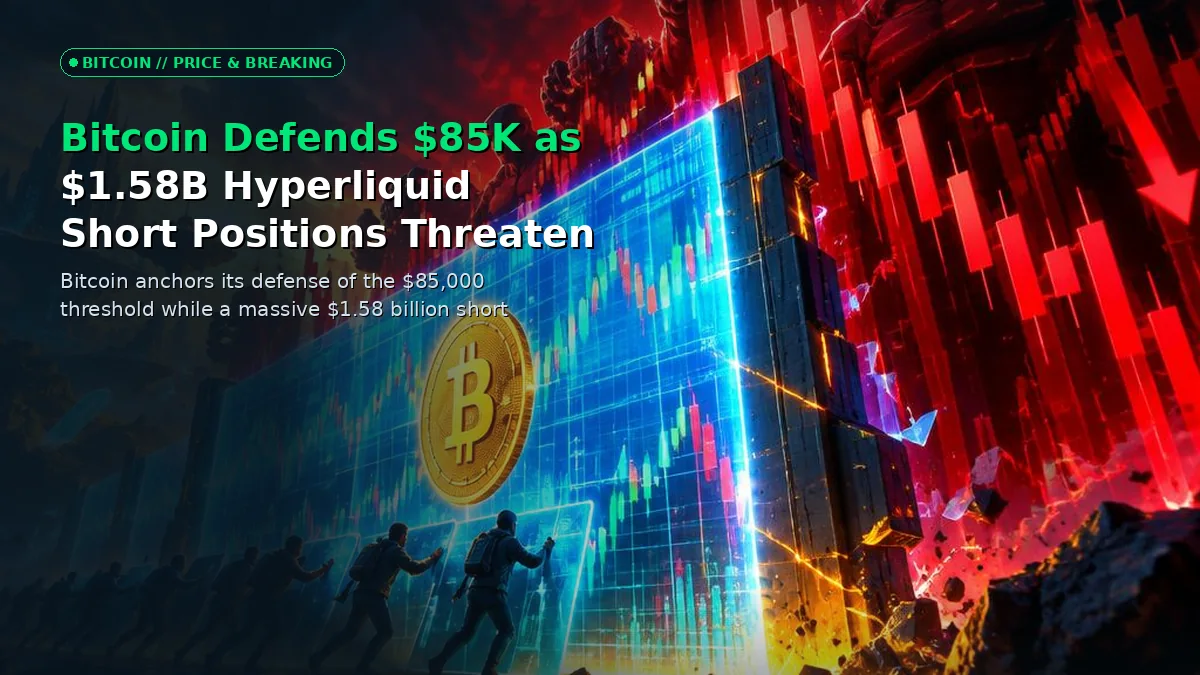
Bitcoin continues to anchor its defense of the critical $85,000 price band, showcasing remarkable resilience following twin tests above the $86,000 threshold. Yet, beneath the calm surface of spot price consolidation, a high-stakes derivatives war is quietly brewing. Trading desk monitors across the globe have flagged an astonishing $1.58 billion in combined net short exposure concentrated across massive Hyperliquid wallets targeting top-tier digital assets like Bitcoin and Ether, a phenomenon recently analyzed by Bitcoin.com. This heavy-handed bearish positioning represents one of the most aggressive concentrated bets seen on decentralised perpetual exchanges this cycle, setting the stage for a violent liquidation cascade should buyers manage to punch through near-term resistance. Risk remains elevated, and monitoring real-time shifts on the live Bitcoin price tracking hub is essential for active market participants.
At the heart of this friction point lies an ongoing structural tug-of-war between leveraged macro bears and resilient spot accumulation. While the looming $1.58 billion short overhead creates a psychological ceiling, spot market absorption has consistently thwarted aggressive attempts by sellers to break below the $84,000 vulnerability threshold. As market participants await the upcoming Federal Reserve minutes for clues on future liquidity injections, trading desks note that these heavily margined short positions are skating on thin ice, building upon earlier findings in Bitcoin market liquidity mechanics. A quick squeeze back toward the upper end of the range could easily trigger an algorithmic chain reaction, forcing aggressive short covering and propelling the asset class into uncharted price discovery. The shift was immediate.
Chapter 02
The Core Catalyst: Hyperliquid Whale Positions and Derivatives Overhang
The modern crypto derivatives market operates with unprecedented leverage and capital velocity. the current market structure is a textbook demonstration of this phenomenon. According to telemetry from major execution venues, a cluster of prominent whale wallets on Hyperliquid has established a massive $1.58 billion net short exposure targeting Bitcoin and Ether. This staggering aggregate position is not merely a localized hedge; it functions as a directional bet that macroeconomic headwinds, persistent regulatory friction, and slowing institutional inflows will finally crack the bull market thesis that has dominated much of the year. Markets reacted swiftly, as reported during recent price action updates on Bitcoin.com.
Decentralized perpetual exchanges like Hyperliquid have transformed how capital is deployed during high-volatility regimes. Unlike legacy centralized order books where position data can sometimes remain opaque, the transparent on-chain nature of these protocols exposes major whale positioning to the wider market, turning these large positions into high-profile targets for opportunistic spot buyers and high-frequency trading market makers. When a single concentrated pocket of liquidity holds over a billion and a half dollars in directional exposure, the order book dynamics shift fundamentally. Every upward tick in price inches these massive short accounts closer to their maintenance margin thresholds, creating an asymmetrical risk profile that favors sudden upside volatility. Execution remains paramount.
To navigate these treacherous liquidity waters safely, institutional trading desks and high-net-worth investors frequently evaluate their execution venues, assessing platform stability, liquidation engines, and depth. Traders aiming to optimize execution and minimize slippage during periods of extreme derivatives stress routinely compare fee schedules and margin requirements across audited crypto exchanges. additionally, as positions of this magnitude introduce systemic volatility to the broader ecosystem, securing underlying capital against sudden flash crashes or exchange outages makes utilizing offline hardware crypto wallets an essential risk-management step for active portfolio managers. Caution dictates strategy.
Chapter 03
Macro Transmission & Historical Precedents: How This Compares to Prior Cycles
The current macro-driven price compression is reminiscent of prior historical inflection points, most notably the transitional phases following the 2020 halving cycle and the initial institutional wave kicked off by spot ETF approvals in early 2024. In each of these historical instances, Bitcoin experienced extended periods of consolidation within a tightening range as macroeconomic uncertainty—characterized by shifting Federal Reserve rate cuts, sticky inflation prints, and fluctuating Treasury yields—collided with structural supply scarcity. Today’s market is no different; the $85,000 price band acts as a psychological equilibrium where macro bears betting on higher-for-longer interest rates clash directly with long-term holders and corporate treasuries building out sovereign balance sheet allocations. Capital preserves optionality.
What distinguishes the current market structure from previous cycles. Notably,, is the unprecedented depth and sophistication of the derivatives complex. In 2020, leverage was primarily distributed across offshore retail-heavy platforms with primitive liquidation mechanisms. Today, sophisticated market participants utilize decentralized order books, cross-margining protocols, and complex options overlays to express directional views. The $1.58 billion short overhang currently sitting on Hyperliquid reflects a calculated institutional bet that macro headwinds will overwhelm spot demand. However, historical precedent suggests that when aggressive macro shorts crowd into a structurally undersupplied asset, the resulting short squeeze is often swift, brutal, and entirely detached from near-term macroeconomic data releases. Volatility persists, closely mirroring patterns identified in historical cascading short liquidation rushes.
As market participants weigh these macroeconomic signals, managing realized gains and off-ramping liquidity without being tethered to traditional banking friction remains a priority. Many active traders utilize specialized crypto debit cards to spend their digital asset gains directly in the real world, bridging the gap between volatile crypto market cycles and everyday purchasing power. For those seeking to evaluate competing trading platforms, financial tools. liquidity providers side-by-side with verified performance data, consulting comprehensive product comparisons offers invaluable tactical insights.
Chapter 04
Market Contagion, Liquidity Rotation & Microstructure Breakdown
The standoff between spot buyers defending the $84,000 vulnerability threshold and the $1.58 billion short contingent on Hyperliquid has generated severe friction across the broader crypto microstructure. Perpetual funding rates have oscillated between neutral and slightly negative territory, indicating that leveraged sentiment remains heavily guarded. Spot exchange order books reflect thick buy-side liquidity clusters parked just beneath the $84,000 mark, acting as a concrete floor against speculative flushing. Meanwhile, altcoin markets have experienced localized liquidity drains as capital concentrates inward toward Bitcoin and Ether to weather the impending volatility storm.
When examining the mechanics of this market structure, quantitative metrics paint a clear picture of how spot resilience is actively boxing in aggressive sellers. The following comparative breakdown illustrates the shift in market parameters during this consolidation phase:
| Metric / Indicator | Previous / Baseline | Current Level | Tactical Market Implication |
|---|---|---|---|
| Aggregated Hyperliquid Short Exposure | ~$400 Million (Average Q3) | $1.58 Billion | Massive institutional bearish overhang vulnerable to violent short-squeeze cascades. |
| Bitcoin Spot Price Range | $78,000 - $82,000 Support | $85,000 Consolidation ($84K floor) | Higher low formation demonstrating persistent spot absorption and buyer defense. |
| Perpetual Funding Rates | Strongly Positive (Bullish bias) | Neutral to Slightly Negative | Leveraged traders are hesitant, reflecting balanced or leaning-short sentiment. |
| CME Futures Open Interest | Moderate Institutional Participation | Elevated Near All-Time Highs | High institutional hedging activity underpinning spot price ranges. |
"When over a billion and a half dollars in concentrated short exposure lines up against a structurally supply-constrained spot market, you aren't just looking at a routine technical correction—you are looking at a coiled spring. The moment spot buyers push this market through initial overhead resistance, the liquidity mechanics dictate that those shorts will be forced to cover at any price." — Senior Derivatives Desk Strategist, FomoNewZ Market Intelligence
Chapter 05
Institutional Order Flow and Whale Accumulation Dynamics
Institutional order flow continues to serve as the primary ballast preventing deeper drawdowns. Daily net inflows into spot exchange-traded funds—led by dominant issuers such as BlackRock's IBIT and Fidelity's FBTC—have maintained a steady baseline of capital absorption, quietly soaking up newly minted supply from miners and early-cycle profit takers. This sustained institutional accumulation creates a structural supply deficit that directly undermines the thesis held by the $1.58 billion short contingent. While derivatives traders can manipulate paper supply and leverage on margin exchanges, they ultimately remain at the mercy of immutable on-chain scarcity when spot coins are pulled off exchanges and locked into cold storage vaults.
Simultaneously, whale wallet clustering data reveals a fascinating divergence in behavior between leveraged speculators and long-term accumulation addresses. While exchange-connected whale accounts are aggressively positioning for a downside break by building out massive short portfolios on protocols like Hyperliquid, cold-storage whale wallets holding over 1,000 BTC continue to exhibit net-positive accumulation patterns. This bifurcation highlights a classic battle between short-term macro traders reacting to upcoming Federal Reserve minutes and long-term structural believers who view any dip toward the $84,000 floor as a generational accumulation opportunity.
For investors navigating these complex institutional flows, ensuring the safety of accumulated assets is paramount. Moving digital wealth off centralized exchanges and into self-custody solutions is the gold standard of risk mitigation. Readers can explore secure options by reviewing trusted hardware crypto wallets designed to protect private keys against exchange insolvency and protocol exploits. For broader updates on institutional movements, macroeconomic trends, and breaking derivatives data, stay tuned to our dedicated Bitcoin market news desk and the latest market wires.
Chapter 06
What Happens Next: The Two Trading Scenarios
As Bitcoin coils tightly within its current range, market participants must prepare for two distinct, high-probability execution scenarios. The impending release of the Federal Reserve minutes, combined with the sheer gravity of the $1.58 billion short exposure sitting on Hyperliquid, guarantees that the current equilibrium will break decisively in one direction.
The first and more explosive scenario is the Bullish Short Squeeze Breakout. In this setup, incoming spot ETF inflows or an unexpectedly dovish macro tone from the Federal Reserve triggers an immediate push above the twin resistance highs of $86,000. As price action pierces this critical technical ceiling, cascading liquidation algorithms on Hyperliquid and other derivatives venues will be forced to trigger automated buy-orders to cover the $1.58 billion short overhang. This involuntary buying pressure could rapidly accelerate Bitcoin toward secondary targets at $88,500 and open a clear runway for a run at the psychological $92,000 milestone.
The second scenario is the Bearish Vulnerability Breakdown. If macroeconomic data prints hotter than anticipated, or if spot buyers exhaust their liquidity reserves, bears may succeed in driving Bitcoin through the critical $84,000 technical floor. A confirmed daily close beneath this support level would invalidate the current consolidation thesis, triggering long-liquidation cascades across leveraged spot and futures accounts. Such a breakdown would open a rapid downward trajectory toward the $80,000 psychological support band, where deep institutional bids and long-term whale accumulation walls are expected to re-engage aggressively, as macroeconomic commentators on CoinDesk's live markets coverage have noted.
To explore related macroeconomic shifts, alternative asset correlations, and ecosystem-wide liquidity flows, readers can visit our dedicated altcoins & ecosystems desk for comprehensive cross-market analysis.
Chapter 07
The Bottom Line for Market Participants
Navigating a market defined by massive derivatives overhangs and resilient spot demand requires strict risk discipline, clear invalidation levels, and a comprehensive understanding of exchange microstructure. To help you position your portfolio effectively ahead of the next major market move, review the following actionable checklist:
- Actionable Takeaway 1: Monitor open interest and funding rates on major perpetual venues like Hyperliquid to track whether the $1.58 billion short exposure is expanding or beginning to capitulate.
- Actionable Takeaway 2: Establish strict stop-loss protocols or alert thresholds around the critical $84,000 spot support floor to protect capital against sudden downside breakdowns.
- Actionable Takeaway 3: Secure your long-term spot holdings by migrating capital off exchange-hosted accounts and into trusted self-custody crypto wallets to insulate against exchange volatility.
- Actionable Takeaway 4: Optimize your trade execution by comparing fee structures and liquidity depth across licensed crypto exchanges before deploying new capital.
Chapter 08
Frequently Asked Questions
What does the $1.58 billion short exposure on Hyperliquid mean for Bitcoin's immediate price action?
The $1.58 billion in net short exposure concentrated across major Hyperliquid whale wallets represents a massive directional bet that Bitcoin and Ether will break down from their current consolidation ranges. However, because this position is heavily margined and sitting in a transparent decentralized environment, it acts as a coiled spring. If spot buyers manage to defend the $84,000 floor and push prices back above the $86,000 resistance ceiling, these short positions will face severe liquidation pressure, likely triggering an aggressive short squeeze that accelerates upward momentum.
Why is the $84,000 price level considered such a critical technical floor?
The $84,000 level has repeatedly acted as a robust line of defense where aggressive spot absorption meets dense buy-side order book liquidity. Technical analysts view this band as the dividing line between healthy range-bound consolidation and a deeper macro correction. A decisive daily close below $84,000 invalidates the current bullish defense structure and opens a technical vacuum where the price could rapidly slide toward the next major liquidity pocket at $80,000.
How do spot ETF flows influence the ongoing battle between bears and bulls?
Institutional spot ETF inflows—driven by heavyweights like BlackRock's IBIT and Fidelity's FBTC—provide a continuous, passive baseline of capital absorption that quietly removes circulating supply from the open market. This structural supply deficit directly counters the paper-driven selling pressure exerted by leveraged macro shorts in the derivatives market. When ETF demand remains steady, it forces shorts to fight an uphill battle against shrinking exchange reserves and long-term institutional accumulation.
What macro catalysts could trigger a breakout from the current trading range?
The primary macro catalyst on the immediate horizon is the upcoming release of the Federal Reserve minutes, which traders will scrutinize for clues regarding future interest rate cuts and liquidity injections. Additionally, any unexpected shifts in inflation data, Treasury yield movements, or broader equities market performance—especially with traditional stock indexes touching record highs—will heavily dictate whether risk-on capital flows further into digital assets or retreats to safety.
How can retail traders protect themselves against high volatility during liquidation cascades?
Protecting capital during high-volatility regimes requires robust risk management practices, including avoiding excessive leverage, setting clear invalidation stops, and holding core positions in cold storage rather than active trading accounts. Traders should utilize offline hardware crypto wallets to secure private keys, compare execution venues across audited crypto exchanges to minimize slippage, and regularly review platform fee structures via comprehensive product comparisons to ensure optimal trading efficiency.